Turnitin in 2026 not only detects plagiarism but also identifies AI-generated content. By learning how its similarity and AI reports work, students can use AI ethically, produce original assignments, meet university expectations with confidence, and maintain academic integrity.
In the sphere of education, the development of AI technology has affected the process of research, brainstorming, and doing assignments among students. Nowadays, AI software such as ChatGPT, Gemini, Claude, and Microsoft Copilot may write an essay within just a few seconds. Therefore, it becomes easy for students to manage their academic writing tasks instantly. However, the use of AI in academic writing poses certain problems related to academic integrity. Therefore, US colleges have implemented some policies to check whether students have submitted original and human-written essays. This is when the significance of Turnitin comes into play.
Firstly, the Turnitin application was made for detecting plagiarism in an assignment. However, today, the tool has developed to become a complete academic integrity solution. In 2026, Turnitin not only detects plagiarism by comparing with billions of online sources but also checks writing patterns and identifies AI-generated content.
Therefore, students need to learn how Turnitin works in 2026. If you are a student, then knowing the pros and cons of Turnitin and how Turnitin detects AI writing will help you use AI academic writing tools responsibly and submit original assignments as per the university guidelines. Read this guide to understand everything about the working process of Turnitin software.
What is Turnitin and why does it matter?
Turnitin is an academic integrity tool that helps numerous colleges, universities, and schools worldwide to check the originality of academic work done. Mainly, to detect the uniqueness of the content, Turnitin compares the submitted documents with one of the world’s largest academic databases that contain previously submitted student papers, journals, books, research publications, websites, open educational resources, and institutional repositories.
If you submit your assignment, the Turnitin software will analyze the entire content and generate a Similarity Report. This report will present the similarity score and highlight the matching text and the sources of the content.
However, many students fail to understand the meaning of a similarity score. For instance, when an essay has a 20% similarity score, it does not imply plagiarism. Likewise, a 5% similarity score does not mean that an essay is completely original. What is important is the context of the content provided. Proper citation of quotes, usage of jargon, and assignment format may also increase the percentage of similarity.
Turnitin states that it is the instructor’s responsibility to decide whether there is any academic misconduct in a situation like this. The platform only provides information and evidence to support academic review
Turnitin Works beyond Plagiarism Detection
The widespread use of generative AI is raising a common question in many Universities, “Is this assignment written by students or done with the help of AI?”
Mainly, to resolve such a matter, Turnitin added the capability to detect AI-assisted writing. These tools determine how likely parts of text have been created by AI software like ChatGPT.
The use of AI detectors is not a replacement for plagiarism detectors but rather an added tool in detecting plagiarism, which allows for a more accurate overall evaluation of the document. The system currently checks the paper’s authenticity by considering factors including:
- Similarity detection
- Citation analysis
- Writing pattern recognition
- Probability of AI-generated writing
- Metadata when using compatible workflows
This enables the instructors to get new information on the sources of the papers. Besides, this feature enables considering multiple sources of the document instead of concentrating on the percentage scores only. Since universities are constantly revising their AI policies, it is best to have the skill of interpreting the results provided by the Turnitin software.
To understand how colleges and universities are dealing with the changing environment, refer to our article on the impact of AI on cheating in higher education.
Turnitin Supports Academic Integrity
Many students believe that Turnitin serves to detect cheating only. In reality, the primary purpose of this tool is to ensure ethical learning and scholarly conduct.
According to organizations like the International Center for Academic Integrity (ICAI), academic integrity involves such aspects as honesty, trust, fairness, respect, responsibility, and courage. Thus, technology should be used to assist in this process instead of substituting for the personal evaluation.
Turnitin does this by providing the following benefits for educators:
- Teach proper citation practices
- Detect accidental plagiarism
- Encourage original thinking
- Support constructive feedback
- Promote responsible usage of AI tools
Professor Tracey Bretag, one of the world’s leading academic integrity researchers, pointed out that integrity comes with education and institutional culture, not only with detection tools. Hence, students should consider Turnitin as a learning tool rather than seeing it as an obstacle.
How Does Turnitin Detect AI in Academic Writing?
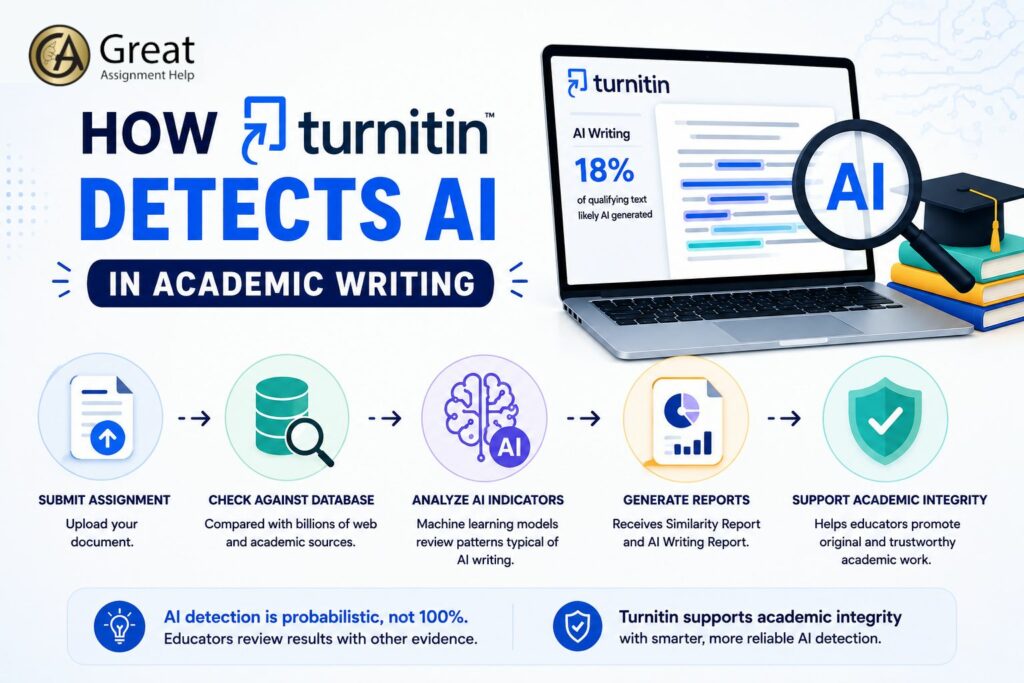
It is often assumed in academic forums that Turnitin can accurately detect the work done by AI tools like ChatGPT. But this is far from being a true statement since artificial intelligence detection is a complex procedure that does not always produce 100% correct results.
Turnitin doesn’t actually compare your essay against a secret database of AI-generated answers. Rather, it runs essays against machine learning models that are programmed to find features typical of AI writing. Usually, these models analyze statistical patterns instead of searching for exact matches
The parameters the machine learning models will look at are:
- Predictability of sentences
- Word frequencies
- Consistency of structure
- Fluency of language
- Patterns of repetition
- Token sequences probability
- Writing style
Large language models usually generate text with highly predictable language patterns. At the same time, humans use different sentence constructions, apply their reasoning, and sometimes use an individual writing style. So, Turnitin’s AI detector analyzes such differences and determines whether some parts of the document look like AI-generated text.
Note that Turnitin only provides AI writing percentages and not complete proof of academic misconduct.
AI Detection is Probabilistic
Turnitin itself makes it clear that its AI detector just gives an indication and not a final verdict. The reason why it matters is that there can be these types of writing that would look like AI-generated
- Well-structured academic writing
- Formulaic lab reports
- Literature reviews
- Technical writing
- Content written by non-native speaking students
- Well-edited papers
Hence, educators are encouraged to consider AI indications along with other supportive evidence while making any decision regarding academics.
Moreover, many universities, such as Vanderbilt University and the University of California, have issued guidance that AI detectors should not be the sole cause for allegations against the students’ academic integrity.
What Happens After You Submit an Assignment?
Once you upload your assignment content to the Turnitin software, this is how it works
- First, Turnitin extracts the text from the document and processes it.
- Next, the tool compares the document content against its similarity database.
- After that, the software separately analyzes AI writing indicators.
- Finally, it generates similarity and AI reports
You can then conduct a comparative analysis of both the generated reports and the submitted content and determine whether the assignments meet the institution’s academic integrity policy.
Can Turnitin Detect Every AI Tool?
No, even though Turnitin frequently upgrades its detection methods, no AI detector can detect all instances of AI-generated texts perfectly.
In general, detection accuracy relies on multiple things, including:
- AI Model Used
- Amount of AI Text Generated
- Human editing after AI generation
- Mixed human-AI writing
- Length of the Assignment
- Quality of Formatting and Submission
For instance, an essay that is written with the help of an AI and then thoroughly edited by the student can be harder to detect than copying a text straight away from an AI chatbot.
Thus, as AI writing tools keep improving, the methods of detecting their use must evolve too through ongoing research and updates.
Michael Carter, Senior Academic Writing Tutor, Great Assignment Help (GAH), states, “Rather than trying to ‘beat’ Turnitin, students should concentrate more on proving their understanding. Ethical use of AI, such as generating ideas or improving grammar, is much more useful than letting AI write an entire paper for you.”
In the same way, institutions are now embracing the ethical use of AI technologies rather than prohibiting it entirely. This means that students who have knowledge of the institution’s policy on AI and who include AI help and their own critical thought process will be better equipped to uphold academic integrity.
If you want to learn more about changing detection methods, explore our detailed guide on AI detection in academic writing.
What Can and Cannot Turnitin Detect?
As the technology behind AI tools continues to improve, there has been much speculation among students about whether Turnitin can detect all types of AI content. However, the truth is somewhat complicated. Turnitin is an excellent tool for maintaining academic integrity, but it is not intended to provide accurate results in every case. If you want to use AI responsibly and avoid common misunderstandings, then know both Turnitin’s strengths and weaknesses.
What Can Turnitin Detect?
Turnitin is highly efficient at detecting similarities in texts and providing content for revision. Depending on your institutional settings, it can:
- Compare submissions with billions of web pages, journals, books, and previously submitted papers.
- Find out plagiarized, paraphrased, and patchwritten passages.
- Provide an artificial intelligence writing flag for any suspiciously similar text.
- Highlight the sources that have not been cited correctly or cited at all.
- Detect unusual writing patterns that need instructors’ attention.
All of these qualities make Turnitin great for assessing originality fairly.
What Turnitin Cannot Detect?
Although significant improvements have been made in AI detection, there are also some shortcomings of Turnitin. It cannot
- Determine for sure whether a student used ChatGPT or any other AI.
- Identify ideas that are truly rewritten after original analysis.
- Scan the images or handwritten text unless it is converted into machine-readable text.
- Determine a student’s intent or replace an instructor’s academic judgment.
Furthermore, false positives remain possible. Even polished academic writing, technical reports, or English assignments may sometimes resemble AI-generated text. For these reasons, many universities treat AI detection reports as supporting evidence and not definitive proof.
Similarity Score vs. AI Writing Score
Many students get confused between these two reports. A similarity score measures how much text is similar to the existing sources. But an AI writing indicator estimates how much text appears statistically similar to AI-generated writing. However, these two scores are not related.
For instance:
- A paper can have 8% similarity but a high AI Writing Indicator since it contains writing typical of AI.
- Another paper can have 30% similarity since it contains cited quotations and references but has no signs of AI-generated text.
Knowing this difference will help you understand the feedback better rather than dealing with percentages.
If you are interested in learning how AI is changing student learning habits, read our article on How AI Cheating is Transforming Student Life
How to Maintain a Low Similarity Score Ethically
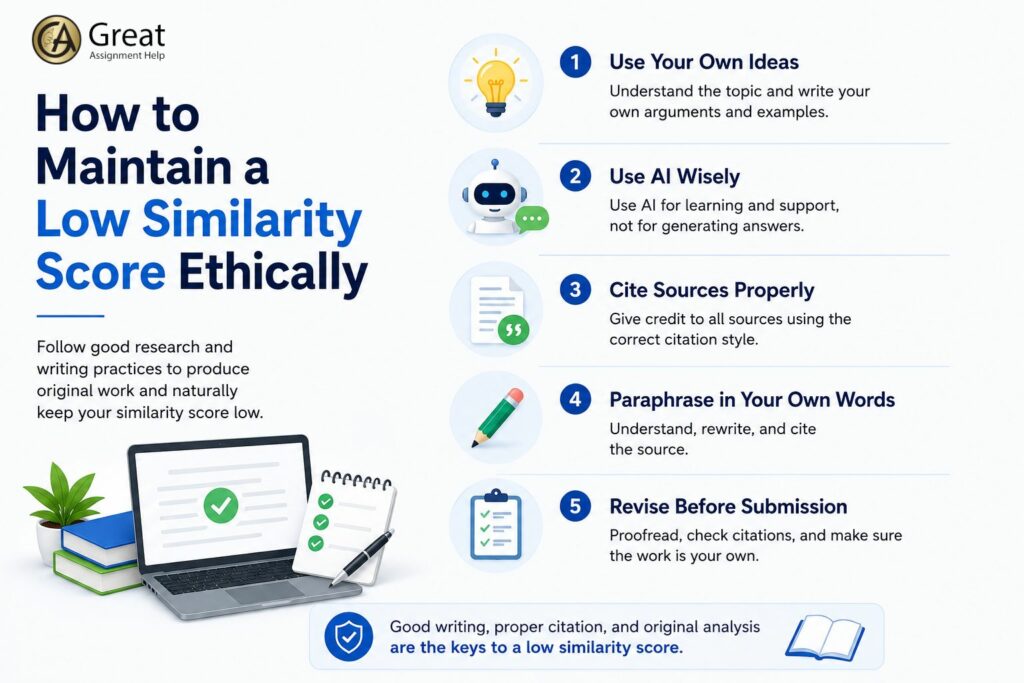
Instead of trying to bypass the detection systems, make sure to follow good research and writing practices. This will help you produce authentic assignment papers that naturally result in a low similarity score.
These are the key steps for developing a high-quality and original assignment ethically
1. Start with Your Own Ideas
First, read the assignment instructions carefully. Next, create an outline prior to using any AI tools and other external sources. Then, write your own thesis statement, arguments, supporting examples, and conclusions. This will demonstrate your subject comprehension.
2. Use AI as a Learning Assistant
Pick any AI tool as a learning assistant. It will assist you in developing research questions, clarifying difficult concepts, organizing essays, improving grammar, and even creating a quiz. But remember that submitting AI-generated text is plagiarism, except in cases where your teacher permits it. Our guide to Ethical Use of ChatGPT in College Assignments will tell you more about that.
3. Cite Every Source Correctly
After that, make sure to cite all sources properly. No matter whether you refer to books, journal articles, web pages, or AI generators that are allowed, make sure to give credit properly. When writing your assignments, keep in mind to use your institution’s preferred citation style, such as APA, MLA, Chicago, or Harvard. This will show you academic honesty and help you reduce issues that are related to plagiarism.
4. Paraphrase Thoughtfully
Next, paraphrase effectively by understanding the sources clearly. While you paraphrase, make sure to express the concept in your own words instead of replacing just a few words. In the end, compare your paraphrase to the source and include the citation.
5. Revise before Submission
Lastly, proofread your assignment thoroughly. Make sure that each paragraph reflects your understanding, all sources are properly cited, and the style of your writing is uniform. In addition, include your analysis.
For additional guidance, read our article on how to avoid plagiarism and maintain academic integrity.
Wrapping Up
AI is revolutionizing higher education. Still, academic integrity remains the cornerstone of meaningful learning. In 2026, Turnitin enables educators to assess the originality of student work through similarity checking and AI Written Indicator detection. But a detection tool alone cannot uncover academic misconduct.
Therefore, students should develop solid skills in research, writing, and critical thinking. The appropriate use of AI can save you time if you work efficiently, come up with ideas, and get help to revise your work. But your paper should ultimately be a display of your own comprehension, creativity, and original thinking.
With the continuous development of the policies related to AI, how to responsibly use technology becomes increasingly important. Students who know how to use Turnitin can avoid accidental plagiarism, interpret report results, and ultimately be able to submit their work with great self-assurance.
No matter if you are preparing a research paper, a case study, a dissertation, or even a piece of coursework, being original is the ultimate form of showing genuine learning. If you need help with your research, referencing, essay editing, or understanding the requirements of the assignments, our experts at Great Assignment Help will guide you so that your work is strengthened without any plagiarism. We promote a culture of academic integrity and ethical learning practices through this.
FAQs
1. Does Turnitin detect ChatGPT?
Turnitin is not designed to detect all uses of AI-generated content. But it can detect text that statistically looks like content generated by AI tools like ChatGPT.
2. Is a high similarity score always plagiarism?
Not necessarily, because similarity can also come from correctly cited quotations, reference lists, and commonly used terminology. In general, the instructors determine the occurrence of plagiarism after reviewing the report and the assignment context.
3. Can Turnitin detect paraphrased content?
Turnitin can detect many forms of close paraphrasing and patchwriting. However, it is fine as long as the paraphrased material shows your understanding of the topic and is properly cited.
4. What is a good Turnitin similarity score?
There is no fixed similarity score. Many academic institutions consider a good Turnitin similarity score to be between 15% and 20% for a well-researched paper, but the limits also depend on the nature of the assignment and university regulations.