
This article has been reviewed and updated with current information, new examples, and the latest academic requirements for 2026
As AI detection in academic writing is increasingly becoming common in higher education, students must familiarize themselves with policies at their institutions, maintain academic integrity, responsibly utilize AI tools, and remain open to producing original and academically accepted papers.
The emergence of artificial intelligence has significantly altered how students perform their research, write, and edit their assignments. Specifically, AI tools like ChatGPT, Gemini, and Claude contribute to idea generation, outline creation, summary preparation, and writing an entire essay within just a few seconds. Even though AI technologies provide many benefits, they also cause many concerns in terms of plagiarism, authorship, and academic integrity.
For this reason, today, many educational institutions rely on various AI writing detection software to assess the assignments that students submit. Still, certain doubts about the AI detection in assignment writing exist, and many students ask us – Is it possible to detect AI-generated content accurately? Are AI detection tools trustworthy? What if an academic paper is falsely accused? Mainly, to clear these doubts, in this blog, we have explained everything about AI detection in academic writing. In particular, we have discussed its pros and cons, academic integrity, and the best ways to use AI in the educational environment.
Whether you choose to use AI tools in the process of brainstorming, editing, or researching, understanding the basics of AI detector technology will help you protect yourself from unnecessary complications and follow the rules imposed by the organization.
Understanding AI Detection in Academic Writing
AI detection in academic writing is an act of checking whether a particular piece of content was written either fully or partly by artificial intelligence systems. Educational institutions have been increasingly using AI detection software to review assignment writing processes. Such tools usually check for linguistic features that are common in machine-written texts. Instead of detecting the type of software used for content generation, AI detection tools determine the likelihood of artificial intelligence technology’s involvement in writing.
The following are some popular AI detection tools
- Turnitin AI Writing Detection
- GPTZero
- Copyleaks AI Detector
- ai
- Winston AI
Generally, these software test features such as
Predictability
Since AI-generated content tends to contain word sequences that statistically match the patterns learned during training, detection programs evaluate the predictability of a text.
Perplexity
The concept of perplexity refers to how surprising or varied the usage of words is. Humans use a wide range of words, while text generated through AI may be uniform and lack variation.
Burstiness
In human writing, the variation of sentence length comes naturally. On the contrary, AI-generated content will be more consistent, which is what detection algorithms assess.
Stylometry
It refers to the examination of the writing style of the text, its vocabulary level, punctuation marks used, and the sentence structure. AI detecting systems involve this capability.
However, it is critical to know that AI detectors are not definitive means of verifying whether or not something was created by artificial intelligence systems. The AI detectors simply provide the probability score of machine-generated text in the academic writing process.
In 2023, a study carried out by scholars at the University of Maryland indicated that the performance of AI detectors was highly variable when it came to different writing styles and models. This shows the fact that AI detection is still a developing process and not an assessment tool yet.
So, a lot of educational institutions are urging teachers to combine the use of AI detectors with other forms of assessment rather than simply relying on the automated scores.
Are AI Writing Detection Tools Reliable and Accurate?
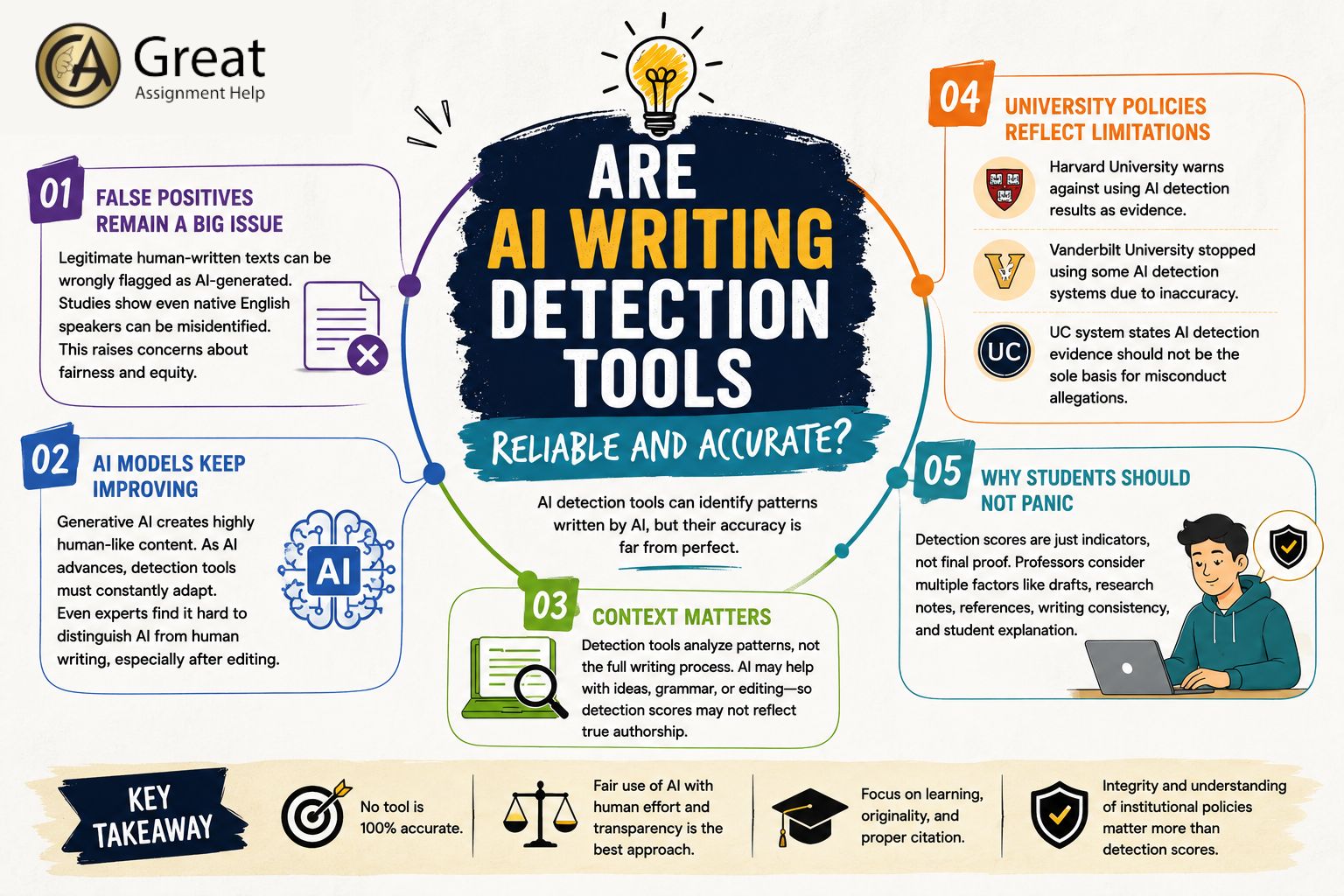
With the continual rise of AI writing detection tools, the topic of their reliability and accuracy has caught the attention of a lot of teachers, academicians, and technology experts. Although such tools can detect patterns written by AI, their precision is far from flawless.
False Positive Remains as Big Issue
One of the most serious issues with AI-generated content detection is false positives. These happen when legitimate human-produced texts are wrongly classified as machine-generated.
A study that was carried out by a group of researchers from Stanford University found that certain detectors unfairly labeled native English speakers’ writings as AI-generated. As non-native speakers generally use less complex sentence structures, their compositions might be mistaken by detectors for AI-generated ones.
This brings up the issue of fairness and equity in the evaluation.
AI Models Keep Improving
The next challenge relates to the ever-changing nature of generative AI technology.
Current AI-based language models create very advanced human-like texts. The more advanced the AI technology is becoming, the more the detection software should adapt accordingly.
The researchers from Princeton University and OpenAI admit that distinguishing between human and machine-created texts is no easy task, particularly after a user edits an AI-generated text.
Context Matters
Detective tools are capable of identifying certain text patterns, yet they cannot comprehend the entire academic writing process.
For instance, AI tools more commonly help students to generate ideas, check the grammar, and edit human-written content before submission.
However, in these cases, detection scores might not accurately indicate authorship.
University Policies Reflect AI Detector Limitations
A few universities have published policies indicating the limitations of these detectors.
For example,
- The Harvard University policy warns against using AI detection results as evidence.
- Vanderbilt University stopped using some AI detection systems because of their unreliability and inaccuracy.
- The University of California system points out that the evidence from AI detection should not be the only basis for the decision to accuse a student of academic misconduct.
Why Students Should Not Panic Over Detection Scores
Sometimes students feel nervous about detection scores in relation to AI-generated content. However, many universities are aware that such tools have their imperfections.
AI detection reports are used mainly as indicators, not as final proofs of plagiarism. So, professors may consider other elements such as draft history, notes from research, reference style, consistency in writing, and student justification.
In any case, knowledge of institutional policies becomes far more important than worrying about AI detection scores.
Academic Integrity Related to AI Detection in Academic Writing
A discussion about AI detection in academic writing ultimately leads to the concept of academic integrity.
A typical definition of academic integrity is the inclusion of honesty, responsibility, fairness, trust, and respect in the coursework and assignments. The International Center for Academic Integrity (ICAI) defines these values as the foundation for ethical education.
In fact, AI alone is not necessarily a contradiction to academic integrity. The main problem is in students’ usage of it.
Acceptable Uses of AI
Several educational institutions allow students to use AI for
- Brainstorming ideas
- Identifying research questions
- Developing outlines
- Enhancing grammatical accuracy and clarity
- Understanding complex subjects
When utilized correctly, AI acts as a good learning tool.
Problematic Uses of AI
There is potential for academic dishonesty when students
- Submit essays written by AI as their own work
- Use AI to fabricate citations and references
- Alter authorship
- Bypass assignment guidelines
- Hide the extensive use of AI
Usually, such unethical practices fail to meet learning objectives.
Transparency Matters
More and more universities are calling for openness about the use of artificial intelligence.
So, in academic papers, students may be required to specify:
- AI tools used
- Contribution of AI to the task
- List of modifications done by AI
Transparency enables instructors to accurately assess learning outcomes.
Expectations of Educational Institutions are Evolving
The policies vary greatly from institution to institution. For example, some universities completely ban the use of AI for certain assignments. On the other hand, certain colleges permit the use of AI with proper acknowledgment.
Hence, when writing academic papers, students should always adhere to
- Course syllabuses
- Guidelines from instructors
- Academic integrity policies of the university
According to Dr. Sarah Mitchell, Senior Academic Tutor at Great Assignment Help, “Rather than replace critical thinking, students should see AI as a helping hand. A responsible use of AI starts with knowing what the course calls for and being open about the writing process.”
This view resonates with contemporary academic practices followed by universities.
For more assistance, students may refer to the article on how to avoid plagiarism and maintain academic integrity, which explains the ethical assignment writing process.
A Practical Framework for Using AI Responsibly for Academic Writing
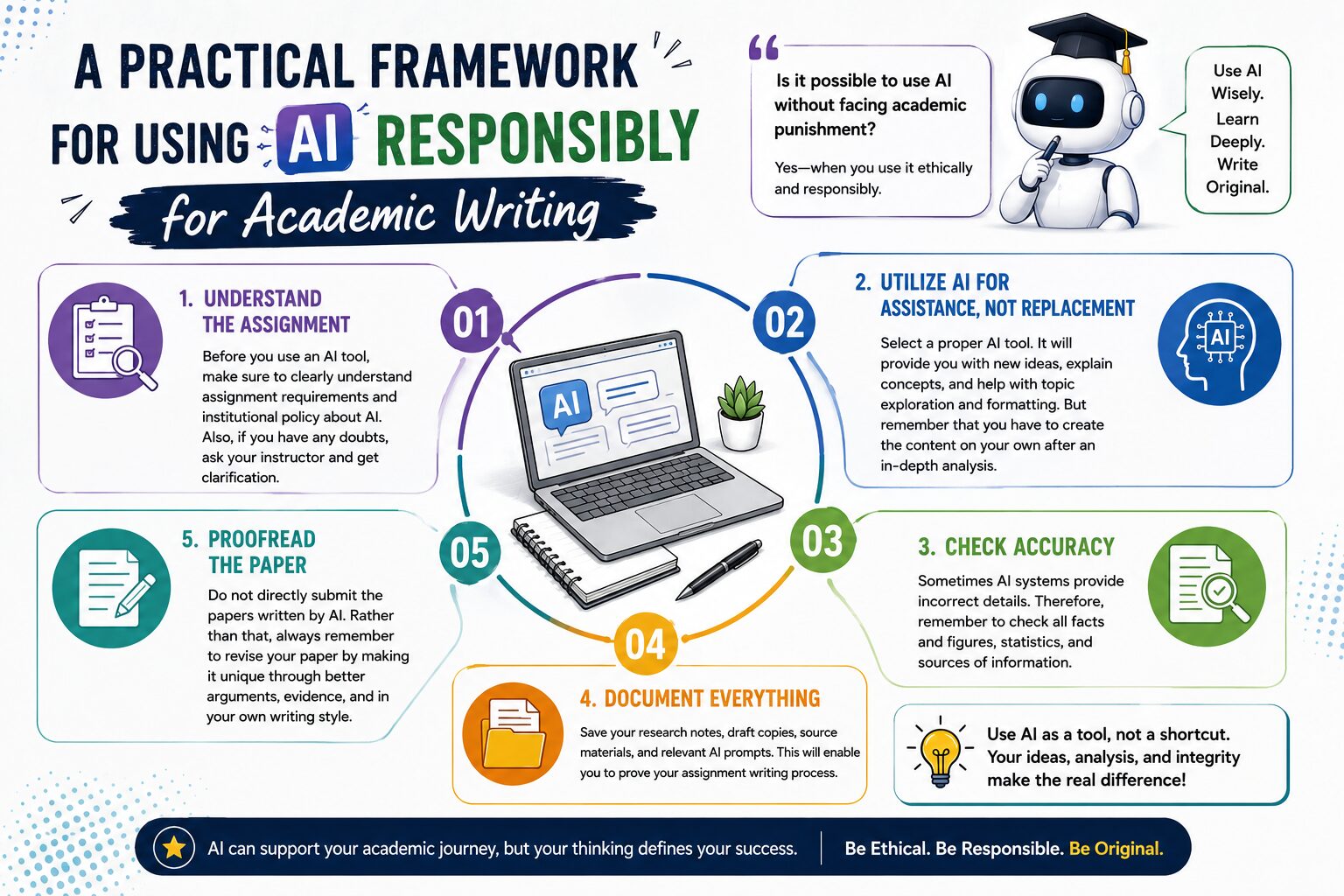
“Is it possible to use AI without facing academic punishment?” is one common question that many students often ask. The answer to this question depends on how AI is used in academic writing.
If you are a student, the following framework will help you use AI for academic writing ethically
1. Understand the Assignment
Before you use an AI tool, make sure to clearly understand assignment requirements and institutional policy about AI. Also, if you have any doubts, ask your instructor and get clarification.
2. Utilize AI for Assistance, Not Replacement
Select a proper AI tool. It will provide you with new ideas, explain concepts, and help with topic exploration and formatting. But remember that you have to create the content on your own after an in-depth analysis.
3. Check Accuracy
Sometimes AI systems provide incorrect details. Therefore, remember to check all facts and figures, statistics, and sources of information.
4. Document Everything
Save your research notes, draft copies, source materials, and relevant AI prompts. This will enable you to prove your assignment writing process.
5. Proofread the Paper
Do not directly submit the papers written by AI. Rather than that, always remember to revise your paper by making it unique through better arguments, evidence, and in your own writing style.
If you need help in conducting academic research with the aid of AI, then read the article about how to write a scientific research paper using ChatGPT.
Example on the Responsible Usage of AI for Assignment
Imagine a student who is writing a paper on psychology research topics.
Instead of using ChatGPT to write the entire paper, the student chooses the AI tools to
- Brainstorm research questions
- Get the gist of major psychological theories
- Create a rough draft of the paper’s structure
- Spot which areas need extensive research
After that, the student:
- Searches for the relevant literature on their own
- Reads peer-reviewed journal articles
- Builds original arguments
- Composes an academic paper
- Properly cite all sources
Here, the function of AI is to be a tool for learning, not a substitute for educational research and writing. Their final essay is a product of their comprehension and ability to think critically and perform research.
Moreover, this method is compliant with the rules of academic honesty as well as the educational objectives of universities.
Students who are eager to be more informed about the responsible use of AI may check out How to Use ChatGPT Ethically for College Assignment Writing.
Conclusion
However, the influence of artificial intelligence on academic writing cannot be ignored. As more educational organizations become interested in AI detection in academic writing, it is essential to have a fair view of the matter.
Firstly, even if AI detection algorithms can spot certain language patterns, they cannot always do so precisely. Mistakes made by the software, changing approaches to natural language modeling, and contextual issues can lead to errors. As a result, most educational institutions put more emphasis on the importance of academic honesty than on AI detection scores.
It is crucial to learn how to use artificial intelligence wisely since it can only serve as a supplementary source of information. Students need to be familiar with their academic organizations’ policies, verify information, document the writing process, and make sure that they own what they produce.
Ultimately, academic achievement is not about escaping from the algorithmic detection systems but about learning, analyzing, and showing good writing skills. But then again, when used responsibly, AI can become an important aid in students’ writing.
Students can contact an Assignment Expert when they need assistance in terms of academic writing standards, research methods, referencing styles, and responsible use of AI tools.
FAQs
1. What is AI detection in academic writing?
AI detection in academic writing is the practice of using specific software to analyze the text and determine if it was written with the help of AI tools like ChatGPT, Gemini, or Claude. These tools help to identify specific patterns of AI-written text.
2. Can universities detect AI-generated text?
University authorities use software to detect whether a particular assignment has been produced using AI or not. However, such software cannot detect AI-generated papers 100% accurately. Thus, detection results are usually combined with other pieces of evidence.
3. Is using AI equivalent to violating academic integrity policies?
No! Using AI does not mean you have violated academic integrity policies. In many institutions, students are allowed to utilize AI tools for brainstorming, researching, writing, and editing assignments according to institutional guidelines.
4. How can I responsibly use AI in academic writing?
If you want to use AI responsibly in academic writing, then treat it as a supporting tool and not as a substitute. AI tools help you brainstorm ideas and improve the efficiency of your work. However, make sure to check all the facts provided, create your unique analysis, and cite your sources correctly.
5. What should I do if my work was incorrectly identified as AI-written?
If your work is wrongly marked as AI-written, instead of panicking, provide all the relevant evidence of your writing process, such as draft versions, research notes, outlines, and revision history.