
This article has been reviewed and updated with current information, new examples, and the latest academic requirements for 2026
By applying anti-plagiarism strategies like correct paraphrasing, conducting thorough research, and writing ethically, learners are likely to enhance the credibility of their writing and get better academic outcomes. Academic integrity is associated with being honest, making correct citations, and using AI tools responsibly.
Originality has become crucial in modern education practice. Nowadays, students depend more on online sources and AI tools for assistance in writing scholarly articles and assignments. Hence, several universities in the United States have reinforced their policies on academic integrity. Although technology makes academic research more accessible than before, the risk of plagiarism increases in relation to the inappropriate usage of online sources, improper citation, and unethical content generation.
Previously, plagiarism referred to copying information from books or web sources. But now, students violate university guidelines by paraphrasing incorrectly, using previously submitted papers, and overusing AI-generated content. In particular, ChatGPT and other artificial intelligence writing tools and assistants are increasingly popular. Therefore, the discussion around AI in academic writing is rapidly evolving.
Generally, knowledge of what plagiarism is and how to avoid it in academic writing will help students to succeed in their studies. So, this guide covers different types of plagiarism, the significance of using AI in academic writing, and plagiarism prevention techniques to maintain originality in assignments.
What is Plagiarism and Why Does Academic Integrity Matter?
Plagiarism is the act of using other people’s ideas, words, or works without giving proper credit. In simple terms, it means presenting another person’s work as original. According to Harvard University’s academic integrity guidelines, plagiarism involves copying of ideas, poor paraphrasing, citation omission, and cheating in collaboration.
Academic integrity refers to the principles that govern ethical behavior in learning, research, and scholarship. The educational institutions hold integrity in high esteem since it symbolizes honesty and accountability. Also, it promotes fairness and respect for original academic work.
Common Types of Plagiarism
Some common forms of plagiarism noticed in academic writing are
- Direct Plagiarism: It occurs when students duplicate texts exactly from any resource without citing or using quotation marks.
- Mosaic Plagiarism: In this case of plagiarism, the copied sentences will be blended with original wording. However, the original sentence structure stays the same.
- Self-Plagiarism: It takes place when students resubmit their previous assignment papers without seeking permission from instructors.
- Accidental Plagiarism: In most cases, this form of plagiarism occurs due to the wrong citation of the work, the absence of citations altogether, and inadequate paraphrasing skills.
- AI-Assisted Plagiarism: This form of plagiarism includes reproducing texts that have been produced using AI technology without proper editing, authentication, and approval.
According to the International Journal for Educational Integrity, most instances of plagiarism are often unintentional in nature. Also, poor writing skills among students cause such issues instead of malpractices such as cheating.
In educational institutions, plagiarism is viewed with great seriousness due to its impact on the entire learning experience. Depending on institutional policies, the possible consequences of plagiarism may include assignment failure, suspension from college, and even expulsion.
The University of Oxford says that students should be aware of proper citation techniques regardless of their intentions. Also, the Purdue Online Writing Lab (OWL) mentions ethical citation as a necessary academic writing skill.
Benefits of Maintaining Academic Integrity
The maintenance of academic integrity is crucial because it will enable students to:
- Sharpen critical thinking
- Acquire academic writing skills
- Establish trust with instructors
- Get ready for research in their careers
- Prevent possible academic/legal consequences
In recent times, academic institutions have been using advanced software to detect plagiarism. Hence, students must follow ethical standards of writing and maintain originality in their academic work.
Also, Read: Why is Plagiarism Illegal by International Laws?
Opportunities, Risks, and Ethical Concerns of AI in Academic Writing
The advent of AI technology has revolutionized the way that students handle their assignments, conduct research, and edit their academic papers. At present, students also depend on AI tools for generating new ideas and engaging in brainstorming sessions. Natural Language Processing enables the AI writing tools to produce outlines, summaries, explanations, and full-length essays in just a few seconds. While AI has made life easier for many students, it has also raised multiple ethical issues in education.
How AI Tools Are Being Used by Students
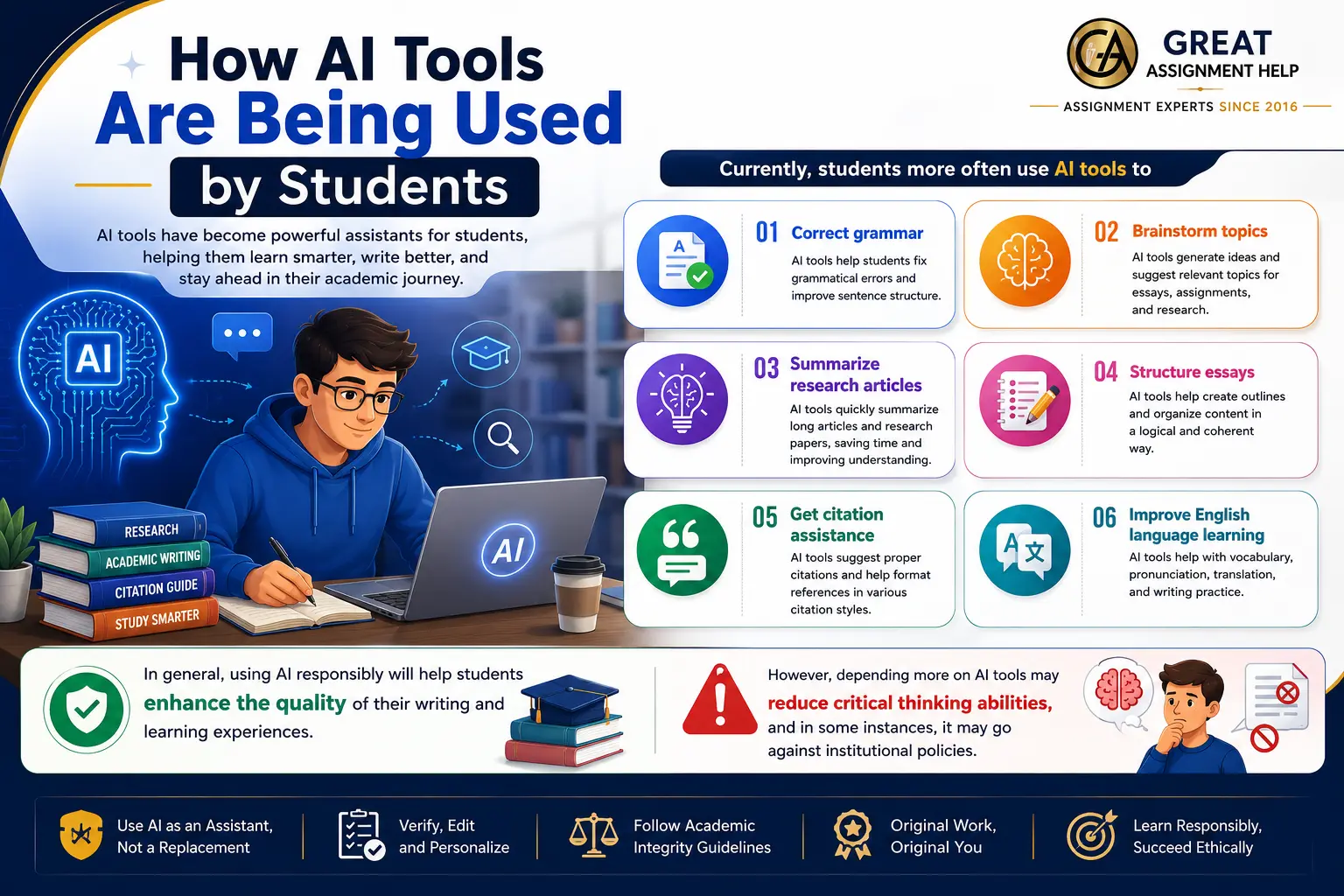
Currently, students more often use AI tools to
- Correct grammar
- Brainstorm topics
- Summarize research articles
- Structure essays
- Get citation assistance
- Improve English language learning
In general, using AI responsibly will help students enhance the quality of their writing and learning experiences. However, depending more on AI tools may reduce critical thinking abilities, and in some instances, it may go against institutional policies.
The UNESCO guidance on Generative AI and Education also states that excessive AI usage might influence originality, transparency, and accountability in educational contexts.
Ethical Risks of AI in Academic Writing
Typically, using AI for writing academic papers or assignments will pose the following ethical risks
Absence of original thinking
AI-generated text may look advanced and impressive. But it may fail to demonstrate critical thinking skills and personal insights into a topic.
False information
In some cases, the AI systems might present false or inaccurate sources, explanations, and information.
Issues with Citation
Most AI tools cannot generate accurate citations automatically.
Violation of Institutional Policy
Not all institutions permit the submission of AI-generated content without appropriate consent or instructor approval.
Can AI-generated Content Be Considered Plagiarism?
The answer depends on the institution’s policies and students’ usage of text produced by AI tools. In most cases, AI-written information might be considered a form of academic misconduct when students do any of the following things:
- Submit it as an original piece of writing
- Fail to check for plagiarism
- Omit citing their sources
- Use AI to bypass learning outcomes
Dr. Sarah Elaine Eaton, a renowned academic integrity expert, states that ethical use of AI in academic writing requires transparency, proper attribution, and human intervention.
Responsible AI Usage Strategies
Students may make ethical use of AI by:
- Employing AI for brainstorming but not for writing
- Closely verifying the accuracy of all written outputs
- Writing their outputs independently
- Manually verifying their references
- Adhering strictly to the institution’s AI policy
With the increased integration of AI in education, institutions are now encouraging ethical use of technology rather than banning its use. Academic integrity in this case requires balance, transparency, and independent thought.
Proven Strategies to Avoid Plagiarism in Academic Work
Plagiarism avoidance is not just about including references in academic papers. Students should develop good research, paraphrasing, note-taking, and citation skills while working on their academic papers or assignments.
The following are effective techniques to avoid plagiarism
Learn Citation Rules
Each academic discipline requires a different style of citation, such as APA, MLA, Chicago, and Harvard. Even an incorrect citation format will be considered plagiarism. Thus, it is essential to know the rules of citation thoroughly. The APA Style Guide explains how to cite academic papers in a proper manner.
Also, Read: APA vs. MLA- Know the Differences
Understand Effective Paraphrasing Techniques
Paraphrasing is defined as the process of stating ideas using different words while retaining their true meanings. Students should implement valid paraphrasing methods to avoid plagiarism.
Weak paraphrasing only involves changing a few words but not altering the sentence structure, while strong paraphrasing entails the need for the learners to:
- Study the source material carefully
- Comprehend its meanings fully
- Write independently without plagiarizing
- Include accurate citations
Maintain Accurate Research Notes
While conducting research, students must maintain proper information in a well-organized manner by distinguishing between quotations, paraphrases, personal analysis, and source details. Improper organization may increase the chances of unintentional plagiarism.
Use Quotation Marks Properly
Mainly, to prevent plagiarism in academic papers, students must use the exact wording from any source inside quotation marks with accurate citations.
Avoid Copy-Paste Habit
It is risky for students to copy whole paragraphs into an assignment. Usually, copying and pasting text as it is from other sources will create accidental plagiarism issues when revising happens.
Check Plagiarism before Submission
Students must conduct a plagiarism test on their written work before submission. The purpose of such software is to detect a lack of citations, similarity problems, and unintentional overlapping issues. But, at the same time, plagiarism checkers can complement ethical writing practices rather than replacing the content entirely.
Carefully Validate AI-Aided Content
When students use AI software for academic writing, they need to:
- Rewrite generated content meticulously
- Ensure factual correctness
- Include reliable scholarly sources
- Adhere to instructor policies and institutional guidelines
Manage Time Effectively
The reason why many students plagiarize is the enormous amount of pressure they face due to tight deadlines. But beginning assignments earlier helps students in conducting adequate research, revising the drafts, validating citations, and proofreading.
As stated by Dr. Linda Adler-Kassner, students can enhance their academic writing skills by considering it an ongoing process rather than doing it hurriedly.
Get Expert Assistance when Needed
Students can utilize online assignment help service providers if they are unaware of the importance of referencing in academic writing and the ways to use different citation styles. The subject professionals, tutors, assignment experts, and writing centers will usually offer helpful academic assistance.
Michael Reynolds, Academic writing specialist at Great Assignment Help (GAH), stated, “Plagiarism is largely preventable. Most students get into panic situations when they face tight deadlines or forget to use citation practices. Proper organization of research would be the ideal solution to this problem.”
Also, Read: How to Avoid Plagiarism in a Research Paper
A Practical Framework for Maintaining Academic Integrity
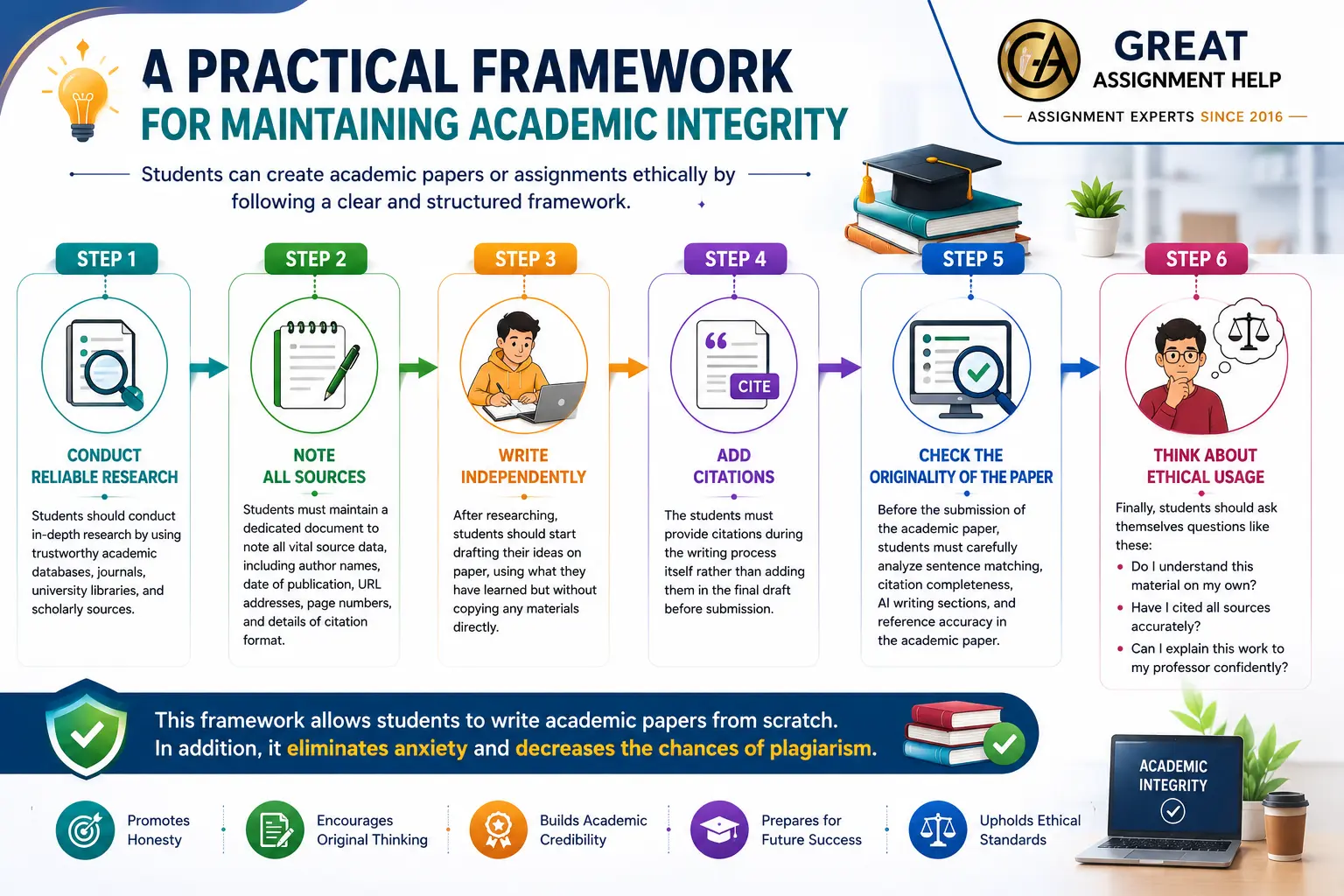
Students can create academic papers or assignments ethically by following a clear and structured framework that includes the following steps
Step 1: Conduct reliable research
Students should conduct in-depth research by using trustworthy academic databases, journals, university libraries, and scholarly sources.
Step 2: Note all sources
Students must maintain a dedicated document to note all vital source data, including author names, date of publication, URL addresses, page numbers, and details of citation format.
Step 3: Write independently
After researching, students should start drafting their ideas on paper, using what they have learned but without copying any materials directly.
Step 4: Add citations
The students must provide citations during the writing process itself rather than adding them in the final draft before submission.
Step 5: Check the originality of the paper
Before the submission of the academic paper, students must carefully analyze sentence matching, citation completeness, AI writing sections, and reference accuracy in the academic paper.
Step 6: Think about Ethical usage
Finally, students should ask themselves questions like these:
- Do I understand this material on my own?
- Have I cited all sources accurately?
- Can I explain this work to my professor confidently?
This framework allows students to write academic papers from scratch. In addition, it eliminates anxiety and decreases the chances of plagiarism.
Example: Ethical AI Use in a Student Research Assignment
Take the example of a university student who is preparing a psychology research paper on social media addiction.
Incorrect Method
Here, the student makes use of AI technology to write a complete 2000-word paper. Afterward, the student submits the paper without making any alterations or checking it.
Among other issues, the following problems will arise as a result:
Such actions may lead to some issues like:
- Plagiarism
- False citations
- Generalized analysis
- Breach of policies
Ethical Approach
On the other hand, the use of AI tools by the student is done responsibly. First, the student uses AI for generating topics. Second, the student uses the AI to develop an outline. Furthermore, the student uses AI to simplify complex concepts. Moreover, the AI also provides suggestions for improved grammar.
After this process, the student does the further tasks alone. This involves carrying out research through journal articles from peer-reviewed sources. Then, the student generates the analyses based on comprehension. Finally, the student adds relevant citations to the work. Revision is done by the student too.
This is how real learning is achieved with academic integrity preserved.
The only thing that changes here is whether or not technology complements learning or replaces it entirely.
Also, read: How to Use ChatGPT to write a scientific research paper
Conclusion
The problem of plagiarism is still very relevant in today’s educational system. In particular, the use of the Internet and artificial intelligence tools for conducting research and writing papers poses many new challenges to the integrity of modern college learners. Thus, it is essential to study the importance of academic integrity, which will save students from punishments but also develop their professionalism.
There are new challenges associated with using AI in academic writing, yet the key components of integrity, such as honesty, respect for the ideas of others, and ethical writing practices, stay the same. Students can create original papers by using their knowledge of correct citation styles, efficient paraphrasing techniques, proper organization of the research process, and responsible AI usage.
Academic integrity is not a matter of perfection but rather one of accountability and continual improvement.
Professional assignment help could be beneficial to students who have problems with citation, research, and ethical writing.
FAQs
1. What is Academic Integrity?
Academic integrity means behaving honestly and responsibly in an educational environment. It involves presenting original ideas, citing properly, and conducting ethical research.
2. Is AI-generated content considered plagiarism?
If students submit AI-generated content without editing, adding proper citations, or following institutional policies, then it can be treated as plagiarism.
3. What are the most common types of plagiarism?
Direct plagiarism, mosaic plagiarism, self-plagiarism, unintentional plagiarism, and AI-generated plagiarism are some common plagiarism types in academic writing.
4. What can students do to avoid plagiarism?
Students can prevent plagiarism in their academic papers by citing sources properly, paraphrasing the text correctly, and using the right plagiarism detection tools.
5. Why do universities take plagiarism seriously?
Universities take plagiarism seriously because of its effect on learning outcomes. It also compromises academic integrity and reduces the credibility of the work.