If you are accused of plagiarism, remain calm, analyze the evidence, understand your university’s policies, preserve all your academic papers and sources, and respond honestly. Also, you can protect your academic integrity by seeking expert support.
Getting an email informing you that there is a risk of your paper being plagiarized can be scary. Also, immediately, you may start worrying about your grade, academic record, or future at your university. But instead of panicking, make sure to learn what exactly you are accused of.
Plagiarism can take many forms, like copying texts or sentences, borrowing someone else’s idea without giving credit, incorrect paraphrasing, unapproved collaboration, or some other misuse of sources. Most importantly, remember that a similarity report is not automatic evidence of plagiarism. According to Turnitin, the Similarity Report identifies matching text, and it is up to the instructor to interpret the report in context and with academic judgment to identify plagiarism.
In this guide, you will find out what to do if you are accused of plagiarism, how to respond to accusations, what kind of evidence you need, how AI in academic writing might influence your case, and how to preserve your academic integrity.
Understand Exactly What You Are Accused Of
According to Berkeley University, plagiarism is defined as the use of intellectual property created by someone else without giving proper credit. Also, the Honor Code of Stanford states that plagiarism falls under the violation of academic integrity.
If you are accused of plagiarism, first analyze the accusation thoroughly. Do not react emotionally or believe that your university has already made its decision that you are guilty.
Instead, identify the particular problem. Check whether it is an accusation of using plagiarized text, absence of citations, poor paraphrasing, self-plagiarism, forbidden collaboration, or usage of AI in academic writing. Keep in mind that all these issues will not be treated in the same way under every university policy.
After spotting the issue, find out the policy that is related to your particular course. Never take advice from a friend, social media post, or an older student because universities have varying definitions, procedures, deadlines, and consequences.
Some institutions provide a formal hearing or appeal process. For instance, RIT’s policy states that there will be written notice, evidence, a hearing on the matter of academic integrity, and participation by an advisor/advocate. Similarly, at the University of California Santa Cruz, there are provisions for students to submit evidence and witnesses.
This is the reason why knowledge of your university’s policies on academic integrity is important.
Moreover, note that maintaining academic integrity is not just about avoiding copied sentences. It mainly includes conducting honest research, adding accurate citations, collaborating responsibly, reporting data truthfully, and following rules that are related to technology and AI.
Review the Evidence Before You Respond
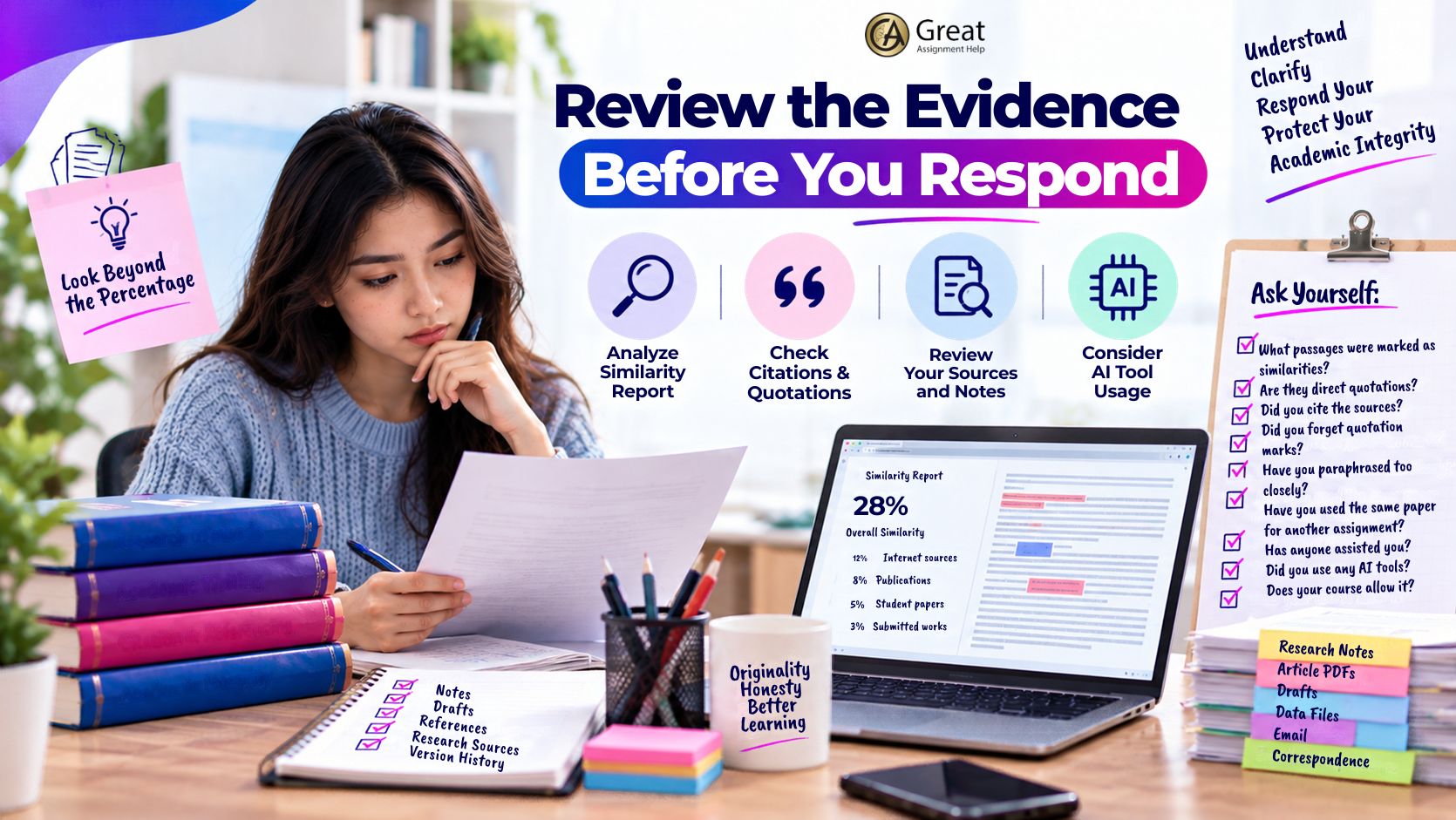
Once you are clear about the accusation, analyze the evidence in detail. If there is a similarity report, pay attention to the individual matches rather than looking only at the percentage.
Similarity percentage doesn’t have a universal interpretation. A paper may have similarities due to properly quoted parts, references, general terminology, language of the assignment, draft submissions, etc. On the other hand, a low similarity percentage doesn’t automatically mean that there is no plagiarism in a paper. Turnitin itself makes a clear distinction between similarity and plagiarism. Get to know how Turnitin detects AI in academic writing.
Especially when you review the evidence, ask yourself these questions
- What passages were marked as similarities?
- Are they direct quotations?
- Did you cite the sources?
- Did you forget quotation marks?
- Have you paraphrased too closely?
- Have you used the same paper for another assignment?
- Has anyone assisted you with this work?
- Have you used any AI, grammar, or paraphrasing tool?
- Does your course allow that type of assistance?
After that, collect your original research materials. Some useful pieces of evidence are your handwritten or digital notes, article PDFs, library searches, outlines, early drafts, document version history, reference manager records, data files, and emails with your instructor.
In some cases, your academic writing process could actually give you additional context at times. For example, a series of drafts might show the development of your argument throughout the time period. Likewise, research notes could help you understand where a certain idea or quote originated.
Whenever you use AI in academic writing, keep all relevant prompts and outputs rather than removing them. There may be guidelines from your university about using AI writing tools and citing sources. Even recent studies have indicated that the use of generative AI raises certain academic-integrity issues around authorship, originality, and assessment. Read this article to learn about plagiarism and the ways to avoid it in the AI era.
Respond Honestly and Use the Proper Process
After reviewing the accusation, write a response that is calm and fact-based. You should not insult the professor, blame a peer, delete any files, or fabricate evidence.
If you have done something wrong, state it and explain what really happened. For instance, you may have written out some text into your notes without quoting the actual text in the future. You may also have paraphrased the source improperly, thinking you know what paraphrasing means. Learn how to paraphrase correctly.
Being responsible for a mistake is not the same as accepting an allegation that you believe to be false. If you do not agree with the allegation, you can state why, along with your evidence.
Your response must be objective. It must include the following facts:
- Acknowledge that you understand the allegation.
- Highlight the specific document that is being accused.
- Explain how you created that particular section.
- Present relevant and supporting drafts, notes, citations, or other evidence
- Cite the applicable university policy.
- Ask what the next procedural step is if it is unclear.
Do not come up with a false story just to sound credible. False evidence or testimony may cause you another academic integrity problem. Stony Brook University warns that presenting false evidence or testimony in an academic integrity hearing might be the reason for yet another accusation.
It is also sensible to ask for procedural help. At your university, it may mean reaching out to an academic integrity office, a student advisor, ombudsman, writing center, library, or any other legitimate resource.
The aim of this step is not to bypass the process but to make sure that you understand the procedure well enough to provide a true account of your work.
Get to Know What AI in Academic Writing Means for a Plagiarism Allegation
The use of AI in academic writing has also made plagiarism accusations more serious. But an allegation based on AI could be about something other than any conventional form of copying.
For instance, your instructor can accuse you of submitting AI-generated writing as your own, using an AI paraphrase tool without authorization, failing to cite the use of AI, or using AI-generated references that don’t exist. However, simply using AI does not necessarily mean a violation of plagiarism or other academic integrity rules. It all depends on what the online class and university permit. Read this article to learn about AI detection in academic writing.
Some schools accept AI for brainstorming ideas, language editing, or creating questions for studying. Some others prohibit the use of generative AI in certain assessments. Therefore, you need to be aware of the course instructions and institutional policy.
Dr. Jenifer Wilson, a tutor at GAH, says, “The best-performing students take ChatGPT as an improvement tool but not as a substitute for their own brains”.
If your university and teacher allow you to use AI, explain in your academic paper how you used it and follow all the rules for disclosure. If AI is not allowed, be honest about using AI writing tools and do not try to hide it. Learn how to use ChatGPT ethically in college.
Steps to Handle a Plagiarism Accusation
Plagiarism
We know how high your emotions would be when you are accused of plagiarism. So, during such scenarios, effectively handle the situation by following these steps
- Do not reply angrily or hurriedly. Read the allegations two or more times and mark all deadlines.
- Distinguish facts from assumptions and note down your understanding of the allegations.
- Review all relevant academic-integrity and online class policies. Pay attention to definitions, procedures, evidence requirements, meeting dates, and appeal deadlines.
- Gather all documents, including academic drafts, notes, sources, citation information, and research notes related to the AI policy.
- Create a brief timeline to describe your research, writing, editing, and submission process.
- Respond directly to the allegations. Admit any mistakes you made and argue against incorrect claims with evidence.
- Attend all meetings and hearings unless the policy explicitly states otherwise. Make sure to bring your evidence.
- No matter what the result is, try to learn what led to this situation. It might be citation management, paraphrasing, note-taking, collaboration, or a violation of the AI policy.
A Practical Example: When Similarity Report Flags Your Paper
A situation occurred in which an instructor contacted a student and informed the student that a paragraph in the history essay was very similar to a published article.
Initially, the student examined the Similarity Report, which showed that the paragraph resembled the source but did not contain quotation marks. Although the student had included a citation, the wording and sentence structure were still too similar to the source.
In such a situation, instead of arguing that citing the author had justified everything, the student referred to the university’s definition of plagiarism and explained the mistake. The student also attached the source used for research along with the draft of the essay as evidence.
The instructor then followed the existing procedure within the institution, and the outcome depended on the available evidence, the circumstances of the case, and the student’s prior history regarding similar matters.
This scenario illustrated why the Similarity Report was only the beginning of a review.
How to Protect Academic Integrity after a Plagiarism Accusation
A plagiarism accusation can be a chance to learn and improve your behavior.
- Keep a source log: Whenever you research, record the author, title, publication details, page numbers, DOI or website, and where you found each quotation. Write down direct quotes in your notes so you do not accidentally present someone else’s words as your own.
- Paraphrase properly: Read and understand the source carefully. Then look away from it and explain the idea in your own words and structure. Always give credit to the source. Simply changing a few words is not proper paraphrasing.
- Check AI citations: Never assume that citations created by AI are correct. Check each citation against the source.
- Follow your instructor’s AI rules: If AI is allowed, find out what your instructor requires. You may need to say which AI tool you used and explain how you used it. Follow the correct rules for citing AI in academic work.
- Get help, but do your own work: Writing centers, librarians, tutors, assignment help services, and academic advisers can teach you about research, citations, paraphrasing, and school rules. They can support your learning, but the academic work should remain your own.
Conclusion
An accusation of plagiarism can be a very big problem for you, but an accusation itself is not the same as a conviction. When you are accused of plagiarism, stay calm, understand what you are being accused of, check your university’s rules, and honestly explain your work with evidence.
Do not just look at the similarity score or AI detection results because, many times, such tools can mislead. Every university has different procedures, so make sure you follow the rules and deadlines of your institution.
Most importantly, it is necessary to practice academic honesty during your work process, not only before submitting assignments. Therefore, conduct proper research, cite your sources properly, paraphrase in your own words, be honest about the use of AI, and maintain good records of your research. All these practices may help you to avoid any problems related to plagiarism.
In case you have any questions regarding academic integrity policies, do not hesitate to consult your professor, academic integrity officer, librarian, writing center, or Great Assignment Help professionals who will explain all about academic integrity and responsible academic writing.
FAQs
1. Does a high Turnitin score automatically mean plagiarism?
No! A high Turnitin score does not necessarily mean plagiarism. The tool simply highlights similarities between your work and other sources. However, many universities accept similarities that are related to quotations, citations, and common phrases.
2. What should I do if I genuinely made a citation mistake?
Admit your error honestly. First, refer to your university’s policy and have all of your drafts and research notes ready. Next, explain clearly what went wrong. Do not create, change, or fake evidence after you have been accused.
3. Can I appeal a plagiarism accusation?
Yes, you can appeal or ask your instructor to review your case. Usually, the process and deadlines vary among universities. So, before you appeal, read your university’s current academic integrity policies to understand your rights and the steps you need to follow.
4. Can AI use lead to a plagiarism or academic-integrity allegation?
Yes, it does, based on the guidelines set by your university and specific coursework. There might be some courses that permit the use of AI tools, some that restrict their usage, and yet others that require you to declare your use of these resources. The most crucial part is that you should adhere to the guidelines and ensure that what you are submitting is reflective of your input.
5. What evidence should I keep when writing an academic paper to avoid plagiarism?
Keep research notes, sources, article PDFs when permitted, outlines, drafts, revision history, citations, data sets, and permitted AI use documentation. All this evidence demonstrates how your work developed and what sources you used to gather information.