
Academic integrity means completing your scholastic work honestly and responsibly. If you want to maintain academic integrity, first be aware of the university’s academic integrity policy and the proper referencing of sources. Also, use AI tools transparently and avoid misconduct.
What if you receive a high score on your paper, but find out later that one forgotten citation, improper collaboration, or use of AI tools caused the university to identify academic misconduct? This does not mean that you have consciously cheated; most likely, you simply did not understand your university’s academic integrity policy.
Academic integrity goes far beyond just not plagiarizing. It covers all stages of the research and writing process, including examinations, source usage, data reporting, and technology usage. The International Center for Academic Integrity (ICAI) defines it through six core values, namely honesty, trust, fairness, respect, responsibility, and courage.
Since university policies tend to vary from one institution to another and from one department to another and even from assignment to assignment, you should consider the university’s policy as a starting point. But it may not necessarily be the only policy that you need to apply. If you want to understand everything about the university’s academic integrity policy, read this blog. Here, you will get to know the core principles, common violations, and practical ways to protect your academic integrity.
What Does Academic Integrity Mean?
In simple terms, academic integrity means doing your academic work honestly and being accountable for how you do it.
These six principles of academic integrity outlined by the ICAI give a useful framework
- Honesty: Represent your work, your sources, your data, and your contribution honestly.
- Trust: Assist in building an academic environment where both students and educators can trust each other.
- Fairness: Meet the same standards of academic behavior as your fellow students.
- Respect: Recognize the intellectual contributions and rights of other individuals.
- Responsibility: Know the rules and take ownership of your decisions.
- Courage: Do the right thing regardless of whether it takes less effort than cheating.
These core values of academic integrity matter the most because universities do not simply evaluate the answers you have submitted. They make sure to evaluate your learning process, reasoning abilities, research skills, and independent judgment.
For instance, if you reproduce a paragraph in a journal without giving due credit, then this is an issue, as the reader gets the impression that the ideas are your own. Likewise, creating false survey data produces an erroneous academic record. Also, submitting work done completely by some other individual would result in misleading others regarding your true abilities.
Therefore, the policies of a university typically cover various kinds of academic misconduct. Even the University of North Carolina at Chapel Hill identifies plagiarism, fabrication or falsification of information, and unauthorized help or cooperation as academic dishonesty problems. Learn all about how to avoid plagiarism in the AI era.
The main idea is that academic integrity is not only about avoiding penalties but also about protecting the credibility of your qualifications and showing that your academic performance is truly based on genuine learning.
What Your University’s Academic Integrity Policy Usually Covers
Your university’s academic integrity policy may stretch for several pages, but certain key points that are listed below will make it more understandable.
Plagiarism and Improper Source Use
Plagiarism means presenting other people’s ideas, thoughts, structures, information, findings, arguments, and other intellectual efforts as your own without any proper acknowledgment.
It can take place on purpose, yet it can also occur unintentionally due to poor note-taking skills, forgotten citations, and inadequate paraphrasing. But to avoid such issues, whenever you use any information, idea, finding, quotation, image, dataset, or arguments of someone else, check whether you should reference it or not.
Even when you paraphrase the content of others, add a citation to avoid plagiarism. For additional guidance, see this article on how to paraphrase properly to maintain academic integrity.
Cheating and Unauthorized Assistance
The University’s academic integrity policies usually prohibit the use of unauthorized resources on examinations, getting unauthorized help, answer sharing, accessing confidential examination information, and helping another student violate assessment policies.
Note that collaboration is not necessarily considered academic misconduct. Sometimes an instructor may allow collaboration in one assignment but forbid it entirely in another. So, make sure you understand the requirements that are related to a particular assessment.
Fabrication and Falsification
Fabrication is the act of inventing non-existing information. Falsification is the manipulation or misrepresentation of information.
Some examples include
- Creating non-existent survey participants or research findings.
- Manipulating experimental data to reach a desired result.
- Preparing non-existent references.
- Misrepresenting attendance, participation in research, and academic record.
This aspect becomes especially important in the context of AI since generative models can produce inaccurate claims or fake references.
Self-Plagiarism and Duplicate Submission
Sometimes students think that since they have already written some earlier papers, they can resubmit those. But it is not always the case.
A few colleges and instructors do not allow resubmission of substantially similar works for more than one assessment. So, before submitting a paper based on any previous work, ask your instructor. This will help you maintain academic integrity.
Unauthorized Use of Artificial Intelligence
An AI policy will depend greatly on the individual course and educational institution. Some courses may prohibit AI tools like ChatGPT, Gemini, and others entirely, while others may allow the use for brainstorming and editing or require students to disclose their use of AI. In some cases, students may need to submit their AI prompts and responses, use AI only for specific tasks, or follow different AI guidelines for different assessments.
For example, Cornell University’s Centre for Teaching Innovation suggests that instructors give guidance to the students about the use of AI, document and acknowledge it. Similarly, the Office of the Provost at Yale University asks students to follow the AI policies set by their educational institution and instructor.
As Dr. Emily Brown, Senior Academic Writing Tutor at Great Assignment Help, says, “AI will help in framing the ideas in a more complex manner; however, true paraphrasing is about understanding the subject matter first. Technological tools are just assistants in studying, and not a replacement for analytical skills that are most valuable at universities.”
Common Academic Integrity Mistakes Students Make
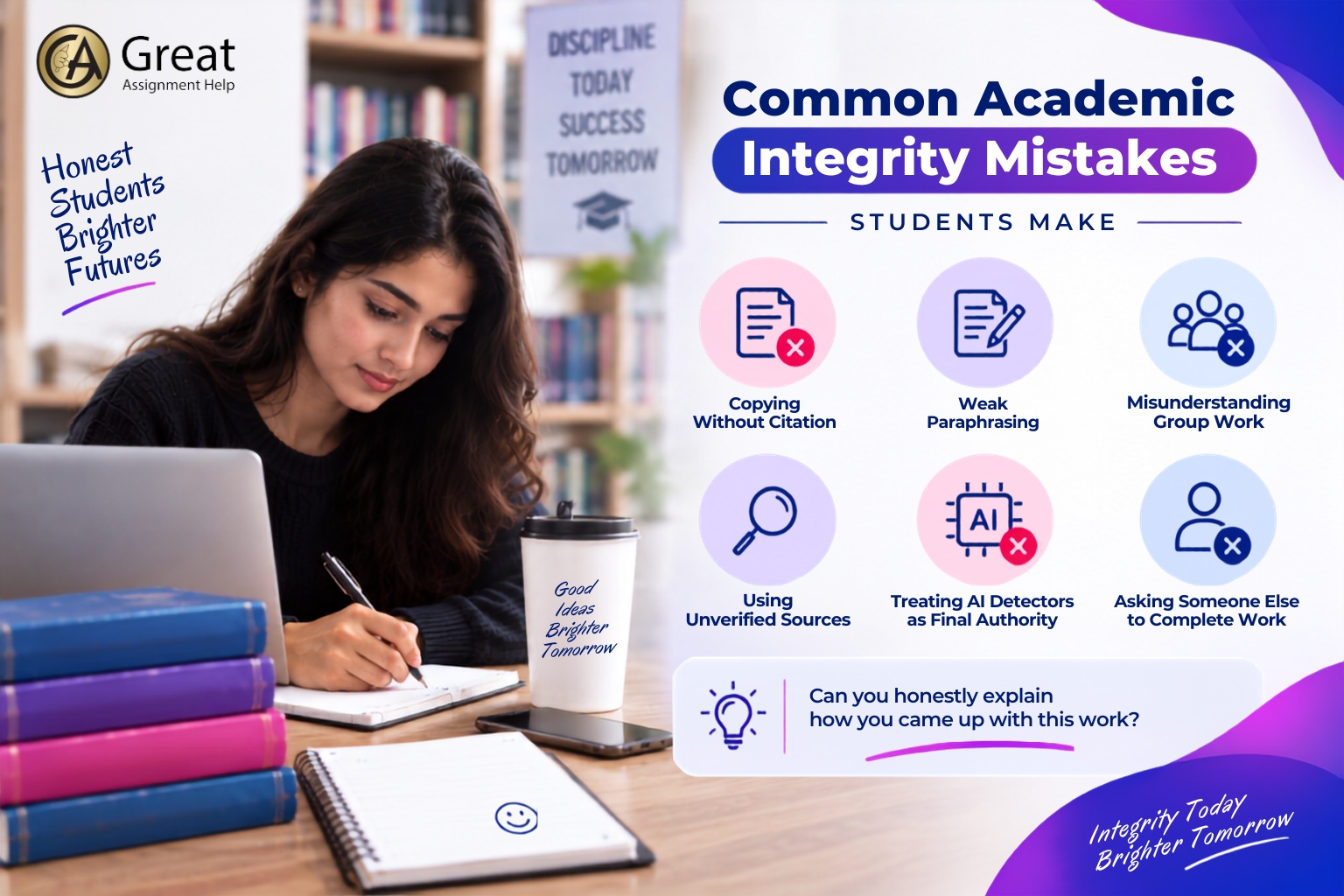
Knowledge of these most frequent errors will help you implement policies effectively in practice.
Copying without citation
Copying a sentence, paragraph, image, table, or idea without giving credit is a typical integrity violation. Even if you take information from the internet and replace a few words with synonyms, it can still be too similar to the original.
Weak paraphrasing
Word-for-word replacement of the text with its synonyms without changing the sentence structure does not constitute good paraphrasing. First, you should read the source, understand the meaning, set it aside, and then explain what you have understood in your own words, structure, and voice. Finally, you should cite the source.
Misunderstanding group work
Sometimes students think that collaboration on an assignment is automatically acceptable. But an instructor could request an individual assignment. When the instructions ask you to “work independently”, then discussion or joint preparation of an answer might be considered an academic integrity violation.
Using unverified sources
Even if your academic essay is well-written, it may suffer from integrity problems due to the use of incorrect references. This is one of the reasons why you have to approach academic writing involving AI with some degree of caution. According to research, generative AI provides learning opportunities while posing certain integrity risks, such as inaccurate and even fictional facts.
Treating an AI detector as the final authority
AI detection in academic writing is a rather complex issue. The Cornell guide for instruction warns that modern AI detectors can make many mistakes and should not be considered reliable evidence of plagiarism or other misconduct.
Thus, it is important to concentrate more on producing an authentic essay rather than on “beating” AI detection tools, preserving your research notes and drafts, complying with all AI instructions of the assignment, and explaining your work.
Asking someone else to complete assessed work
Seeking assistance with ideas is not the same as getting someone else to do the work for you and submitting it as yours. Educational institutions test your knowledge and abilities; therefore, outsourcing the intellectual effort could be counterproductive and might even be against policy.
When you are thinking about cheating, ask this useful question to yourself – Can I honestly explain to my teacher how I came up with this work?
If the answer is negative, you should think again about your assignment requirements.
A Simple Framework for Protecting Your Academic Integrity

This framework will help you apply your university’s academic integrity policy to everyday assignments.
Step 1: Read before writing
Ensure that you have gone through the university’s academic integrity policy, course syllabus, assignment requirements, and assessment requirements. Do not believe what other students tell you.
Step 2: Set assessment limits
Ask yourself
- Can I collaborate?
- Am I allowed to use source material?
- Will generative AI be allowed?
- Am I required to report AI usage?
- Are any applications or grammar tools allowed?
- Can I reuse previous assignment’s material?
In case of doubt, consult the teacher before submission.
Step 3: Keep research records
Note down names of all the authors, dates of publications, page numbers, links, quotes, summaries, and your own observations separately. It will help you distinguish your views from the source materials.
Step 4: Cite while drafting
Do not wait until the last minute to put in your citations. Add them as you write and make sure each in-text citation has the correct reference list entry.
Step 5: Use AI only within the rules
If AI is allowed, find out exactly what is and isn’t allowed. For instance, generating topic ideas via an AI tool may be allowable in one class but not another. Furthermore, when allowed, confirm the accuracy of the information generated through AI against academic sources. Don’t just assume an AI-generated citation is valid because it sounds credible. Learn how to use ChatGPT ethically for college assignments.
Step 6: Preserve evidence of your process
Save outlines, drafts, research notes, data, and version histories as appropriate. These records can help you demonstrate the evolution of your work.
Step 7: Complete an integrity check
Before you submit your academic paper or assignment, ask yourself these questions:
- Have I followed the instructions in the assignment?
- Have I cited other people’s ideas in my work?
- Is the work truly mine?
- Have I used any form of AI tools or software appropriately?
- Can I explain and defend the work?
This final check takes only a few minutes, but by doing it, you can prevent avoidable mistakes.
How to Apply the Rules to Maintain Academic Integrity: An AI Writing Example
Consider a situation in which a student has to submit an essay based on independent research.
Firstly, the student examines the syllabus and finds out that AI can only be used for brainstorming and not for generating the entire academic content.
After that, the student uses an AI tool to generate research question ideas. Then, the student searches scholarly databases, analyzes peer-reviewed articles, formulates their own position, and writes an essay on their own. In addition, the student references the research articles and discloses the use of the AI if requested by the professor. Learn how to cite AI tools in academic work to maintain integrity.
Obviously, this method differs greatly from generating the essay with AI and submitting it without making any changes. This difference is important since the current literature discusses the issue of AI in higher education as both an opportunity and a challenge. For example, a 2025 systematic review of 41 studies suggested that institutions need proper digital literacy and ethics along with appropriate technologies.
Another important thing for students to know is that there could be changes to the policies on using AI. Rather than depending on any outdated blog post or suggestions from fellow students, it is advisable to confirm the most recent information from the university and class guidelines before submitting any work.
Final Thoughts
Academic integrity is not a manual to refer to only in case of some trouble. This is a regular academic practice. Generally, academic integrity shapes your ways of researching, writing, collaborating, citing, using computer technologies, collecting data, and presenting your thoughts.
As university policies vary, it is best to check what is written in the policy of your university and act according to the instructions provided by your professor.
The idea is not just to stay away from any accusation of academic misconduct. Your degree should demonstrate the real knowledge you have, your independent thinking, scholarly responsibility, and professional skills.
In case you are not sure about how to maintain academic integrity when writing an assignment, get guidance from the staff of your institution’s office of academic integrity, writing center, librarian, and instructor. You may also seek assignment writing help from subject experts at GreatAssignmentHelp.com. The ethical assistance from professionals will improve your understanding of the university’s policies and skills.
FAQs
1. What is academic integrity at university?
Academic integrity refers to maintaining honesty while undertaking studies, research, and assignment/exam writing. To maintain academic integrity, it is necessary to include citations, use original work, collaborate effectively, and follow university rules.
2. Is the use of ChatGPT always considered a violation of academic integrity?
Not necessarily. The use of ChatGPT will be treated as an academic integrity violation based on your university, class, lecturer, and assignment requirements. Some universities will not allow the use of generative AI, but certain institutions might allow it under certain conditions.
3. Is paraphrasing without a citation considered plagiarism?
Yes, it can be. Rewording does not make the idea yours. But when borrowing ideas from other sources, you should make sure to acknowledge that source using the required citation style.
4. What if a student breaks an academic integrity code?
The consequences depend on the school, the severity of the offense, past behavior, and procedures involved. Some of the consequences include educational action, penalties for assignments, course penalties, or disciplinary action. Hence, students need to check out the policies and procedures at their school.
5. How do I avoid unintentional academic misconduct?
Begin by reading your syllabus and the assignment guidelines, maintain proper research notes, make citations as you write, know collaboration policies, adhere to AI policies, save your drafts where needed, and seek clarification from your professor when a rule is unclear.