
This article has been reviewed and updated with current information, new examples, and the latest academic requirements for 2026
AI has become a common part of academic writing, and hence it is essential to know how to cite AI tools correctly. In general, citing AI tools in academic work will increase the originality and credibility of your paper, promote transparency, and prevent academic misconduct.
Artificial Intelligence (AI) has also made its way into the academic life of students. Today, with the help of AI applications like ChatGPT, Gemini, and Microsoft Copilot, students can deal with different phases of the academic writing process, including coming up with ideas, explaining complicated issues, summarizing information, and improving grammar. However, due to an increased use of AI in academic writing, universities have started paying more attention to transparency, ethics, and integrity. It is at this point that it becomes imperative for students to learn how to cite AI tools in academic work.
When doing your assignments, you can use AI to brainstorm ideas, refine arguments, or generate academic content. But proper citation of AI tools will help you demonstrate your academic honesty and increase the academic integrity of your work. So, universities and referencing styles have set new citation guidelines for AI. If you understand the AI citation requirements before submitting your assignments, you can earn more benefits.
Therefore, in this blog, we have discussed everything about citing AI tools in academic work to maintain integrity. Specifically, you will learn when to cite AI tools and why it matters the most. In addition, you will discover practical ways to use AI in academic writing responsibly and how different referencing styles recommend citing AI tools.
Why is it Important to Cite AI Tools in Academic Work?

Since AI tools are helpful in many aspects, you can use them to simplify the complexity of your academic work. Especially, you can use AI to understand difficult study topics, prepare outlines, and improve sentence structure. In general, ethical use of AI in academic writing and knowing the importance of referencing in academic writing will enable you to show your honesty about AI’s contribution in your work. Proper citation is one of the responsible ways to highlight the use of AI tools in your academic work.
Acknowledge the Source
Citation of AI tools is similar to giving credit to other sources that have an impact on your assignment. AI is not a traditional author, but it provides information and ideas that can influence your writing. Hence, disclosing the use of AI in your academic paper through proper citation will help your readers understand how your work was developed.
It is also crucial to write references in assignments that use AI because sometimes AI-generated texts can contain errors such as fake references, misinformation, or confusing explanations. Such problems are commonly called “hallucinations”. But if you correctly acknowledge AI use, then you can indicate that you have examined and confirmed the information before including it in your assignments.
Support Academic Integrity
Furthermore, citations help to maintain academic integrity. According to the International Center for Academic Integrity (ICAI), academic integrity involves key values such as honesty, trust, fairness, respect, responsibility, and courage. When you openly reveal the assistance of AI in your academic work, you not only exhibit those values but also make it easy for your instructors to accurately evaluate your original contribution.
Prevent Academic Misconduct
Currently, several universities have policies regarding the disclosure of AI use in academic work or assignment writing. Specifically, institutions such as Harvard University, the University of Oxford, Monash University, and the University of Sydney expect transparency in the scholarly work students submit. Therefore, they advise students to follow citation guidelines while using generative AI. They also state that ignoring these policies can raise concerns about academic misconduct, even if no plagiarism has occurred.
Increase Transparency
Furthermore, proper citation will help protect you from claims of misinterpretation. If your instructors discover a significant amount of AI-generated content without citation, then they might think that you have submitted the assignment without subject comprehension. However, staying transparent about the use of AI in your academic work helps you avoid this confusion.
Citation rules and AI permissions are different. Some universities will allow you to use AI only for editing and will not encourage AI-generated writing. So, you need to read the assignment guidelines and know how to cite AI tools in academic work correctly.
Professor Dr. Emily M. Bender, an expert in linguistics and AI researcher, has said that generative AI systems should be considered as tools, not as reliable sources of information. AI answers need to be double-checked by people who apply critical thinking, verification, and responsibility.
“AI is meant to help you learn, not think for you. Using proper citations will show the reader how technology has helped while showing which parts of academic work are uniquely yours,” states Michael Johnson, Senior Academic Tutor, Great Assignment Help (GAH).
When Should You Cite AI Tools?
One of the typical questions that students ask is whether all the interactions with AI require citation. The answer depends on how you worked with AI and what guidelines apply to your institution or course.
Typically, it is necessary to cite AI if it helped to create valuable content for your assignment. This refers to cases when AI generates ideas, writes paragraphs, summarizes articles, translates texts, explains certain things, and comes up with arguments.
For instance, if you instruct AI tools such as ChatGPT to write about cognitive behavioral therapy and reword it based on scholarly sources, then you must acknowledge the AI assistance. Although the content was written by you, AI has played its role in your thought process. This is why most universities encourage students to make this kind of assistance known. There is a difference between learning about a concept using AI and writing an academic essay using AI. Therefore, citation is necessary when you use AI for content generation.
If you use AI only to edit your writing in terms of grammar and spelling, then formal citation might not always be necessary. This is because policies vary from one university to another. Some universities view grammar editing AI differently from generative AI. So, you should always check your institution’s academic writing guidelines.
The referencing format you choose also plays an important role in the citation of AI in your academic work.
- The APA 7th Edition suggests treating certain AI-generated text as personal communications while giving guidance on how to cite publicly available AI-generated content.
- The MLA 9th Edition gives suggestions on how to cite prompts and the AI-generated answer when necessary.
- The Chicago Manual of Style advises recognizing the use of AI along with meeting institutional guidelines.
- Certain universities have developed their own format for citing AI along with other styles of referencing.
No matter what citation style you choose, your record should contain the following
- Name of the AI tool used
- Version of the tool (if available)
- Company that developed the tool
- Interaction data
- AI prompt
- The URL, where applicable
Even if the AI-generated content is properly cited, submitting your assignment, which consists largely of the same, will be seen as an act of plagiarism since the assignment itself was designed to evaluate your level of knowledge and thought process. Knowledge about how to avoid plagiarism and maintain academic integrity will help you deal with the situation.
Sometimes style inconsistency, unfounded assertions, false references, and weak arguments may lead to further review. Therefore, you should also understand AI detection in academic writing to use AI tools responsibly.
How to Cite AI Tools Correctly in Different Referencing Styles
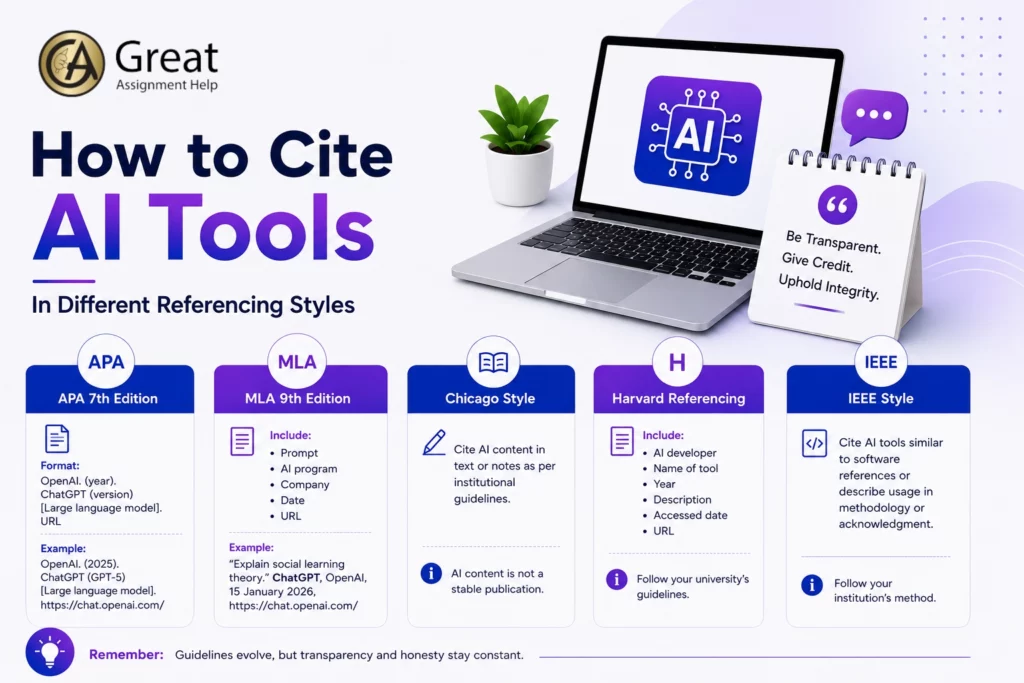
The use of AI-generated content in an academic paper is different from using traditional sources such as books or journal articles. Usually, AI systems provide dynamic responses based on prompts. Therefore, to acknowledge generative AI, citation styles have introduced specific guidelines. Even though the citation guidelines evolve, the principle of being transparent about AI help remains constant across universities.
Here is how you can cite AI tools using different formats
APA 7th Edition
The American Psychological Association (APA) provides guidelines for referencing ChatGPT and other generative AI tools. According to APA, AI tools should be cited instead of the human author.
The general citation format is:
OpenAI. (year). ChatGPT (version) [Large language model]. URL
For example:
OpenAI. (2025). ChatGPT (GPT-5) [Large language model]. https://chat.openai.com/
In case the conversation is not publicly available, APA advises including the AI interaction either in the text or in an appendix so that readers can retrieve the original discussion.
MLA 9th Edition
Modern Language Association (MLA) suggests noting down:
- The assignment/prompt (if applicable)
- The name of the AI program used
- Company name
- Date
- URL
For example:
“Explain social learning theory.” ChatGPT, OpenAI, 15 January 2026, https://chat.openai.com/
According to MLA, it is essential to highlight the usage of AI only when it contributes more to writing rather than proofreading.
Chicago Style
Generally, the Chicago Manual of Style suggests citing AI-generated content either within the text or notes as per institutional guidelines. The reason behind this is that, as AI-generated content does not constitute stable publications, the Chicago Manual of Style discourages the forced inclusion of AI-generated content in bibliography format.
Harvard Referencing
Various universities in Australia and the UK follow the Harvard referencing style. Some universities even have their own guidelines for AI citations. There are slight variations in the styles, but most include:
- AI developer
- Name of tool
- Year
- Description
- Accessed date
- URL
Harvard referencing has no central authority. Therefore, it is always advisable to refer to your university’s guidelines.
IEEE Style
IEEE is one of the most frequently used styles in engineering and computer science. Some universities recommend referencing the AI tool similar to software references. However, sometimes, you will have to describe the application of the AI in the methodology or acknowledgment sections.
University Policies Matter More than Style
Institutional policies are more significant than guidelines. For instance:
- One institution might allow the use of AI in brainstorming but prohibit the use of AI in writing paragraphs.
- Another institution may require an AI declaration.
- Some departments may require you to submit AI prompts alongside your work.
Therefore, before submitting your work, you should:
- Find out whether it is allowed to use AI
- Determine which types of AI usage are permitted
- Know whether disclosure is needed
- Identify which citation style your instructor prefers
Failure to comply with institutional rules may result in academic misconduct despite the proper citations.
A Simple Framework for Citing AI Tools Responsibly
If you want to use AI ethically and cite the assistance of AI properly in your academic work to meet your university expectations, then apply this five-step framework
Step 1: Check the AI Policy of your University
First, you should determine whether you are allowed to use ChatGPT, Gemini, Copilot, Claude, etc. for the completion of an assignment based on your school’s AI policy or assignment guidelines. Some instructors allow AI for brainstorming and proofreading. However, they do not allow AI-generated content in graded assignments.
Step 2: Record your use of AI
Next, maintain a simple log by including this information
- Names of AI tools
- Version (if you know)
- Date
- Prompt
- Reasons for using the AI
Having such details will make it easier for you to provide accurate references or declarations when asked.
Step 3: Verify every output
After that, verify facts, statistics, quotations, and references with reliable academic sources such as peer-reviewed journals, scholarly books, official reports, and publications. Never assume that content generated by AI is factually accurate.
Step 4: Rephrase the content
You should be the major contributor of your academic paper even if the support is provided by the AI. So, use your own mind and rephrase the ideas that the AI tools generate. At the same time, give references to scholarly resources.
Step 5: Cite AI tools appropriately
At last, reveal the AI help according to the required citation method or university policy. If your institution requires an AI declaration statement, then include it with your assignment.
Overall, this process will help you minimize plagiarism risks, and it also stands as clear proof of your honesty.
Example: Ethical AI Use in Assignment
Say, for example, that a psychology student is working on a paper about cognitive behavioral therapy. The student first turns to ChatGPT to get some inspiration for the essay format, perhaps to simplify the theory and present it in the form they want, before looking up a few recent peer-reviewed journal articles for evidence.
The student does not directly use AI-generated content. Rather:
- cross-checks every single source with peer-reviewed academic sources
- rephrases the information
- adds academic literature references
- follows university regulations to cite the AI tool used
The method above treats the AI as a help for study, not a way to bypass writing. It also highlights openness, genuineness, and conformity with the code of conduct.
Final Thoughts
Though the concept of learning has evolved due to the use of AI in higher education institutions, academic integrity remains unchanged. Thus, critical thinking, evidence analysis, and the creation of academic work in its own way are needed. Alternatively, you may stay away from plagiarism and uphold integrity by citing AI tools. AI referencing is an important academic practice and not merely a technical referencing.
On the other hand, in the case of ethical use of AI, it can boost your productivity, comprehension, and the writing process. But you should follow university policies, verify AI content, and disclose the use of AI whenever needed. In general, through the combined use of AI and correct referencing, it is possible to ensure the credibility needed for an academic paper. If it is difficult for you to write well-referenced academic papers, personalized assistance from the Great Assignment Help experts would be useful for you.
FAQs
1. Should I cite ChatGPT in academic writing?
Yes, you should cite ChatGPT and other generative AI tools in your academic work. But when you add citations, follow your instructor’s requirements and your institution’s AI policy.
2. Do I need to cite AI if I only use it for grammar correction?
Formal citation is not needed when you use an AI tool to correct spelling or grammar and not for content generation. However, some universities require the disclosure of AI support for grammar correction. So, check your institution’s AI policy.
3. Which citation styles include AI guidance?
APA 7th edition, MLA 9th edition, Chicago Manual of Style, and many Harvard referencing guides have published recommendations for acknowledging generative AI.
4. Can I trust AI-generated references?
No. Sometimes AI systems generate inaccurate or fabricated citations. Therefore, before including the AI-generated references in your assignment, verify references using library databases, publisher websites, or other reliable academic sources.
5. Is using AI considered plagiarism?
Simply using AI is not plagiarism. But presenting AI-generated content as your own work without proper acknowledgment is a violation of the academic integrity rules and regulations.