
Adding peer-reviewed sources will help to improve research quality, save time, and build stronger, evidence-based academic writing. So, to find peer-reviewed sources suitable for your study, you can use scholarly databases, targeted keywords, advanced search filters, and citation tracking.
Academic writing should be credible, relevant, and original. Mainly to increase the credibility of your work, it is essential to add supporting evidence for your study. So, sometimes your instructors will ask you to find at least 20 peer-reviewed sources before you begin working on your assignment. Initially, this might look like a tough task for you. But you may realize that you have spent several hours researching various databases only to find that most of the articles you have found are either old, irrelevant, or even not peer-reviewed at all. Furthermore, academic stress can increase when deadlines are so tight. Hence, it is important to quickly find high-quality academic sources for references.
Luckily, there are several easy and highly effective approaches to finding credible academic sources faster. If you know where to search, how to use advanced filters, and select the right keywords, then you can collect enough reliable evidence in less time. This, in turn, will also make your research process more organized.
If you are unsure how to find 20 peer-sources for academic writing quickly, then read this guide. No matter whether you are writing a research paper, dissertation, literature review, or essay, the tips suggested here will help you build a strong research base and improve your academic writing. Furthermore, we have discussed what mistakes to avoid and how experienced researchers usually find reliable sources.
What are Peer-Reviewed Sources and Why Do They Matter?
Peer-reviewed sources are scholarly articles that are reviewed by experts in the same field before being published. This process involves the examination of research methodologies, accuracy, uniqueness, and the findings of the study. But only research that meets high academic standards will be approved for publication.
Due to such thorough examination, peer-reviewed articles are treated as one of the most credible forms of academic evidence. This is why many US universities require students to use peer-reviewed sources in their academic papers. Moreover, these sources reflect critical thinking and provide credible support for arguments.
When compared to blogs, magazines, and other general sources, peer-reviewed journals provide:
- Higher credibility
- Verified methodology
- Accurate citations
- Expert evaluation
- Original research results
For example, when writing about artificial intelligence in healthcare, adding a peer-reviewed article from The Journal of Medical Internet Research will provide stronger academic support than an opinion article found through a general web search.
The Purdue Online Writing Lab (OWL) states that the use of scholarly and peer-reviewed sources will make work more academically credible and allow students to create better arguments.
Similarly, the Harvard Library recommends giving preference to peer-reviewed journals wherever instructors ask for scholarly evidence.
Moreover, these sources will also help to determine the research gaps. Furthermore, after reviewing numerous scholarly articles, you can compare various viewpoints, analyze research methods, and clearly comprehend recent academic discussions.
According to Dr. Emily Carter, Senior Academic Tutor from Great Assignment Help, “Good academic papers usually do not rely on only one great article. They are prepared by interconnecting several peer-reviewed sources that support, oppose, or develop each other.”
Knowing this concept will help you search the peer-reviewed journals in an effective manner and strengthen your academic writing.
How to Find 20 Peer-Reviewed Sources Quickly
Google is often the primary source of research used by many students in their search process. But using Google will give you hundreds or even thousands of results with mixed quality, and some of them might be outdated or not necessarily be helpful. So, try using academic databases, which are specifically designed to find reliable peer-reviewed sources more quickly.
Begin with Google Scholar
Google Scholar is one of the fastest places where you can start your investigation. This database includes millions of scholarly works produced by universities, publishers, and research institutions worldwide.
When you work with Google Scholar, instead of performing a search using vague keywords like “Educational”, make sure to use more specific phrases, such as “Online learning student engagement higher education systematic review”.
Usually, specific keywords produce more relevant and accurate results.
Utilize University Library Databases
Generally, universities provide access to high-quality research databases to their students free of charge. Those databases consist of credible scholarly articles in various disciplines.
Some of the most popular databases include
- JSTOR
- ScienceDirect
- ProQuest
- EBSCOhost
- SpringerLink
- Wiley Online Library
Most of these databases feature a Peer-Reviewed filter. Using that filter before searching for articles will help you get rid of non-scholarly materials immediately.
Apply Advanced Search Operators
If you want to enhance your search results, try using advanced search operators.
First, to search for an exact phrase, you should apply quotation marks, such as “climate change adaptation”. Then, you should combine your keywords using Boolean operators like AND, OR, and NOT. For instance, “Social media” AND Adolescent mental health
This technique will help you narrow down your search and locate studies relevant to your research area.
Search Using Review Articles
Review articles can also serve as a good source of information. They provide a summary of many research works done in the same area or topic before.
Since these review papers contain many citations, they can be a very useful tool to help you find several peer-reviewed publications in a very short time. So, they really are a great starting point for your research.
Explore Reference Lists
If you manage to get one high-quality article, then spend some time looking at its reference list.
Researchers used to cite the important and influential studies. Therefore, these references can lead to more valuable sources. This technique, also known as backward citation searching, is another effective way to broaden your research.
Use Citation Tracking
Google Scholar brings a “Cited By” option too. This feature lists more recent articles that have referenced the one you are currently reading.
This will help you discover the latest studies and, at the same time, efficiently organize your bibliography.
Filter by Publication Date
Most instructors prefer research sources published within the last five to ten years. So, always apply the publication date filter.
It not only discards outdated research but also helps you in identifying the latest and most relevant studies.
Save Sources Immediately
In the end, save your sources as soon as you retrieve them. This small practice will save you from looking for the same articles again.
Besides, you can manage your research with citation organizer tools like Zotero, Mendeley, and EndNote. These tools save PDFs, help you arrange your research, and can automatically generate citations in different referencing styles.
If you are wondering why to cite sources properly, read our guide on the importance of referencing in academic writing. It will explain to you why accurate referencing matters the most for creating quality and trustworthy academic papers.
Smart Search Strategies That Save Hours
Finding twenty high-quality sources is not about going through thousands of search results. Instead, it is about using the right search methods. Experienced researchers save time because they search in a smart and organized way.
Divide your topic into keywords
For example, if your assignment is on “remote work and employee productivity”, then instead of searching the whole topic again and again, split the topic into several small ideas like remote working, telecommuting, employee productivity, hybrid working, and working from home. Then, search each keyword or combine various terms. In this way, you can find more relevant research articles.
Use subject headings
Most academic databases arrange the articles by standard subject headings. Once you get one relevant article, check the subject headings given to it. Then, do a search using those same headings. This method usually helps you find many closely related papers that keyword searches don’t bring out.
Search multiple databases
There is not a single database that lists every academic journal. So, it is always a wise move to search across multiple databases. For a well-rounded search, you can use Google Scholar, JSTOR, ProQuest, EBSCO, or ScienceDirect. Accessing multiple databases will help you minimize the risk of bias and get a comprehensive and detailed literature review.
Check abstracts first
There is no need for you to download every article you come across. Just check the title, abstract, and keywords, so you can tell in a minute whether an article fits your topic or not. This simple routine saves you both time and energy.
Maintain a research tracker
As you gather sources, arrange them in a spreadsheet by including separate columns for Author, Year, Main Finding, Useful Quote, and Citation Saved. This format will help you stay organized and avoid re-downloading an article several times.
Verify peer review
Remember, not all articles with an academic look are really peer-reviewed. So, check the journal site, database filters, Ulrichsweb directory, and information from the university library before you refer to any source. In general, spending a few more minutes to verify your source will result in using legitimate and trustworthy research.
Balance classic and recent sources
A good literature review normally comprises both influential studies and the newest articles. Combining them both will demonstrate your knowledge of the topic’s history and your awareness of the current research.
For more help with writing a literature review, check out our guide on how to write an ideal literature review. It will explain to you how scholarly sources interconnect to form a thoroughly supported research base.
Common Mistakes Students Should Avoid When Searching Peer-Reviewed Sources
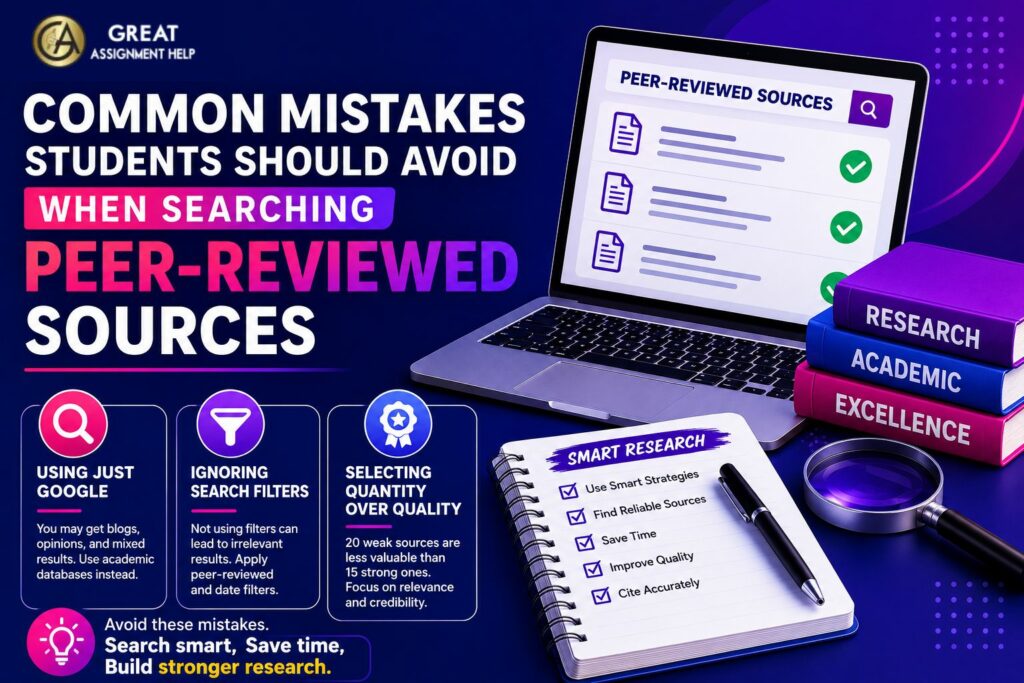
It can be quite frustrating to find 20 sources quickly if you make a few big mistakes. But actually, by learning what to do and what not to do, you will not only save yourself time but also get better research results.
Using just Google
A lot of students use only general search engines such as Google. But in most cases, these searches will generate results such as blogs, business sites, opinions, and scholarly works. So, always give priority to academic databases when searching for reliable sources.
Ignoring Search Filters
One of the biggest errors is not using the search filters available to you. Therefore, before you begin your search, make sure to select peer-reviewed, full-text, publication year, and subject area. These filters will help you find more relevant and reliable research quickly.
Selecting Quantity over Quality
Collecting more sources does not always lead to better research. In fact, 20 weak sources are often less valuable than 15 high-quality ones. Therefore, before including any article in your assignment, take time to evaluate its relevance, credibility, research design, and publication quality. This simple step helps you select stronger evidence, build more convincing arguments, and improve the overall quality of your research.
Depending on One Author
When preparing your academic paper, avoid depending on the work of only one researcher. Rather, add research papers from different authors. It will let you demonstrate that you have considered different perspectives and, as a result, gained a deeper understanding of the subject matter.
Forgetting Citation Details
The best practice is to write down the citation details the moment you save a source. This is because locating missing publication details will consume additional time and cause additional stress.
Overlooking Reference Management Software
Reference management software can really simplify the research process for you. Moreover, this saves a great deal of time, especially when your assignment needs APA, MLA, Chicago, or Harvard referencing styles.
A Simple 30-Minute Framework to Collect 20 Peer-Reviewed Sources
Here is a step-by-step approach that many students follow to collect 20 credible peer-reviewed sources within 30-minutes.
- Define the topic (3 minutes): Initially, jot down a concise research question so that you can stay focused on your work. For example, “How do social media influence adolescent mental health?”
- Generate keywords (5 minutes): Next, create 8-10 keyword pairs. While generating keywords, take different words and phrases that are associated with the topic.
- Search Google Scholar (7 minutes): After that, enter the search terms or keywords in Google Scholar and gather the top 8-10 most relevant peer-reviewed articles.
- Explore two library databases (10 minutes): Then, search two library databases. You can use advanced filters to find 8-10 extra sources.
- Expand using references (5 minutes): Finally, open reference lists and citation networks. It will allow you to find extra useful sources.
Example: Finding 20 Peer-Reviewed Sources for Psychology Assignment
For instance, when the topic for a psychology assignment is “sleep deprivation among college students”, then a fast search process might look like this
- Search Google Scholar:
- Sleep deprivation in college students
- University students’ sleep quality
- Filter:
- Since 2021
- Peer-reviewed
- English
- Next, save eight articles.
- Then, repeat the search in ProQuest and PsycINFO.
- After that, save another eight articles.
- Finally, use the references from two systematic reviews to locate four foundational studies.
Within just an hour, you will have more than twenty reliable scholarly sources. The sources will provide information on causes, effects, interventions, and research gaps. Moreover, this well-structured approach can be used in assignments on other disciplines, including nursing, business, education, engineering, psychology, and healthcare.
Wrapping Up
The process of locating 20 peer-reviewed sources will not necessarily take the whole weekend. Instead, use scholarly databases to save your time. Then, narrow down your search terms and add advanced filters. Lastly, explore citation networks. All these steps will enable you to gather high-quality research sources much faster than using web searches.
Always remember that academic success is not just about finding sources. You also need to evaluate, organize, and incorporate these sources into your writing. Usually, good research will lead to stronger arguments, clearer analysis, and more persuasive conclusions. So, do your research in advance whenever possible. At the same time, maintain a record of all the sources you use. Besides, use citation management tools for better organization.
If you need assistance with journal interpretation, research organization, or literature review development, rely on the experienced academic professionals at Great Assignment Help. They will guide you through any stage of the academic writing process. Thus, exploring reliable research methods now will allow you to save time later and produce more evidence-based assignments confidently.
FAQs
1. How do I know if my source is peer-reviewed?
Find out if the journal uses the peer review process. You can confirm this by looking at the journal website, checking the database details, or using a library directory.
2. Does Google Scholar only list peer-reviewed articles?
No, Google Scholar provides various types of scholarly works, including books, theses, conference papers, and other non-peer-reviewed material. However, it is always best to verify the publication before you begin to use.
3. How many peer-reviewed sources should I include in a research paper?
The number of sources to include in a research paper generally varies based on your assignment requirements. Most university research papers contain 10-20 scholarly articles, but dissertations probably require more scholarly sources.
4. What is the quickest database for finding peer-reviewed articles?
Google Scholar is the fastest database for finding peer-reviewed articles. Additionally, databases such as JSTOR, ProQuest, EBSCOhost, and ScienceDirect even offer advanced filtering options to make the search faster and deliver accurate results.