
This article has been reviewed and updated with current information, new examples, and the latest academic requirements for 2026
Learning how to write an ideal literature review will make your work easier. If you want to write a literature review, identify gaps, define your scope, and organize sources thematically or chronologically. Next, critically evaluate existing research, synthesize findings, and structure your review. Always make sure to use clear language and proper citation to engage your audience effectively.
If you are a student pursuing a bachelor’s, master’s, or doctoral degree program, then while preparing your thesis, dissertation, or research paper, you must add a literature review section to present an overview of already published works on the topic of your discussion. In case you wish to know in detail about what it means and how to write an ideal literature review, then continue reading this blog. For your convenience, here, we have shared everything about the literature review and its presentation steps.
How to Write a Literature Review That Actually Stands Out
Most students know the basics of a literature review: read sources, summarise them, arrange them in some order. But most literature reviews produced this way earn average marks at best. They read like a shopping list of summaries, not like a genuine intellectual engagement with a body of knowledge.
This guide focuses on what separates a mediocre literature review from a strong one — and gives you the specific writing techniques to get there.
The Biggest Mistake: Summarising Instead of Synthesising
Summarising means reporting what each source found.
Synthesising means comparing sources against each other, identifying patterns and contradictions, and building an argument about the state of knowledge.
Summarising (Weak)
Smith (2019) found that social media use was linked to increased anxiety in teenagers. Brown (2020) also found a connection between social media and anxiety. Jones (2021) studied a sample of 500 university students and found similar results.
Synthesising (Strong)
Three studies converge on the finding that social media use is associated with increased anxiety (Smith, 2019; Brown, 2020; Jones, 2021). However, their methods differ significantly: Smith used self-report questionnaires, Brown used clinical diagnostic criteria, and Jones employed a longitudinal design. The consistency of findings across different methodologies strengthens the association, though none of the studies establish causation — a limitation Jones acknowledges explicitly.
The difference is not just stylistic. The synthesised version does intellectual work. It builds an argument. It evaluates the strength of evidence. It points to a limitation. This is what a strong literature review does on every page.
Purpose of Writing a Literature Review
Perhaps, if you have enrolled in a post-graduation degree, it’s most vital to write a thesis depicting your perspective. Also, consider depicting the past researcher’s work on the subject, as it may add more credibility to your work.
Important Requirements
- Firstly, demonstrate your expertise and enthusiasm for the topic, because writing a Ph.D. thesis might be challenging. Moreover, you will have to think about writing a literature review to show how passionate you are about your subject.
- Secondly, think about teaching other people through your literature review because the supervisors might not be familiar with all of the ideas that were discussed. Even though the professor may be an expert in the subject, not all students will be aware of everything.
- Finally, create contexts because a thesis typically adds another perspective to an ongoing discussion. Also, you might have to give your readers a point of view, so you should be extra careful.
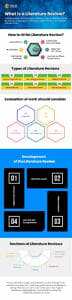
The Five Qualities of an Excellent Literature Review
1. It Is Organised by Ideas, Not by Sources
A weak literature review is organised author by author. A strong one is organised by theme, concept, or argument. The sources appear inside the ideas — not the other way around.
Weak Structure (Author-Centred):
- Paragraph 1: What Smith (2019) found
- Paragraph 2: What Brown (2020) found
- Paragraph 3: What Jones (2021) found
Strong Structure (Idea-Centred):
- Paragraph 1: The association between social media and anxiety — evidence and methods
- Paragraph 2: The role of content type as a moderating variable
- Paragraph 3: Methodological limitations across the field
2. It Evaluates, Not Just Describes
Every source you cite should be evaluated as well as described. Ask: What are the strengths and limitations of this study? What can we trust and what should we be cautious about?
Describing:
Radesky et al. (2015) conducted a longitudinal study of 2,400 families and found a link between early media exposure and attention difficulties at age 5.
Evaluating:
Radesky et al.’s (2015) longitudinal study of 2,400 families provides strong evidence for a link between early media exposure and attention difficulties, with the longitudinal design offering a methodological advantage over cross-sectional studies. However, the reliance on parent-reported data for both screen time and attention difficulties introduces potential shared-method bias.
3. It Uses Hedging Language Appropriately
Academic writing uses hedging — careful, qualified language — to reflect the genuine uncertainty of research. Strong literature reviews hedge accurately.
Over-Claiming:
Research proves that social media causes depression.
Under-Claiming:
Some research might possibly suggest a link.
Well-Hedged:
Converging evidence suggests a significant association between heavy social media use and depression, though causal direction remains difficult to establish from existing cross-sectional research.
Common hedging words and phrases:
- suggests, indicates, points to
- may, might, could
- tends to, appears to
- is associated with (rather than “causes”)
- in most studies, in the majority of cases
- to some extent, under certain conditions
4. It Builds Toward the Gap
Every section of a literature review should be doing two things at once: reporting what is known, and building the case for why something is still unknown or unanswered. The gap is the reason your own research exists.
At the end of each section, ask yourself: what has this group of studies left unanswered? That answer becomes the bridge to the next section — and eventually to your research question.
5. It Shows the Development of Ideas Over Time
Where it is relevant, a strong literature review notes how thinking about a topic has changed. This shows the reader that you understand the field as a living thing, not just a static collection of facts.
Example:
Early studies in this area (Festinger, 1954; Bandura, 1977) focused primarily on face-to-face social comparison. The rapid growth of social media from the mid-2000s prompted a second wave of research (Haferkamp & Krämer, 2011; Vogel et al., 2014) applying these frameworks to digital contexts, with largely consistent findings. More recent work has begun to interrogate the assumed directionality of these effects (Coyne et al., 2020; Odgers & Jensen, 2020), finding that the relationship may be more bidirectional and context-dependent than earlier research suggested.
This paragraph tells a story about how the field has developed. That is synthesis at its best.
How to Write Strong Transitions Between Sources
Transitions are where most literature reviews fall apart. Students move from source to source with no connection, producing a choppy, disconnected review.
Strong transitions do one of four things:
1. Show Agreement
- Similarly, …
- In line with these findings, …
- This view is supported by …
- Corroborating this, …
2. Show Contrast or Contradiction
- In contrast, …
- However, …
- These findings are challenged by …
- Conflicting evidence comes from …
- Not all researchers support this view. [Author] found that …
3. Show Development or Addition
- Building on this, …
- Extending this argument, …
- A later study by [Author] explored …
- This finding was replicated in a larger sample by …
4. Show the Gap
- However, what remains unclear is …
- What these studies do not address is …
- A notable gap in this literature is …
- Despite this convergence, no study has yet examined …
Sentence-Level Writing Techniques
Use Author-as-Subject Constructions Carefully
There are two ways to introduce a source:
Author prominent: Smith (2019) argues that…
Finding prominent: Social media use has been linked to increased anxiety (Smith, 2019).
Use author-prominent constructions when you want to draw attention to a specific researcher’s argument or perspective. Use finding-prominent constructions when the finding itself is what matters and the author is secondary. Over-using author-prominent constructions makes a literature review feel like a list of name-drops.
Vary your reporting verbs
Using only “found” and “showed” makes a literature review monotonous. More importantly, different verbs carry different levels of certainty and different types of claims:
| Verb | Use When |
|---|---|
| argues, contends, claims | The author is making a theoretical argument |
| found, reported, observed | Empirical results |
| suggests, indicates | Findings that are not conclusive |
| demonstrates, proves | Use sparingly — only for very strong evidence |
| challenges, questions, critiques | The source is pushing back on another claim |
| acknowledges, admits | The author is conceding a limitation |
| explores, examines, investigates | Describing the scope of a study |
Write in the Present Tense for Ongoing Knowledge
Academic convention in many disciplines is to write about research findings in the present tense, because knowledge is considered current and ongoing.
- Smith (2019) finds a correlation between…
(present tense — the finding still stands)
Use past tense only for historical events or for studies whose findings have since been superseded.
What Critical Analysis Looks Like in Practice
Critical analysis in a literature review does not mean criticising everything. It means evaluating the strength, reliability, and relevance of evidence — and being honest about what the evidence can and cannot tell us.
Questions to ask about every source you cite:
About the Method
- How was the sample selected? How large was it? Is it representative?
- Was the measurement tool validated?
- Was there a control group?
- Is this cross-sectional (one point in time) or longitudinal (over time)?
About the Findings
- How strong is the effect size? (Statistical significance is not the same as practical importance)
- Do other studies replicate this finding?
- Are there alternative explanations for the result?
About the Relevance
- Was this study conducted in a context similar to yours (country, age group, setting)?
- Was it published recently enough to reflect current conditions?
You do not need to ask all of these about every source. But regularly engaging with these questions moves your writing from description to analysis.
Before and After: Rewriting a Weak Literature Review Paragraph
Before (Weak — Summary Only)
Bandura (1977) introduced social learning theory. He argued that people learn through observation and imitation. Festinger (1954) developed social comparison theory. He found that people evaluate themselves by comparing themselves to others. These theories have been applied to social media research by many later researchers.
After (Strong — Synthesised and Evaluated)
The theoretical foundations for understanding social media’s psychological effects were established decades before the platforms themselves existed. Bandura’s (1977) social learning theory demonstrated that behaviour is acquired through observation and modelling — a mechanism that social media amplifies by making the lives of others continuously, curated, and visible. Festinger’s (1954) social comparison theory proposed that individuals evaluate their own abilities and opinions by comparing themselves to others, particularly when objective standards are unavailable. Both frameworks have proved remarkably durable in digital contexts: the mechanisms Bandura and Festinger described operate with greater frequency and reach on social media than in the face-to-face environments they originally studied. Their enduring relevance suggests that the psychological risks of social media are not entirely new phenomena but rather intensifications of existing human tendencies.
Conclusion
We hope you are now clear with the literature review preparation steps. Especially, by following the steps suggested above, you can come up with a detailed literature review. In case you are not confident enough to critically analyze and compose a literature review, call us immediately. We have literature assignment help experts on our team to assist you in developing a detailed literature review with proper evidence. Especially, with the guidance of our professionals, you can also improve your critical thinking and analytical abilities.
FAQs
Q: What is the difference between a literature review and a research paper?
A research paper presents original research you have conducted. A literature review surveys and synthesises existing research by others. A literature review is often a chapter within a research paper or dissertation, providing the context for your own study.
Q: How many sources does a literature review need?
This depends on your level and subject. An undergraduate literature review section might draw on 10–20 sources. A standalone master’s-level literature review might use 30–60. A doctoral review may cover 60–150+. Quality and relevance matter more than quantity.
Q: Do I have to include every source I read?
No. Include the sources that are most relevant, most credible, and most directly related to your topic and research question. Mentioning marginal sources to appear thorough weakens the review.
Q: Can I include sources I disagree with?
Yes — and you should. A literature review that only cites studies that support one position is selective and weak. Including conflicting evidence and explaining why shows critical thinking.
Q: How do I know when my literature review is long enough?
It is long enough when it has covered the main themes, identified the key debates and contradictions, evaluated the evidence, and made a clear case for the gap your research addresses. Word count is secondary to whether the review has done these things.