
This article has been reviewed and updated with current information, new examples, and the latest academic requirements for 2026
A good literature review not only provides a summary of various sources, but it also focuses on critically analyzing the evidence, making comparisons to identify gaps in the research area, and building an academic argument to demonstrate where current research stands and what deserves further study.
In the academic research process, literature review is one of the key steps that outlines existing scientific knowledge, analyzes discoveries made by scholars, compares different theories, and identifies research gaps in a particular field. Literature review is not just about reading several journals or scholarly articles and sharing a summary of sources relevant to the study topic. In addition, it provides a comprehensive overview of what researchers already know about a specific research question.
Generally, when preparing research papers, theses, or dissertations, you must add a literature review section in a well-structured manner to demonstrate your existing knowledge of the subject and build context for the study. So, to help you deal with this task, this guide explains how to write a literature review in simple steps. Specifically, it teaches how to choose and evaluate useful sources, how to identify common themes, develop a strong academic argument, and compose a clear conclusion. Furthermore, it shares the main types of literature reviews and practical tips for improving academic writing.
What is a Literature Review?
A literature review is a critical analysis and synthesis of scholarly studies conducted in relation to a certain topic, question, or academic field. It can either be an independent assignment or a section in research papers, theses, dissertations, or research proposals. The University of Utah Valley Writing Center describes a literature review as the collection and evaluation of scholarly works for the identification of patterns, debates, gaps, and areas that need further investigation.
Synthesis is one of the primary aspects of literature review. For example, let us consider a case where five researchers are examining the influence of social media on university studies. After research, one scholar discovers that excessive use of social media decreases study time. Another researcher finds out that social media may serve as a tool for peer learning. Yet another one states that the result depends on the way students use the social platforms. In case of a poor literature review, all these pieces of research will be discussed separately. But a good literature review would compare the outcomes from all these researchers and figure out why the results are different. Overall, this difference is essential for developing strong academic arguments.
Main Types of Literature Review
There are different types of literature review. So, when it comes to preparing a literature review, you should make sure to choose a type that matches your research purpose and assignment instructions. The following are some common forms of literature review
- Narrative review or traditional review: It is often included in essays, theses, or research papers. Typically, a narrative review provides a critical synthesis of existing literature on the subject matter.
- Systematic review: This type follows a well-defined process of searching and synthesizing research to answer a particular question posed.
- Scoping review: It is a literature review type that maps the research on a particular subject to identify what evidence already exists and where the gaps persist.
- Critical review: It not only describes but also critically analyzes the assumptions, methodology, limitations, and findings of previous studies.
- Integrative review: It synthesizes research conducted using different methods or approaches to provide a more comprehensive understanding of the topic.
- Meta-analysis: This type statistically synthesizes results from similar quantitative studies. Meta-analysis is typically used within the framework of a systematic review, but not vice versa.
Harvard Library states that one can use literature reviews as stand-alone essays or as part of scholarly writing pieces. Additionally, it points out that historiography is one of the discipline-specific types of literature reviews that examines how historians researched a certain topic over time.
Whenever it comes to choosing a literature review type, first, make sure to check your instructor’s requirements. For example, a 2,000-word undergraduate assignment will not require the same level of formality as a systematic review for publication.
Furthermore, when planning, develop a literature review outline because it can help you arrange sources around themes instead of listing them author by author.
How to Research and Organize Your Sources

You must start reviewing even before you write your first paragraph. Usually, the success of your final argumentation will highly depend on the way you search, select, and organize your evidence. These are the key steps involved in researching and organizing the sources of a literature review
1. Start with a focused research question
Do not start your work with a general topic like “artificial intelligence in education.” Try to turn it into a clear research question such as “What are the impacts of generative AI on students’ writing practices in universities?”
This focused question will help you know your boundaries and the sources you need and do not need.
2. Strategically conduct the search
Next, begin the search on the research question using scholarly databases, university library collections, Google Scholar, and subject databases. When you search, try using keyword combinations rather than asking the whole research question.
For a research topic regarding online learning, you can use search terms like:
- online learning AND student engagement
- virtual classrooms AND participation
- digital education AND motivation
- higher education AND online interaction
As advised by Great Assignment Help in their recent guide on how to find 20 peer-reviewed articles fast, you can use a combination of specific keywords with search filters, citation tracking, reference lists, and publication-date limits.
3. Assess the sources before inclusion
The search will help you find a list of academic sources relevant to the study topic. Don’t just include anything that looks like an academic article in your literature review. Rather, evaluate each resource for:
- Authority: Who is the author? Where was the article published?
- Relevance: Does it answer your research question?
- Method: Is the research methodology used appropriate and clearly described?
- Evidence: Do the results support the conclusions made?
- Limitation: What does the article not address?
Read for connections, not just information
When you read an academic source, ask
- Which researchers agree?
- Where do scholars disagree?
- Do different research methods produce varying results?
- Has the field of study evolved?
- Which theories appear repeatedly?
- What remains uncertain?
- What limitations appear across several studies?
Similarly, Purdue OWL suggests considering key debates, influential authors, evolution within the field, and research gaps when reading literature for advanced research.
You can easily handle this process by creating a simple evidence matrix that includes columns for author, year, research question, method, main finding, limitation, theme, and relevance to your argument.
Build the Academic Argument, Not a Source List
Moving from summary to synthesis of information is one of the biggest challenges involved in writing a literature review.
For example, a paragraph that says “Smith discovered X. Jones discovered Y. Brown discovered Z” may present accurate information, but it does not constitute an analytical paragraph. Instead, you have to demonstrate the connection between those discoveries.
According to the University of Illinois’ Writing for Inquiry and Research guide, synthesis is defined as the way one shows the connections between pieces of research. The guide suggests focusing on finding patterns, themes, contradictions, and gaps rather than viewing each source separately.
Useful Structure for a Paragraph
When you present a paragraph in a literature review, make sure to structure it by following this order
- Claim
- Evidence
- Comparison
- Analysis
- Link
Organize around ideas
You should organize your literature review using any of these three major structures:
- Thematic: In this type, sources are organized based on themes or ideas. This is usually the most effective structure as it helps in comparing sources easily.
- Chronological: This format deals with the organization of sources chronologically. It suits well if theoretical developments, policies, or discoveries matter.
- Methodological: It organizes sources based on the method used in conducting research (such as survey, experiment, interview, or case study).
If needed, you can also organize your work by combining these approaches. For instance, in a literature review, you may use themes as its main structure while briefly showing how each theme developed over time.
Structure every paragraph around a purpose
Usually, when composing a paragraph for a literature review, first, you should start with a topic sentence that informs the reader about what the paragraph is arguing. After that, you should add sources with information. Finally, you should explain your analytical insights on why that evidence is important.
Address disagreement instead of hiding it
Academic research doesn’t always result in agreement. If there are two reputable pieces of research offering different conclusions, such a contradiction is valuable. So, mention the reasons for disagreement in your literature review.
For instance, they might have worked with different groups of participants. Otherwise, there could be differences in the sample size, definitions, measurements, or theoretical background. Overall, a disagreement becomes a part of the analysis, rather than an issue you should hide.
In fact, that is how literature review works as an integral part of the academic discussion. It allows you to highlight not just what you know, but how you know it.
According to Dr. Jenifer Brown, Senior Academic Tutor at Great Assignment Help, “Good academic papers do not just depend on a single great article. They are written by connecting several peer-reviewed sources which support, contradict, and develop each other.” This idea perfectly illustrates the concept of synthesis.
If you want to understand more about the relationships between claims, evidence, counterarguments, and conclusions, read this guide on how to structure an academic argument.
A Simple Literature Review Framework
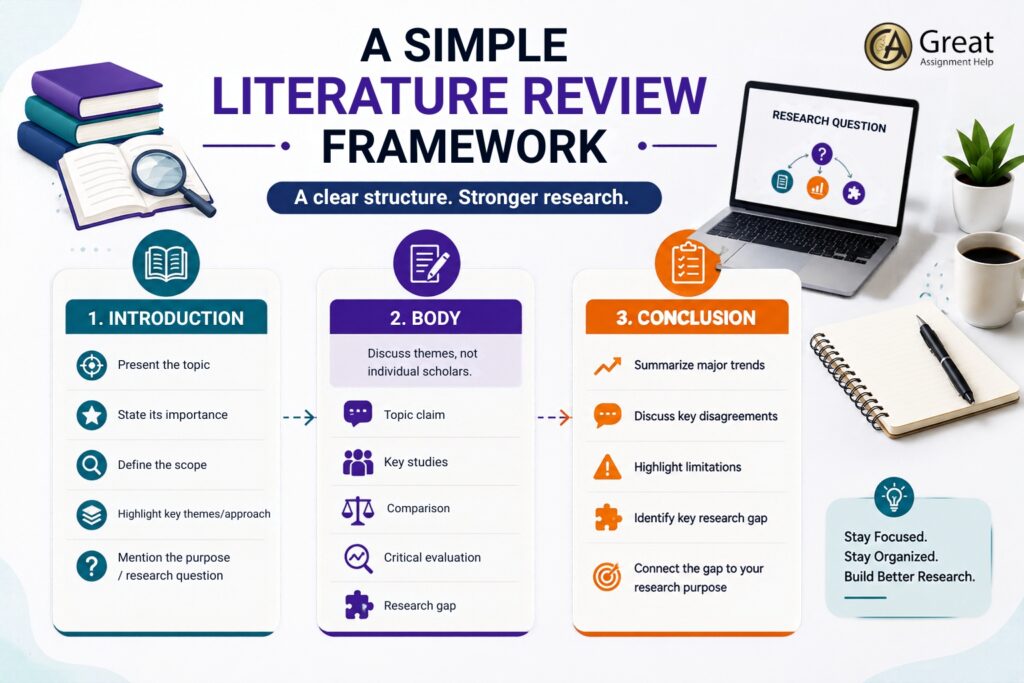
After conducting the research, follow a framework that will keep every part of a literature review linked back to the research question. Especially when you deal with a literature review in academic writing, adhere to a systematic approach to make your work comprehensible.
These are the key components you should include in your literature review
Introduction
It is the opening section where you have to briefly
- Present the topic
- State its importance
- Define the scope of the literature review
- Highlight the key themes or approach
- Mention the purpose/research question
Body
It is the core part of your literature review. When preparing this section, you should structure the discussion around three or four themes rather than individual scholars.
For each theme, you should include all these elements
- Topic claim
- Key studies
- Comparison
- Critical evaluation
- Research gap
Such an organization will provide a clear logical flow. Hence, for every section, you need to address a portion of the broader research question.
Conclusion
Do not just restate the previous sections. Instead:
- Summarize the major trends
- Discuss the main points of disagreement
- Highlight the limitations
- Present the most obvious research gap
- Connect this gap to the purpose of your research.
Literature Review Example: From Sources to Synthesis
Here is how to write a strong academic argument for a literature review when you have these three studies for an essay topic on “The impact of social media on the academic performance of university students”
- Research ‘A’ shows that extensive social media use is associated with reduced time spent studying.
- Study ‘B’ demonstrates that online discussion groups within social platforms may facilitate collaboration.
- Source ‘C’ indicates that the effect depends on the frequency and purposeful use of social media.
Instead of devoting a separate paragraph to each source, you will have to develop a thesis statement regarding the purpose and intensity of usage of social media.
Your thesis statement could be:
“Academic research does not provide clear evidence whether social media usage is good or bad for academic performance. It provides evidence of different outcomes depending on intensity, purpose, and usage patterns of social media.”
Therefore, the sources work together to support one conclusion. This is synthesis rather than summary.
Practical Tips for Writing Better Literature Reviews
Following these tips will help you increase the quality of your literature review
- Maintain a source tracker with details such as the author, year, method, finding, limitation, and theme.
- Use recent and foundational sources relevant to your research topic.
- Do not aim for a fixed number of sources; prioritize quality and relevance.
- Use more paraphrasing and synthesis than direct quotations.
- When connecting studies, use transition words like “however,” “similarly,” and “in contrast”
- Strengthen evidence and analysis, remove repetition, and improve links between paragraphs.
- Cite claims correctly and ensure all in-text citations appear in the reference list.
- Adapt your review to your field and follow your department’s guidelines.
Conclusion
Learning how to write a literature review will help you effectively participate in academic conversation. Rather than showing the number of articles you have read, you should demonstrate what the sources express, what they agree on, what gaps exist, and which questions remain unanswered.
First, you should formulate a clear research question. Next, you should search strategically, evaluate your sources carefully, and categorize the sources thematically. Finally, you should connect the evidence through comparison and analysis.
When all paragraphs are built according to the same logic, your literature review gains new meaning. Consequently, your literature review provides a basis for scientific, evidence-based research and academic writing. You may approach PhD experts at Great Assignment Help when it is challenging to compose a literature review relevant to a topic from your field of study.
FAQs
1. How many sources should a literature review have?
The quantity of sources that should be used in a literature review is not constant. The number varies depending on the type of assignment, academic level, discipline, topic, and the required word count. Rather than giving importance to the number, you should choose relevant and credible scholarly sources.
2. What should I avoid in a literature review?
You should avoid making a list or summarizing each source individually. Furthermore, you should not cite irrelevant or untrustworthy sources, depend too much on quotes, or fail to address conflicting views among researchers.
3. How can I find sources for literature review?
You can find sources by searching with focused keywords related to your research question on academic databases, university library collections, Google Scholar, and discipline-specific databases.
4. What is the difference between a literature review and a summary?
A summary describes what one particular source states, while a literature review combines several sources to compare, evaluate, and synthesize their findings. A strong literature review also identifies patterns, disagreements, limitations, and gaps in existing research.