
This article has been reviewed and updated with current information, new examples, and the latest academic requirements for 2026
APA 7 citation style uses author-date in-text citations and a matching reference list to credit sources accurately. Knowing how to cite sources such as books, journal articles with DOIs, reports, web pages, and theses in APA correctly by following formatting rules will help to maintain integrity in academic writing.
Citation guidelines usually contain commas, italics, initials, dates, and brackets, and hence it can be tough for you to understand them. But APA 7 citation style follows a logical system, and having a good comprehension of its basic pattern will make it easier for you to implement. The publication manual of the American Psychological Association (7th edition) is an official APA Style guide that includes citation format, references, formatting, ethical writing, and clear scholarly communication. If you are clueless about how to cite sources in APA referencing style, read this article and avoid common citation mistakes. Here, you will learn about citing sources within your writing, how to create a reference page and format common sources correctly, and how to use quotations and paraphrases in APA 7 citation style.
What is APA 7 Citation Style?
APA 7 is an author-date referencing style and formatting system developed by the American Psychological Association. It is widely used for citing works in fields such as psychology, education, nursing, social sciences, business, communication studies, and related disciplines. Typically, the APA 7 citation system connects in-text references to full reference list entries.
Why Does APA 7 Matter?
The process of referencing does not merely involve adhering to a certain format but rather provides information about the source of the evidence to your readers. Also, referencing gives credit to the original authors of the information and makes it easy for other people to access the sources of information you cited. Referencing, in addition, contributes towards academic integrity, builds credibility, and helps readers trace the sources used to support an argument. If you wish to understand why proper citation matters, read this article on the importance of referencing in academic writing.
The Basic APA 7 System
APA 7 Citation Style includes the use of two interrelated components:
- In-text citation: It is a brief citation placed within the sentence or at the end of it.
- Reference list: It is a list of complete publication information placed at the end of the academic paper or document.
For example,
Studies on student motivation have found that feedback may affect the level of engagement (Smith, 2024).
The reference list will then contain full bibliographic details of Smith’s work.
Both of these components should match each other. Consequently, all the citations mentioned in the paper’s text should have a matching reference-list entry. In addition, every reference-list entry should appear as a citation in the paper. Overall, APA citation guidelines highlight the clear connection between works cited in the text and the reference list.
APA 7 Student-paper Formatting
APA 7 citation style generally demands one-inch margins, double-spaced lines, page numbers, paragraph indentation, and an APA-approved font for a regular student paper. Moreover, student papers usually do not require a running head. But individual instructors can have their own specifications.
The common elements to include in a student title page are the paper title, the student’s name, the institutional affiliation, the course details, the instructor’s name, and the submission date. However, before you begin writing your academic paper, make sure to check your assignment instructions because some universities or professors may ask for a specific variation.
How to Cite Sources in APA 7
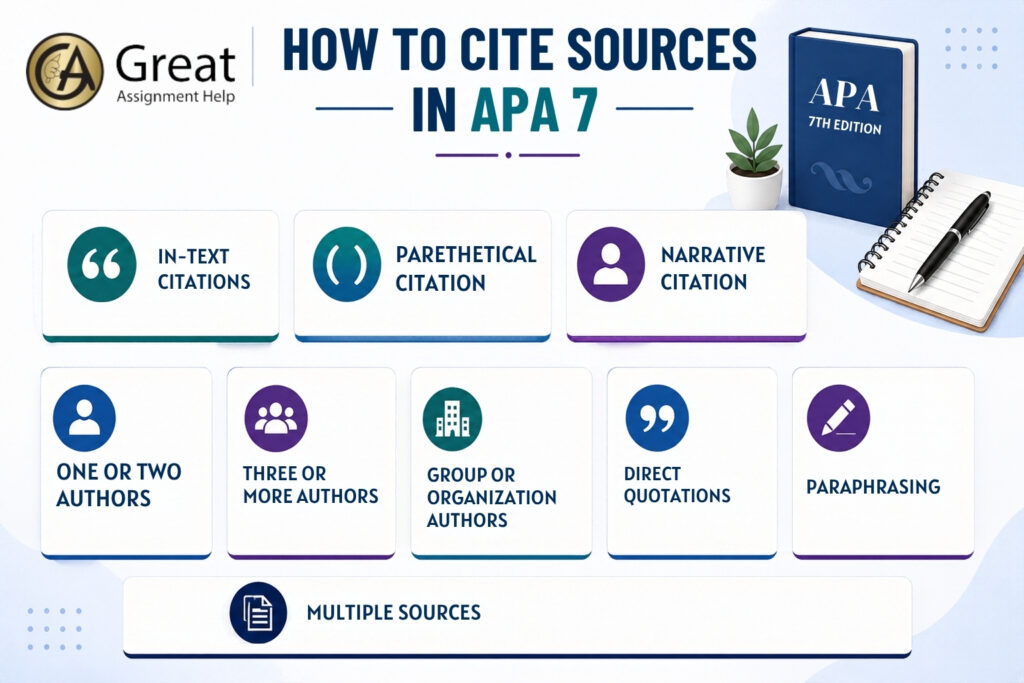
The simplest way to learn how to cite your sources is to start with in-text citations. Typically, in APA 7 referencing style, in-text citations consist of the author’s last name and year of publication.
Parenthetical Citation
For parenthetical citation in APA 7, you should put the citation inside the parentheses.
Example: Social media use can impact students’ academic experience (Johnson, 2023).
Narrative Citation
For narrative citation in APA 7, you should add the author’s name as part of the sentence.
Example: According to Johnson (2023), social media use can impact students’ academic experience.
One or Two Authors
If you want to add a citation for works with one or two authors in APA, then follow this format
One Author:
For one author, you have to use this citation format:
(Brown, 2022)
Two Authors:
For two authors, you have to include the surnames of both authors every time you cite their work as follows
(Brown & Lee, 2022)
In narrative citations, you should use ‘and’ like the one presented below
Brown and Lee (2022) obtained similar results.
Three or More Authors
If you want to add a citation for works with three or more authors in APA, then mention the surname of the first author followed by et al. from the first citation.
Example: (Garcia et al., 2024)
Purdue University’s APA 7 guidance supports this author-date approach. Furthermore, it explains the different treatment of narrative and parenthetical citations.
Group or Organization Authors
If an organization is the author of a document, then write down its name as follows:
(World Health Organization, 2024)
If the organization has an abbreviation that is familiar to many people, then introduce it before using the abbreviation in later citations like this
(World Health Organization [WHO], 2024)
After that, you can use this format
(WHO, 2024)
Direct Quotations
When you directly quote text from the source material without changing any word, you should provide the author’s name, year of publication, and page number like this
(Taylor, 2021, p. 45)
For multiple pages, use this format:
(Taylor, 2021, pp. 45–47)
If a quotation has 40 words or more, then you should format it as a block quotation instead of enclosing it in quotation marks. Moreover, APA 7 citation guidelines recommend that you provide another locator (section, figure, paragraph number, etc.) when no page number is available for the source.
Paraphrasing
A paraphrase is a restatement of another author’s ideas in your words. However, you need an in-text citation since you did not come up with the idea yourself.
Example:
Students generally show greater engagement where feedback is specific and actionable (Taylor, 2021).
It is not necessary to include page numbers in a paraphrase citation, but they are useful in locating certain parts of the text.
Multiple Sources
When you use various sources in support of one point, you should put all of them together in a single in-text citation as follows:
(Brown, 2020; Garcia, 2022; Lee et al., 2024)
According to the rule, you should arrange all sources alphabetically by the first author’s surname.
APA 7 Reference List: Rules and Formats
The reference list provides readers with all the information they require to locate the sources used in the research. It begins on a new page after the main text and is titled References. When writing a reference list in APA 7 citation style, you should bold and center the heading. Also, you should use double-spaced lines for the list and a hanging indent for entries.
Key Reference Page Rules
While writing reference pages, you should make sure to follow these formatting rules
- Begin the reference list on a fresh page
- Label the list as References
- Centrally align and make the heading bold
- Double-space the list entirely
- Arrange references alphabetically based on the first author’s surname
- Use a hanging indentation for each citation
- Include only sources cited in the paper, unless your instructor asks for a bibliography
- Use sentence case for titles of articles, books, reports, and web pages
- Italicize appropriate publication names, e.g., book names, journal names
- Provide a DOI number if present
- Present DOI and URL links as hyperlinks starting with https://
Both the University of Sydney and University of Portsmouth guidelines emphasize the author-date system and format rules for reference lists. They also point out that specific instructions from your academic department take precedence over any general formatting preferences.
Common APA 7 Reference Formats
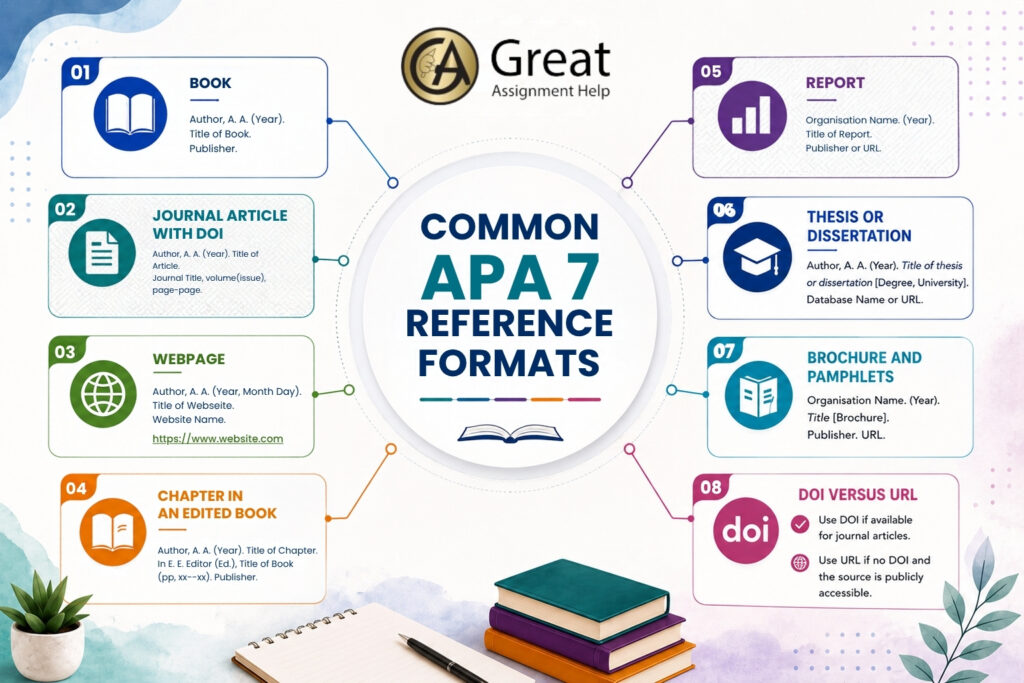
If you want to cite sources such as books, journal articles with DOIs, reports, web pages, and theses in your work according to the APA 7 referencing style correctly, then follow this format
Book
Author, A. A. (Year). Title of Book. Publisher.
Journal Article with DOI
Author, A. A. (Year). Title of Article. Journal Title, volume(issue), page – page. https://doi.org/xxxxx
Journal references typically feature the journal title, volume, issue where applicable, page range or article number, and DOI when available.
Webpage
Author, A. A. (Year, Month Day). Title of Webpage. Website Name. URL
If the webpage author and website name are the same organization, then you can omit the website name. When there is no date, you can use n.d.
Chapter in an Edited Book
Author, A. A. (Year). Title of Chapter. In E. E. Editor (Ed.), Title of Book (pp. xx–xx). Publisher.
Report
Organisation Name. (Year). Title of Report. Publisher or URL.
Thesis or Dissertation
APA 7 style has different rules for citing unpublished, published, or database theses/dissertations. For detailed examples, see how to cite a thesis or dissertation in APA format.
Brochure and Pamphlets
A brochure is another type of source that requires citations. Its reference usually contains the author or organization, year, title, bracketed term such as [Brochure], name of the publisher, if available, and URL if it is available on the Internet. For more examples, see how to cite a brochure in APA format.
DOI versus URL
If a journal article has a DOI, then you should use the DOI instead of a database URL. But if your online source lacks a DOI and is publicly accessible, then you can use a suitable URL. The University of Newcastle guidelines provide distinct patterns for journal articles with a DOI, journal articles without a DOI, and web articles in APA 7.
APA 7 Paper Format: A Simple Framework
APA 7 is not only about references. Instead, you can use it as a framework to present your academic work clearly.
Here is the typical structure of an academic paper
- Title page: Provide all required student paper information.
- Main text: Start writing the paper on a new page. Write the paper title in bold and in the centre at the top of the first text page. Then, proceed to writing the introduction.
- Headings: Organize longer papers using APA heading levels. Moreover, use them to show how ideas are interconnected.
- References: End the paper with an alphabetized reference list.
- Tables, figures, and appendices: Use them if they are required. Additionally, format them in accordance with APA guidelines.
If you need guidance on formatting essays in APA, refer to the article on how to format an essay in APA.
When you add citations, following this simple workflow may help you avoid numerous APA formatting mistakes
- Conduct Research
- Gather sources’ details
- Draft the academic paper
- Add citations
- Build References
- Proofread
- Edit
Do not wait till the last minute to insert citations into your paper. Rather, while taking notes, note down the author name, year of publication, title, DOI/URL, and page numbers of useful quotations. This will make the final stage of referencing easier.
APA 7 Citation Style Example: From Evidence to Reference
Consider the scenario in which you are writing about the impact of feedback on students’ learning process.
If you paraphrase information from a scholarly article in your assignment, then an APA 7 in-text citation should be as follows:
Provision of timely and specific feedback may assist students in identifying weak areas in their work (Morgan & Patel, 2024).
Your reference list would look like:
Morgan, R. T., & Patel, S. K. (2024). Feedback quality and student engagement in higher education. Journal of Educational Research, 18(2), 115–129. https://doi.org/10.xxxx/xxxxx
Here, in this APA 7 citation style example, the authors’ names appear in the text. At the same time, the reference list gives the complete source details.
This connection is the core part of the APA 7 citation style, where seeing an in-text citation in the assignment or academic paper enables the reader to look for the source in the references list.
APA 7 and AI: What Students Should Know
AI has brought another dimension to the problems of citation and integrity. Thus, you need to consult your course and institution policies before using generative AI. The updated APA 7 guidelines of RMIT mention that APA guidance on citing AI-generated content was updated. Also, they mention that educators can have their own requirements.
The safest way would be to be transparent. If you are allowed to use AI tools for academic writing, stick to the required procedure for citing the AI tool and its output. Do not assume that each instance of using AI requires the same treatment as using a traditional journal article.
Dr. Michael Carter, senior tutor of Great Assignment Help, states, “The most successful students use ChatGPT as an improvement tool rather than as a replacement for the brain itself.”
If you need practical tips for AI citations, refer to the article on how to cite AI tools in academic work to maintain integrity.
Conclusion
It is much easier to master APA 7 citation style when you stop thinking about each reference as an independent problem. First, determine the source type. Next, find the author and date, then use the appropriate APA format, and cross-check the in-text citation with the reference entry. Specifically, pay attention to author names, dates, italics, punctuation, DOIs, URLs, quotations, and hanging indents. Most importantly, follow your professor’s or university’s requirements if they contradict the general APA requirements. You can use this guide as a checklist. In case you face an unusual source, turn to the official APA manual or approach Great Assignment Help for citation support. Our professionals assist with all types of citations and referencing styles involved in academic writing.
FAQs
1. What is APA7 Citation Style?
The APA 7 citation style is a type of author-date citation style developed by the American Psychological Association. It requires brief in-text citations within your work and complete citations in a reference list at the end of the paper. It is widely used in education, psychology, and social sciences.
2. How do I cite a source in APA 7 format?
For the majority of in-text citations, you should include the author’s surname and the year of publication of the cited work. Then, you should include all the source details in the reference list.
3. Do APA 7 citations require page numbers?
Page numbers are necessary if you use direct quotations from a paginated source. Normally, they are not needed for paraphrases.
4. What is the difference between an APA citation and an APA reference?
APA citations are short mentions of your sources within the text, while APA references include all details of the source in the reference list at the end of the paper.
5. Does APA 7 require a running head for student papers?
No. APA 7 citation style does not require running heads in student papers. But individual instructors or educational institutions may provide different requirements.