
A strong academic essay structure includes an introduction, body, and conclusion. Typically, a well-organized essay contains a focused thesis, logical paragraphs, credible evidence, analysis, transitions, counterarguments, and a purposeful conclusion relevant to the topic of discussion.
A well-written academic essay is not just a combination of various facts organized into paragraphs. Rather, it should be a logical answer to some issue, problem, or question. If your essay’s structure is weak, it can be hard for readers to understand your research process. However, an essay with a logical structure will help readers to easily comprehend your ideas and trace connections between facts and arguments. So, you need to follow a standard academic essay structure.
In case you are unsure how to format your academic essay, read this guide. Here, you will learn all about structuring an academic essay. Specifically, you will get to know about academic essays, their types, and the framework for writing well-organized essays of different word limits.
What are Academic Essays and Their Types?
Academic essays are specialized forms of formal writing. These essays are meant to investigate a topic, explain an issue, examine evidence, or make an argument. When compared to informal writing, academic essays must have a clear purpose, good organization, and supporting evidence. Usually, the actual tone and writing style of academic essays vary depending on the subject and assignment requirements shared by the instructors.
The first step in the essay writing process involves the identification of the task to perform in your academic paper. Therefore, you should carefully read the essay questions before you begin writing. According to George Mason University’s Writing Center, you need to pay special attention to certain instructions like analyze, compare, evaluate, discuss, explain, and argue in your essay question. Each of these words will help you figure out what type of response your assignment requires.
Some common academic essay types include
- Argumentative essay: This essay type clearly states a position and provides evidence for it while taking other viewpoints into account as well.
- Persuasive essay: It is similar to an argumentative essay, but it uses emotions to convince the readers.
- Analytical essay: This essay breaks a topic, text, event, or issue down into smaller parts and examines the relationships between them.
- Cause and Effect essay: This form of writing explores the reasons behind the occurrence of certain events and their outcomes.
- Expository essay: This essay explains the subject in detail by providing relevant information rather than trying to persuade the audience.
- Compare-and-contrast essay: This type of essay examines similarities, differences, or both between two subjects and explains their importance.
- Critical essay: It critically analyzes a source, a theory, a text, or an idea by using evidence and logical judgment.
- Reflective essay: This essay relates an experience to the author’s perception and learning process despite the lack of focus on argumentation.
- Narrative essay: It tells a true or imagined story, which is normally written in a first-person perspective to relate an experience or lesson learned from life.
- Research-based essay: It uses multiple academic sources to develop an analysis, explanation, or argument.
Such categories can overlap, as well. For instance, a research essay can be both analytical and argumentative. The argumentative essay, in turn, can include research information supporting its thesis.
Typically, an academic essay structure consists of three major parts, namely introduction, body, and conclusion. However, this doesn’t imply that any essay should necessarily consist of exactly five paragraphs. According to the Harvard College Writing Center, instead of following a fixed pattern, the number of paragraphs in an essay should depend on the number of points necessary for elaboration of the argument.
Hence, consider the common five-paragraph essay as a useful starting framework, not a strict rule. For example, a 500-word essay might require two body paragraphs. On the other hand, a 2,500-word college essay may need eight or even more paragraphs to properly convey its ideas. If you struggle to compose a well-organized essay under time pressure, read this guide on how to write answers to essay questions in an exam.
How to Build an Essay Introduction, Body, and Conclusion
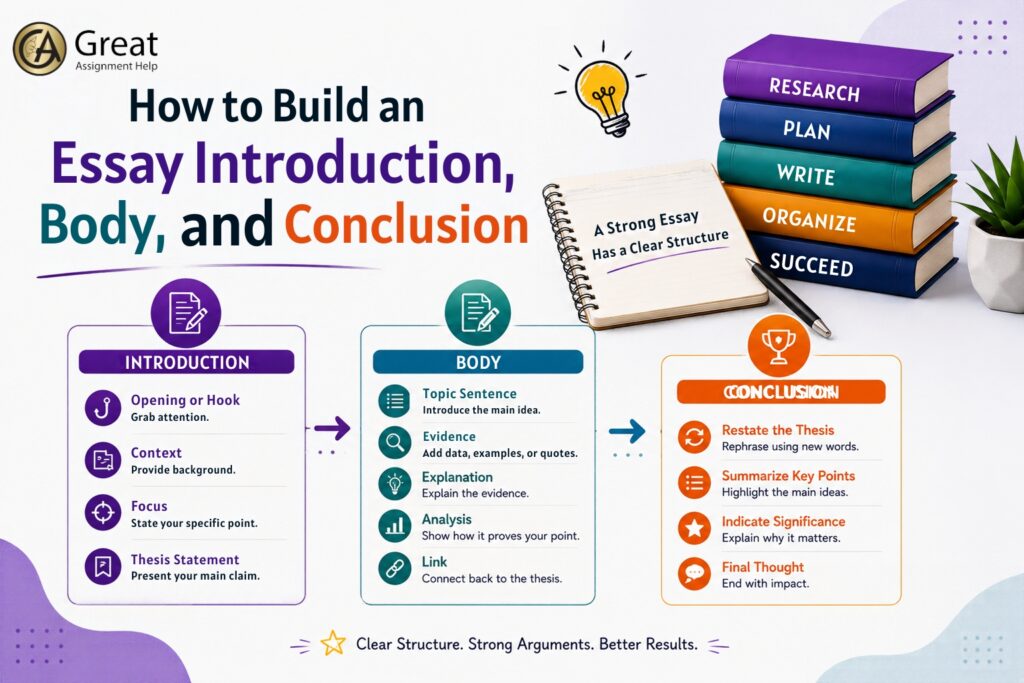
An introduction is the opening section where you should provide the basic information that your audience needs to understand your essay. A good introduction usually includes four components:
- Opening or hook: It is an appropriate statement, question, fact, observation, or quotation that will introduce the main issue.
- Context: It is a brief explanation of the background of the problem or topic that will improve your readers’ comprehension.
- Focus: It is a clear statement of the particular question, issue, or point of view that the essay will address.
- Thesis statement: It is the main statement or claim that the rest of the essay will aim to prove.
The Harvard College Writing Center says that the most effective introduction usually introduces a question or a problem analytically, explains its importance, and states the thesis as an answer to it. However, it also adds that not all academic disciplines require an attention-grabbing opening or hook. If you want to try different opening styles, get to know about the essay hook examples or learn how to start an essay with a quote.
The thesis is your essay’s anchor
The thesis statement is the central idea or argument of your essay. It informs readers what your essay will discuss and what position you will take. Thus, your thesis statement should be specific, debatable, and match the allocated word limit. According to Harvard University’s Writing Center, an effective thesis statement should represent a claim that is arguable and can be supported by evidence and analysis, but not only describe the topic.
For example,
Weak Thesis Statement: “Social media has transformed education”.
A Strong Thesis Statement: “Even though social media can aid collaborative learning, its excessive use can decrease concentration and academic engagement of the students”.
This stronger thesis statement gives the essay a clear point to explore. Also, it indicates the possible body sections, such as benefits, limitations, concentration, and academic engagement. Learn how to write a thesis statement that holds up.
Remember, your thesis statement can be used for creating an essay outline. According to Harvard University, first you should break the thesis statement into main arguments to prove. After that, you need to identify the evidence and arguments to support each claim. This idea is also well explained by Dr. Jenifer Mitchell, a Senior Academic Tutor at Great Assignment Help. She states, “The best thesis statements do not simply state what the topic is.”
The body develops the argument
There must be a purpose in each body paragraph you write. A good body paragraph of an essay should include the following
- Topic Sentence
- Evidence
- Explanation
- Analysis
- Link
The topic sentence is a statement that introduces the main idea of the paragraph and its connection with the thesis statement. After writing a topic sentence, you should add relevant evidence to prove your idea. But just listing evidence is not enough; you need to explain what this evidence means, why it is relevant, and how it helps prove your point.
For example,
Topic Sentence: Online education makes higher education more accessible to students who cannot attend on-campus classes.
Evidence: Provide data from a study or an institution about participation or access to higher education.
Analysis: Interpret the data, state its significance, and note any potential drawbacks.
Link: Relate the finding to the overall argument about flexibility in education.
Never let the sources dominate your body paragraph. Use them to prove your ideas and to explain the meaning of the evidence in your own words. Make sure your analysis explains why the evidence is relevant and important.
For further guidance on using evidence and giving proper credit to sources, read this article on how to cite sources in an essay.
Conclusion brings the argument together
Conclusion is a summary of your paper. It should not be a repetition of what was mentioned in the introduction of your essay. In fact, you need to refer to your thesis statement again and prove its validity by summarizing the major points of your essay.
Here is how you should structure the conclusion
- Restate the thesis
- Summarize the key points
- Indicate significance
- Provide a final thought
Start by restating your thesis using new words and sentences. After that, summarize the most important ideas from the body of your essay. Further, give an explanation for the importance of these facts or explain why the topic is significant. Finally, finish your essay with a concluding thought which will leave readers with the impression of completeness.
Try not to introduce any new facts or arguments into your conclusion. You should prove only what was stated previously in your essay.
If you are asked to write assignments of a minimum word count, gain insights from this article on how to write a short essay.
How to Organize Evidence, Arguments, and Paragraph Flow
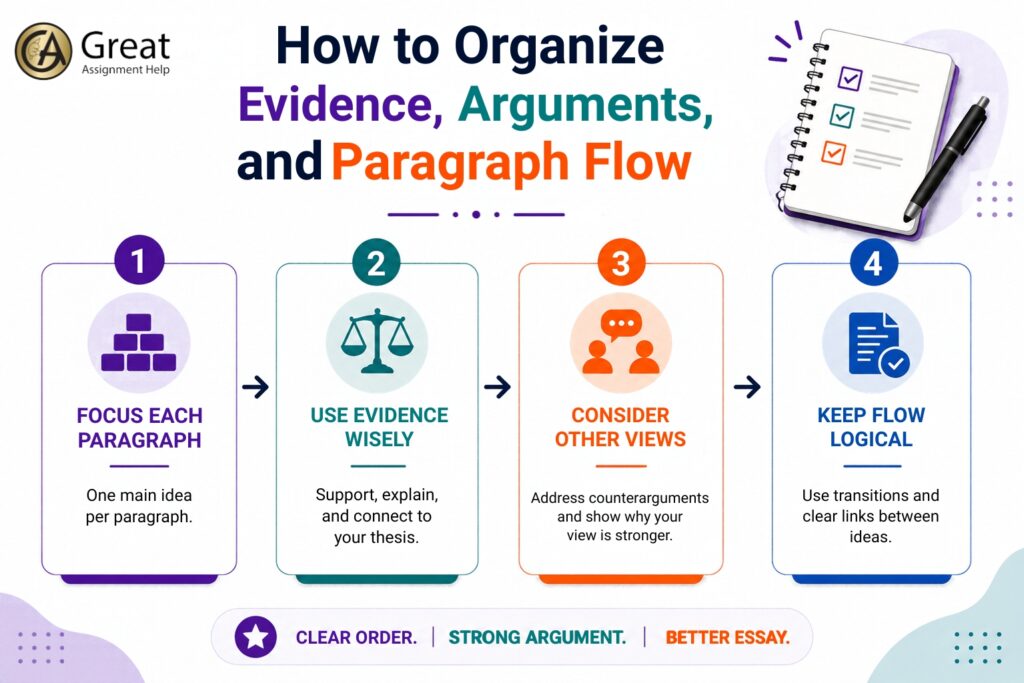
When the thesis statement is ready, you need to figure out how to arrange your thoughts so that one point follows another most logically. Good organization may help you create a convincing essay, but bad organization may confuse even the best ideas.
Start by creating a list of all the points that you will be discussing in the paper. Then try to arrange them in a logical order. There are different ways of organizing your points. But still, there is no standard pattern that works for all types of essays. The best order depends on your essay question, topic, and the way you wish to develop your arguments.
Use paragraphs as building blocks
Generally, a paragraph needs to concentrate on only one issue at a time. For example, if a paragraph starts by talking about students’ motivation and then shifts the attention to the financing of universities, and later to artificial intelligence, it may be trying to address too many points.
Harvard’s body-paragraph guidance notes state that each paragraph should be focused on one idea. It further recommends that a new body paragraph should begin each time there is a shift to a different idea, point, or example.
However, all body paragraphs must have good connections between themselves. Generally, transitions will help you establish the connections between your ideas. Some common transition words for essays, such as however, similarly, therefore, in contrast, and more importantly, indicate addition, contrast, cause, effect, or emphasis, respectively.
Balance evidence and analysis
One common problem in academic writing is using too much summary instead of enough analysis. This can make your paragraph feel more like a report of what others have said than your own academic discussion.
Assume that you paraphrase three sentences of the ideas proposed by some researcher but provide only one sentence describing the significance of these ideas. In such a situation, the dependence of your paragraph on the source is likely to be high because of insufficient analysis.
Rather, use evidence to prove your reasoning:
- Claim: Formulate the statement clearly.
- Evidence: Support the claim with credible evidence.
- Interpretation: Explain what the evidence means.
- Evaluation: Analyze the quality, relevance, possible effects, or limitations of the evidence.
- Connection: Relate to the thesis statement.
Include counterarguments when appropriate
Your argumentative essay gets even better when you discuss a reasonable opposing viewpoint. Generally, demonstrating another side of the story will help you make your argument more valid.
If you are unsure how to write a counterargument, then follow this structure
- Add opposing argument
- Share reasons for the opposition
- Include your opinions
- Present evidence
- Explain why your position remains strong
Counterarguments do not imply any negation of the opposite view, but rather demonstrate your awareness of the various aspects of the problem. Moreover, it allows you to elaborate why your position is more reasonable. Harvard’s Writing Center recommends considering reasonable counterarguments and showing why your argument is better than others.
Proper paragraph organization, evidence-based academic arguments, accurate citations, and appropriate transitions are important in academic writing. For more guidance on organizing an argument in an essay, read this guide on structuring an academic argument.
A Practical Academic Essay Framework You Can Reuse
When you have a flexible academic essay structure, then planning becomes much easier. Here is a systematic essay writing process you can follow
- Understand the assignment prompt: First, determine the essay topic, word count, restrictions, required sources, and other guidance. Make sure to underline these key points for easy reference.
- Formulate an analytical question: Afterwards, formulate an assignment question that requires more than just a factual response. How and why questions usually help in analyzing things.
- Conduct selective research: Then, collect relevant and credible sources. You can use scholarly books, peer-reviewed journals, university resources, government publications, and other credible sources related to your essay topic for research.
- Formulate a thesis statement: Develop a possible answer to your analytical question. Use it as a working thesis so that you can modify and improve it later on when researching.
- Create an essay outline: Finally, organize the main elements of your essay. This includes the introduction, claims, evidence, analysis, counterarguments if any, and the conclusion.
Before you begin writing your essay, sketch an outline. It will help you present all the key points in an organized manner without omitting any. Here is what your academic essay outline should include
- Introduction: Hook or opening, Background information on the essay topic, Research problem/ question, Thesis statement
- Body Paragraph 1: Main claim, Evidence, Analysis, Connection to thesis
- Body Paragraph 2: Main claim, Evidence, Analysis, Connection to previous point
- Body Paragraph 3: Main claim, Evidence, Analysis, Implication
- Counterargument: Alternative position, Evidence/reasoning, Response or qualification
- Conclusion: Restate the thesis, Synthesize the main findings, Explain significance, End with a meaningful final point
Wrapping Up
A strong academic essay structure is essential for presenting your ideas clearly. First, read and comprehend the essay prompt, determine the type of essay you have to write, create a focused thesis, and prepare an outline. Next, compose body paragraphs with clear claims, reliable evidence, explanation, and analysis. Use transition words and counterarguments where necessary. Remember that the structure you follow must help you with your reasoning, rather than dictate how every essay should look. Finally, edit the essay to meet your university’s writing and referencing guidelines.
If you need expert essay help, approach Great Assignment Help. We have well-qualified and skilled essay writers in our team to assist you in submitting well-structured academic papers as per the requirements and citation style recommended by your university.
FAQs
-
Where to include a thesis statement in an academic essay?
A thesis statement would be mostly placed at the end of the introductory part of the academic essay. However, its placement varies depending on the subject area and assignment guidelines.
-
How many paragraphs should be there in an academic essay?
There is no fixed number of paragraphs to include in an academic essay. Usually, it varies based on the word count, complexity of the argument, and number of points that need to be developed. The majority of universities expect students to follow the 5-paragraph academic essay structure.
-
Is a hook necessary in an academic essay?
No, it is not necessary at all. For an engaging introduction, you can use a hook relevant to the topic. But Harvard states that it is good to start an introduction with context, a problem/question, and a thesis, and highlights that hooks aren’t necessary in academic writing in any discipline.
-
Do I have to include headings in an academic essay?
It all depends on your assignment guidelines. Usually, for shorter essays, headings are not necessary. But for longer essays, you can use headings to improve readability.