
This article has been reviewed and updated with current information, new examples, and the latest academic requirements for 2026
Ending your writing on a strong note is important. Generally, conclusion starters can help you effectively wrap up your ideas in a conclusion. But when you use the right phrases as a conclusion starter, you can leave a lasting impression on your readers and make your final thoughts memorable.
A conclusion shows that you are wrapping up a paragraph or the whole piece of your writing. In general, a good conclusion can change the perspectives of the readers when they approach the end of your work. To make your work more impactful, first, you should understand the right way to write your conclusion. Basically, by using appropriate conclusion starters, valid summary points, and strong closing sentences, you can make your conclusion more persuasive. If you have no idea about how to compose a conclusion using the ideal conclusion starters, then continue reading this blog post.
What is a Conclusion?
A conclusion is the final paragraph of a piece of writing that indicates to the readers that they are at the end. It is one of the important sections that is mainly written to summarize the content of the entire essay or research paper.
Note that the conclusion you write would be considered good only if it gives a clear picture of your entire work by highlighting the major points and evidence supporting your arguments. Also, it should help your readers to remember the strengths of your work. In case you write a blog post, your conclusion section should be powerful enough to motivate the readers to leave their comments or subscribe to your account.
Usually, when it comes to writing an academic paper, many writers will fail to include a conclusion paragraph. If you close your essay in a hurry-burry without a concluding paragraph, then chances are there for your readers to easily forget the points you have discussed in your writing. So, to let your key points get stored in your reader’s mind, write a strong conclusion paragraph.
At times, your target readers may regret reading your work if your concluding statement is poor. Therefore, whenever you compose your conclusion, make sure to follow the necessary tips and steps for writing a good conclusion.
How to Write a Strong Conclusion Paragraph
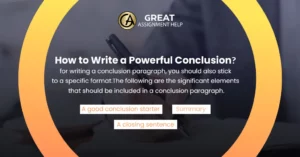
Generally, to write a research paper or essay, a standard format should be followed. Likewise, for writing a conclusion paragraph, you should also stick to a specific format.
The following are the significant elements that should be included in a conclusion paragraph.
- A good conclusion starter
- Summary
- A closing sentence
If you want to come up with a good conclusion, then this is what you should do.
- Firstly, begin writing your conclusion paragraph with a perfect conclusion starter. A conclusion sentence starter is a word or phrase that gives a sense of closure to the readers.
- After including that, summarize all the major points that you have discussed in the introduction and body of your work.
- Finally, end the paragraph with a closing sentence. Your closing sentence can be a call to action, suggestions, quotes, or any other impressive final words.
Tips for Writing an Engaging Conclusion
Listed below are a few key tips you should remember while crafting the concluding paragraph.
- Never introduce a new idea that was not discussed in the introduction and body paragraphs.
- Don’t highlight less important points in the conclusion paragraph.
- Always emphasize only the major points or ideas that you would like to share with your readers.
- Your conclusion statement should be memorable, highly influential, and leave an impression on the minds of your readers.
- To create an impact on the minds of your readers, always provide some valid suggestions in your conclusion section.
- To engage with your audience, ask thought-provoking questions, a call to action, or a warning relevant to the main theme of your academic paper.
What are Conclusion Starters?
A word or phrase in the opening sentence of a concluding paragraph is referred to as a conclusion starter. It is a kind of transition word or phrase that mostly acts as a link between the body paragraphs and the conclusion section. Often, it is used to inform the readers that they are at the end of the writing.
In the English language, there are numerous conclusion sentence starters available. According to your type of academic writing, you can select any apt conclusion sentence starter. In general, the conclusion starter words will be the same for argumentative essays, narrative essays, compare and contrast essays, and descriptive essays, but the conclusion sentence will be different.
Characteristics of the Best Conclusion Starters
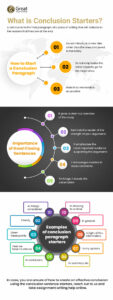
Remember, the conclusion starter that you use in your concluding paragraph should possess the following characteristics.
- Make use of only a few words to introduce the starting sentence of the conclusion paragraph.
- Ensure to notify the audience that you are approaching the end of your work.
- Inform the audience that there is nothing new that they will find in the conclusion section.
- Create expectations among the readers that they are reaching the end of their work.
List of Conclusion Starter Words and Phrases
In this section, we have suggested some amazing conclusion starter ideas that you can use in your speeches, essays, and research papers. Just take a look!
Simple Conclusion Starters for Essays and Speeches
When writing an essay and delivering a speech, it is important to hint to the readers and listeners that they are at the closing part. So, for this purpose, any simple conclusion starters can be used. These are some basic conclusion starters to be used for essays and speeches.
- Lastly
- Therefore
- Hence
- Finally
- Thus
- As expressed
- In general
- In conclusion
- For this reason
- all things considered
- I feel we have no choice but to conclude
- Upon considering all the facts
- Upon exploring the situation from various perspectives
- Frankly speaking
Good Conclusion Starters Ideas
Are you looking for a catchy conclusion starter to use in your dissertation? If yes, then make use of the list recommended here. In the list, we have included a collection of some impressive conclusion starter phrases.
- Clearly
- Given these points
- All aspects considered
- I think there is no option but to conclude
- In drawing to the closure
- Nevertheless
- Overall
- Now that we know
- Ultimately
- To sum up
- In my opinion
- Generally
- The logical conclusion seems to be
- With all these in mind
- Considering the perspective of
- There is nothing else we can conclude but
- When faced with the question of
- On exploring the situation from different angles, it can be concluded
- Thus, it can be restarted
- On considering the different facts presented in this work
Conclusion Starters for Research Papers
While you compose your research paper, you must make sure to start the final paragraph with a perfect conclusion starter. In case you are clueless about what conclusion starter sentences to use in your research paper, explore the list suggested below and pick any conclusion starter that suits your paper.
- As expected, the results signify
- Due to the result
- Since the data indicate
- Based on the evidence presented
- As per the data, it can be indicated
- In light of these findings
- The data reveals
- The significant revelations made by the study
- To assume from the data
- The result of this research showcases
- Unexpectedly, the data revealed
- What the study reveals is
- While further research is required
- On reviewing these findings, it can be stated
- As per the final analysis
- In the context of the concept
- From the above-determined results, it seems
- While further research is competent
Conclusion Starters for Less Formal Papers
Sometimes you might be asked to write academic papers or personal essays in a less formal or friendlier tone. In such instances, you may use any conclusion starter words that are not so professional. Listed below are some conclusion starter ideas that you may take into account while crafting less formal papers.
- As I observe things
- After all has been told and done
- At the end of the day
- In a nutshell
- From my perspective
- No one could have assumed that
- To make a long story short
- As the time comes to wrap up
- To reach the core of the heart.
- On the whole
- In simple language
- beyond a shadow of a doubt
- What it boils down to
- without all the mumbo-jumbo
- to plainly state the facts
- When all is said and done
Effective Conclusion Starters
Do you need impactful conclusion starter ideas for your thesis? If yes, then look at the list presented below. In the list, we have added certain effective conclusion starters that you may consider for writing a strong conclusion paragraph.
- As a final point
- Hence, I have come to the conclusion
- The study concluded
- In effect
- To wrap it up
- After all the discussion
- Looking back
- In the future
- You should now consider
- The summative conclusion is that
- For the above-discussed reasons
- For the majority of the part
- Towards this end
- Last but not least
- Without any doubt
- I agree that
- Now is the time to
- From my viewpoint
- To review
- I hope by now you have understood that
- Altogether
- As mentioned above
Engaging Conclusion Starter Words
Instead of using simple conclusion starter phrases, it is recommended to use a catchy conclusion starter to grab the attention of the readers. The following are some engaging conclusion starter sentences that you may use in the final paragraph of your article.
- It is my conviction that
- I look forward to
- The final take is that
- It is worth re-examining
- It is my sincere belief that
- I would like to say, finally
- My verdict is that
- Meanwhile
- Instead of
- That is why I think
- As expressed
- To end it up
- On the contrary
- So, finally, it can be stated
- Henceforth
- To Summarize
- In the final analysis
- As expressed
- In a word
- According to the core issue
Conclusion Starters Examples
Since some students have no idea how to begin their conclusion, for their convenience, here we have shared a list of some good conclusion starter examples. If you require a captivating conclusion starter word or phrase, then from the list, pick any phrase relevant to your essay and compose the last paragraph.
- Thus, it would be worth
- Thereby, attention should be given to
- Indeed
- Nevertheless
- One can conclude that
- Given these points
- In reaching a close
- In light of this data
- Keeping all this in mind
- What else can we conclude but this
- On considering all these facts
- When faced with the question
- On considering this condition from multiple approaches.
- With results like this, it seems
- This is evidenced by
- Based on the findings of
- Significant inference
- As per re-examining
- With regards to
- In the same way
The Bottom Line
The conclusion starters generally indicate to the readers that they are at the end of the article they are reading. In specific, when writing an essay, dissertation, or any academic article, adding an appropriate conclusion starter at the end of the conclusion paragraph will give a good reading experience to the readers. From the list suggested above, you can choose any conclusion starter relevant to your paper and frame a powerful conclusion. In case you struggle to write an impactful conclusion paragraph with the necessary call-to-action, approach the finest assignment helpers in our team for assistance.