
This article has been reviewed and updated with current information, new examples, and the latest academic requirements for 2026
Advanced machine learning techniques help engineering students solve complex assignments by enabling predictive modeling, pattern recognition, and intelligent decision-making. Some popular machine learning tactics include neural networks, SVMs, ensemble learning, clustering, dimensionality reduction, reinforcement learning, and time series analysis.
Machine learning is an integral part of modern engineering education. In today’s world, almost every industry uses data-driven technologies. Hence, engineering students are expected to know how machine learning algorithms work. In most engineering assignments on machine learning, students are asked to create predictive models, analyze the data, and apply machine learning algorithms to solve the problems. Generally, working on advanced machine learning techniques requires strong fundamental knowledge of the subject and high analytical and programming abilities. Therefore, it can be challenging for students to do assignments. However, by learning complex machine learning strategies, students can achieve better accuracy in their assignments. In this blog, we have discussed the advanced machine learning tactics such as neural networks, SVM, clustering, dimensionality reduction, etc.
Basics of Machine Learning in Engineering Assignments
Before exploring techniques, it is necessary to understand the fundamental machine learning concepts in engineering coursework. Machine learning is a field of computer programming that trains algorithms to identify patterns in data and make predictions or decisions, without explicit programming. In engineering assignments, students are likely to come across these three types of machine learning
Supervised Learning: In supervised learning, models learn from labeled data. Examples of supervised learning include regression and classification problems, such as predicting energy consumption or detecting faults in machines.
Unsupervised Learning: It uses unlabeled data for learning. It helps in the discovery of patterns or structures within the available datasets.
Reinforcement Learning: It is a type of learning where the model learns by interacting with the environment and receiving rewards or penalties for its actions.
Usually, assignments that involve the implementation of machine learning algorithms need knowledge of programming skills in languages like Python or R, along with libraries like TensorFlow, Scikit-learn, and PyTorch. If it is challenging to execute the techniques or understand the design of algorithms, coding, and data analysis techniques, students can take machine learning assignment help from experts online.
Top Machine Learning Techniques for Engineering Assignments
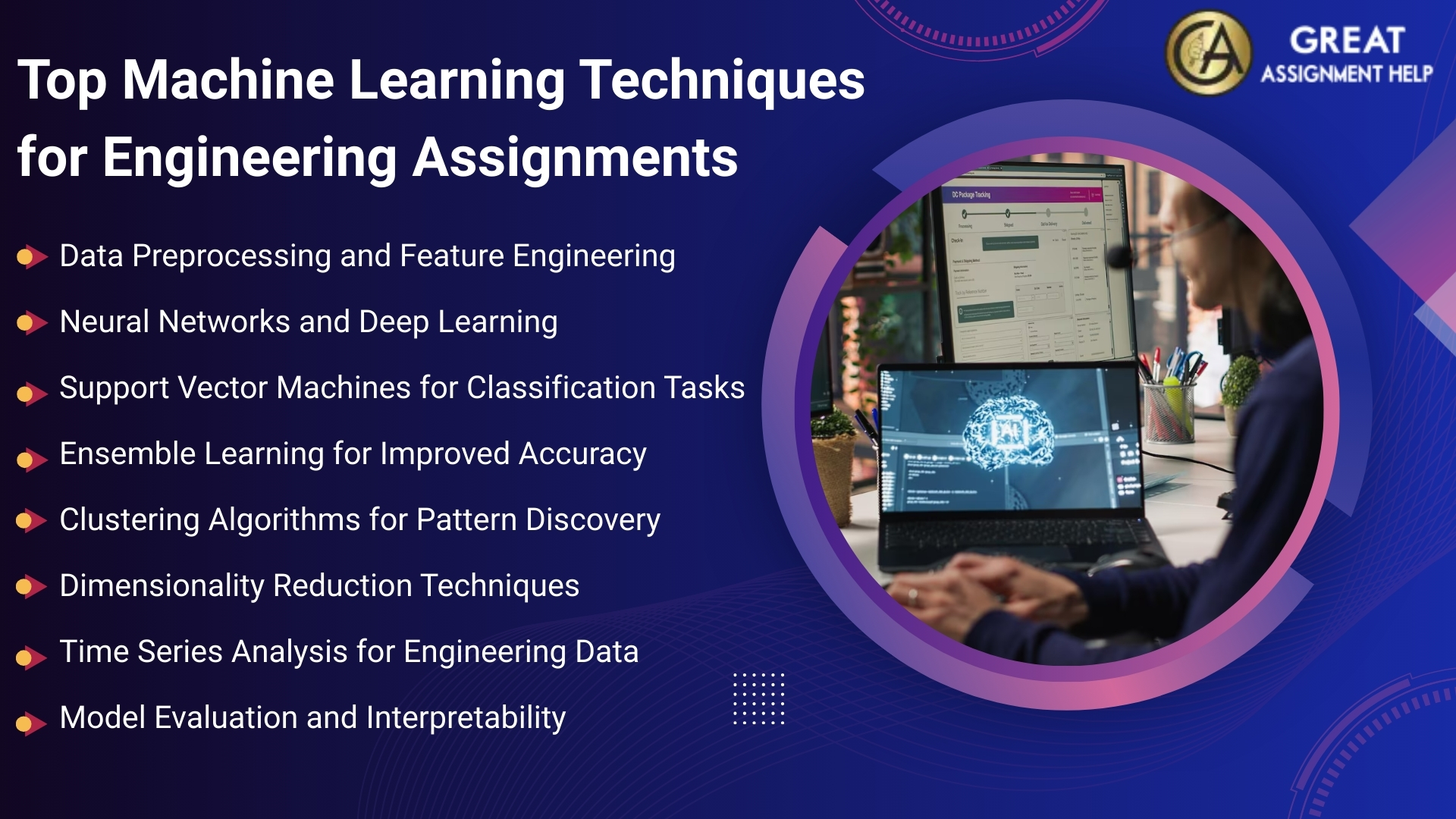
Here, let us explore the advanced machine learning techniques students should be aware of to do engineering assignments
Data Preprocessing and Feature Engineering
One of the most important steps in any machine learning project is the preprocessing of the data. Most raw data contains errors, missing values, or inconsistencies that can impact the performance of the machine learning model. Therefore, the preprocessing step is essential to clean and prepare the data.
Data Preprocessing involves the removal of duplicate values, handling errors, normalizing or scaling the data, and converting the categorical variables into numerical formats.
Furthermore, feature engineering is another important step that helps in the creation of important variables that improve the prediction of the machine learning model. By working on these techniques, the engineering students can ensure that their machine learning models function with the best possible data. This, in turn, leads to more reliable predictions and better outcomes.
Neural Networks and Deep Learning
Neural networks are one of the most powerful machine learning techniques used in engineering assignments. Typically, neural networks are inspired by the human brain, and they are composed of layers of interconnected nodes that process the data and learn patterns.
Moreover, deep learning is a subset of neural networks that comprises various hidden layers for handling complex data. These models play a key role in image recognition, speech processing, and natural language processing, among other applications.
Students undertaking engineering courses often rely on frameworks such as TensorFlow and PyTorchto build and train these models. However, deep learning also needs a good comprehension of optimization techniques, activation functions, and backpropagation for the models to operate effectively.
Support Vector Machines for Classification Tasks
Support Vector Machines (SVMs) are usually utilized for classification and regression analysis tasks in engineering assignments. They operate by identifying the best boundary that divides the data from different classes.
This method is useful for handling high-dimensional data sets and complex classification problems. SVMs are often applied in fault detection, image classification, pattern recognition, and bioinformatics.
Therefore, students working on SVM projects must get to know about the kernel functions, margin optimization, and how to tune the model properly for accurate results.
Ensemble Learning for Improved Accuracy
Ensemble learning is an advanced machine learning technique that helps make accurate predictions using a combination of models. Instead of relying on a single model, it merges several models to enhance reliability and reduce errors.
Random Forest, Gradient Boosting, and Bagging are some of the most commonly used ensemble learning models. These models are extremely helpful for solving engineering assignments that involve prediction models or complex data sets.
While working on machine learning models, engineering students face difficulties in implementing different models and their results. In such cases, they can seek engineering assignment help from subject experts available online.
Clustering Algorithms for Pattern Discovery
The clustering algorithm is one of the most important tools used in the process of performing unsupervised learning in engineering projects. It groups similar data points without the use of labeled data.
K-Means, Hierarchical, and DBSCAN are some popular clustering algorithms. These techniques can be used to conduct network traffic analysis, segment customers, and detect anomalies.
In general, to successfully use the clustering algorithm in engineering assignments, the student needs to know how to measure the similarity between the data points and the number of clusters.
Dimensionality Reduction Techniques
Engineering datasets usually have a large number of features. So, it might be challenging to process machine learning models. However, dimensionality reduction techniques simplify the datasets by reducing the number of features and retaining the essential information.
Principal Component Analysis (PCA), Linear Discriminant Analysis (LDA), and t-SNE are some popular dimensionality reduction techniques that can improve the performance of machine learning models, reduce the cost of computation, and improve data visualization.
In addition, dimensionality reduction is essential for handling high-dimensional datasets, such as image data or sensor readings, which are common in engineering assignments.
Time Series Analysis for Engineering Data
Most engineering applications involve time-dependent data, such as sensor readings, equipment monitoring, or financial trends. Hence, by using time series analysis, students can study the sequential data, predict future values, and make forecasts using historical data trends.
The models used for time series analysis include ARIMA models, seasonal decomposition techniques, and Long Short-Term Memory (LSTM) models. These models are often applied in predictive maintenance, demand forecasting, and environmental monitoring.
Also, time series analysis involves appropriate data preprocessing, along with model evaluation, to ensure accurate and reliable predictions in engineering assignments.
Model Evaluation and Interpretability
After building a machine learning model, it is important to evaluate its performance to ensure accuracy and reliability. Based on the problem they are solving, engineering students can use different evaluation metrics, such as accuracy, precision, recall, F1 score, mean squared error, and confusion matrix.
In addition, cross-validation techniques are useful for checking how well a model performs on unseen data. Model interpretability is also crucial. Tools like feature importance analysis, SHAP values, and LIME help explain how models make predictions.
Conclusion
Mastering advanced machine learning techniques will make engineering students confident in solving complex assignments. Usually, by applying methods like neural networks, SVMs, ensemble learning, and reinforcement learning, alongside proper data preprocessing and model evaluation, students can enhance accuracy, gain practical skills, and prepare for successful careers in AI and data-driven engineering. If it is challenging to interpret a complex model or evaluate results, students can take assignment help from machine learning experts on our team. They will provide guidance to enhance subject comprehension and submit accurate assignments on time.
FAQs
What are the advanced machine learning techniques I can use in engineering assignments?
In your engineering assignments, you can use advanced machine learning techniques such as neural networks, SVM, ensemble learning, clustering, dimensionality reduction, reinforcement learning, and time series analysis. These techniques will help you solve complex engineering problems through data-driven models.
Why is data preprocessing important in machine learning assignments?
Data preprocessing is important because it will keep data clean and organized. Also, it will improve the accuracy of machine learning models by handling missing data, reducing noise, and transforming data into an appropriate format for analysis.
How can engineering students improve their machine learning assignments?
Students can improve their assignments by learning the fundamental algorithms, applying feature engineering, tuning parameters, measuring performance, and accurately interpreting results.