
If you want to write an effective precis, focus on the main ideas, keep the original tone, stay objective, and organize your points logically. Also, make sure to use concise language to create a well-structured precis that communicates information clearly and accurately.
Are you struggling to turn a long text into something short and clear? If so, then learning how to write a precis will help you. A precis is a brief and well-organized version of a longer passage that keeps the main ideas and tone of the original without adding unnecessary words. In case you are interested in understanding precise writing, read this blog. For your better understanding, here we have explained what a precis is, its basic format, and how it differs from a summary and an abstract. Additionally, we have presented the tips and steps for writing a strong precis. Follow them all to improve your precise writing skills.
Definition of a Precis
The word ‘precis’ comes from French and means precise or cut short. It shows that the text will give a clear and brief overview of another piece of writing. In general, a precis sums up the main ideas and key points the author wants to share. Moreover, it gives the reader a basic understanding of the author’s viewpoint and how the author reached that conclusion. Especially when writing a precis, it is important to make sure the summary matches the original text accurately.
How a Precis Differs from a Summary and an Abstract
A precis, an abstract, and a summary all shorten a longer text, but each one has a different purpose. A precis is a short version of an argument that keeps the tone and structure of the original. It focuses only on the main ideas, and is usually about one-third the length of the original. In contrast, a summary explains the main points in your own words and gives a general overview, with its length depending on the original text. Meanwhile, an abstract is a brief overview of a scholarly or technical work that highlights the key findings and conclusions. It is typically around 200 words and follows a set format to help readers quickly understand the work.
Steps for Writing a Precis
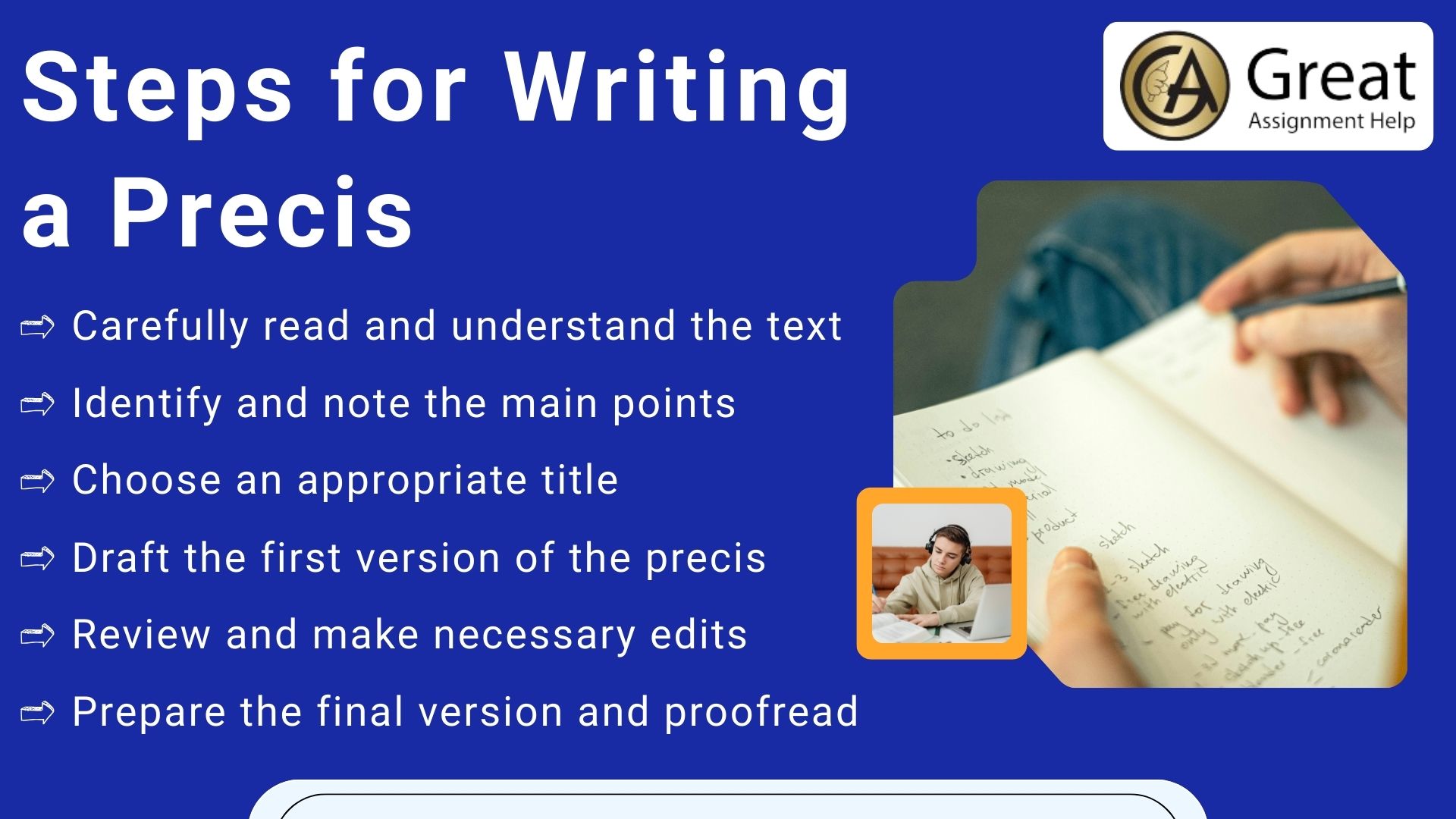
Initially, precise writing will appear tough, but it becomes easier if you follow these simple steps.
Carefully read and understand the text
Read the original passage carefully, even more than once if needed, to understand the main idea, tone, and the author’s purpose. When you read the text, identify the main arguments, the thesis, and the supporting evidence, and set aside minor details or examples. This will help you focus on what is most important for your precis.
Identify and note the main points
As you read, write down the main ideas and important information in your own words. Specifically, focus on what matters most in the original text. When taking notes, summarize each section of the text in one or two sentences to make sure you include all the key points.
Choose an appropriate title
Next, find a clear and easy-to-understand title. But make sure the title reflects the main idea of the article. For example, you could use something like “Summary of the Article.”
Draft the first version of the precis
After you have selected a title, use the notes you made to write your first draft in a clear and organized way for each section. When you prepare the draft, follow the same order as the original article to keep your paragraphs coherent. Make sure you write objectively in the present tense, avoid personal opinions, and use the third person. Most importantly, keep your draft about one-third the length of the original text and focus on facts, not feelings.
Review and make necessary edits
Once you prepare the draft, review it to make sure it is clear and covers all the main ideas. When reviewing, specifically, check for grammar, punctuation, and spelling mistakes. Also, simplify your language where possible and avoid repeating the same phrases to keep your writing clean and easy to read.
Prepare the final version and proofread
Finally, compare your precis with the original text to make sure it is accurate and includes all the important points. Additionally, make any final changes and ensure your final version follows the required format, including font and layout.
By following these steps, you can come up with an effective precis. In case you still face any difficulties with precise writing, take Assignment Writing Services offered by skilled academic professionals. They will assist you in preparing a good precis.
Standard Format of a Precis
When you write the first draft of your precis, make sure to follow this standard format
Title: Write your title as “Precis of [Author’s Name]’s [Name of Work/Article].”
Font: Use size 12.
Spacing: Use double spacing.
Margins: Keep at least 1-inch margins on all sides.
Name and Pledge: Place your name and pledge at the end of the precis.
Direct Quotes: Avoid using direct quotes unless necessary. If you do, put them in quotation marks and add the page number, e.g., (p.35).
Do’s and Don’ts of Precis Writing
Whenever you write a precis, follow the guidelines listed below to make your work appear strong, clear, and effective. Otherwise, you can use Essay Writing Services offered by experts for help with writing a great precis.
Do’s
- Keep your own voice, but stick to the original message.
- Focus on the main ideas and key points.
- Stay objective and neutral in your writing.
- Follow the original logical order for clarity.
- Write clearly and concisely using simple language.
Don’ts
- Do not add your personal opinions or observations.
- Avoid including all the minor details or examples.
- Do not change the order of points randomly.
- Avoid making your writing wordy or unclear.
- Do not use complicated or confusing language.
Additional Tips for Writing a Good Precis
When you write a precis, it is important to make sure your work is clear, accurate, and faithful to the original text. No matter whether it is a rhetorical precis or a regular one, your precis writing should include these five key qualities:
- Keep your writing concise. Use short, simple, and easy-to-follow language so that everyone can understand your precis.
- Be objective. Focus only on the main ideas and key points from the original text, without adding extra examples or repeating information.
- Maintain coherency. Include only the facts, ideas, and evidence from the original text. Also, avoid adding personal opinions or criticism.
- Ensure clarity. Make sure the précis you create accurately reflects the content and meaning of the original work and maintains the same tone as the author.
- Check for correctness. Include all the necessary information to convey the original argument or position fully. Summarize only what is in the text while keeping the author’s message complete.
Wrapping Up
Precise Writing is an important skill that helps you present ideas clearly and briefly without exaggeration. Simply by following this guide, you can develop an excellent precis. However, when you write a precis, it can be challenging for you to keep the original tone and style of the author. In such situations, you can approach us for the best Assignment Help services. Our team consists of well-qualified and experienced academic writers to assist you in quickly and efficiently creating a precise.
FAQs
1. What should be the length of a precis?
A precis is usually about one-third the length of the original text, but this can vary. Especially when you write a precis, you should focus on the main ideas and avoid unnecessary details or wordiness.
2. What are the precis writing rules?
First, read and understand the original text carefully, then note the main points and create a rough draft using simple and clear language, and lastly write the final precis including all the key ideas.
3. What should I not include in a precis?
In a precis, you should avoid including your personal opinions, critiques, or any outside information. Also, you should never ask questions and use only what is in the original text.