Revising your own academic writing is not just about correcting grammar. Before the submission of your academic paper, you need to review your thesis statement, structure, evidence, organization of paragraphs, language, referencing, and formatting in different passes. This will help you submit error-free papers worthy of top grades.
Usually, first-draft writing may seem like finishing an academic assignment, but for the most part, it is the starting point of useful work. Your academic paper may not appear perfect in the very first attempt. Once you finish writing, you may have to reorganize your ideas, need a strong explanation for your evidence, or require a logical connection between paragraphs. This is why revising is necessary. When you revise, you will get a chance to step away from your draft and view it from a reader’s perspective.
Revising your own academic writing is different from simply correcting grammar. While revising, you will have to deal with these bigger questions: Does the paper answer the assignment question? Is the thesis statement clear? Are all sections relevant to the main argument? Does the evidence relate to the topic, and is it analyzed enough? According to Purdue OWL, you should revise your paper separately from proofreading by using different passes.
If you have no idea about the best possible ways to revise your own academic writing, use the checklist and follow the expert tips suggested in this blog.
How to Revise Your Own Academic Writing
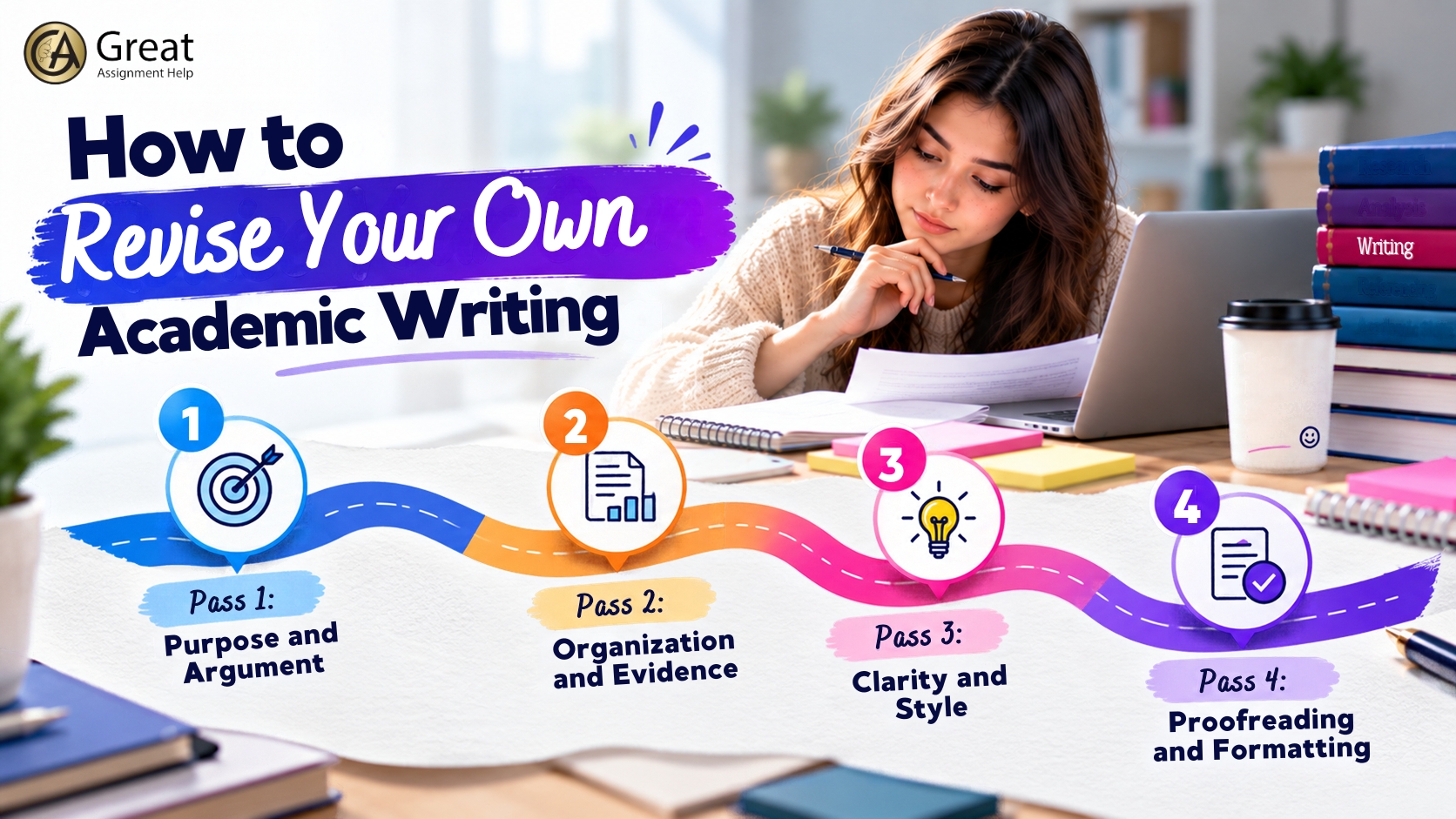
Revising is not simply about changing individual sentences or improving the wording. As part of your revision process, you need to carefully examine the entire academic paper and fix errors that are related to structure, citation, grammar, and so on. In general, having an academic writing revision checklist will help you increase the quality of your work.
1. Enhance the Assignment Structure
First, make sure to pay attention to your assignment question, structure, and thesis statement.
Recheck the assignment question
Once you finish writing your assignment, start your revision by rereading the original prompt. In the prompt, pick out the instruction words like “analyze,” “compare,” “evaluate,” “discuss,” and “argue.” Ask yourself if your essay actually addresses the question posed.
A well-written academic paper can miss the task if it answers a different question rather than the assigned one.
Test your thesis
Your thesis statement should provide a clear direction to your academic paper. So, by keeping that in mind, ask these questions to yourself
- Is my thesis statement in one or two sentences?
- Is my thesis statement clear?
- Does the main body of my essay prove or develop the thesis statement?
- Have my results become different from my first thesis statement?
If you have modified your thesis during the research process, rewrite it instead of forcing the whole essay to follow the old thesis statement. By reading our guide on thesis statement writing, you can understand how clarity, specificity, evidence, and focus strengthen a thesis.
Look at the structure
Instead of reading other information in your paper, take a look at the headings and first sentences of your paragraphs to find out whether you can clearly understand the main argument without reading every detail.
If it is hard for you to find the core message without reading the heading and first sentence of a paragraph, then create a reverse outline. George Mason University recommends writing the main idea of each paragraph after the completion of the first draft. This, in turn, will help you identify missing links, unwanted sections, repeated points, and weak progression.
Remove material that does not earn its place
Editing also involves deleting text. Sometimes, you might have to delete a paragraph with accurate information when it does not answer the assignment question.
Even Purdue OWL recommends that writers should keep the valuable information from a draft, eliminate unnecessary information, add missing information, and clarify confusing parts.
The aim of revision is not necessarily retaining all the content you have written. While revising, your idea should be to make the final draft of your academic paper more focused.
2. Strengthen your Argument, Evidence, and Paragraphs
If the structure is perfect, then move to the logic of individual paragraphs. This is where revision of the academic paper will become more analytical.
Mostly, a paragraph is said to be well-organized if its framework includes a claim, evidence, explanation, analysis, and link.
When you begin revising your essay paragraphs, first, determine the claim of a paragraph. After that, verify if the evidence really backs up the claim. Next, check whether there is an explanation of what the evidence implies. Finally, find out whether there is a discussion that relates the thesis to the following point.
For example, imagine a paragraph stating that online education will increase accessibility of higher education.
In this case, the poor paragraph will just mention that online education is flexible and support it with a citation. But a revised version will explain why flexibility is significant, who is going to benefit from the finding, analyze any drawbacks of the evidence used, and link to the argument on access to higher education.
Always have a clear idea about the difference between evidence and analysis. Evidence does not automatically become analysis. Your reader should not be left to figure out why some evidence supports your claims.
Even Senior Academic Writing Tutor Jenifer Richardson from Great Assignment Help states this relationship clearly: “A persuasive academic paper is more than gathering evidence. It shows why that evidence is relevant and how it backs up the argument made by the writer.”
Check every paragraph
When you review the paragraphs in your essay, make sure to ask these questions
- Does this paragraph have one clear purpose?
- Does the first sentence introduce the purpose?
- Is the evidence provided relevant?
- Have I explained the evidence in my own words?
- Have I compared or evaluated different sources?
- Does the paragraph support my thesis?
- Does the next paragraph follow logically?
George Mason University Writing Center recommends examining topic sentences, focus, logic, progression, transitions, and paragraph length during revision.
Examine your sources again
Furthermore, revision is a great opportunity to assess whether your evidence is strong or not. Never simply assume that the source is appropriate because it sounds academic.
Make sure to look at the relevance, authority, accuracy, currency, and purpose of a source. Even Harvard Library lists out these criteria for assessing sources and the importance of peer review in establishing academic credibility.
If your evidence is lacking, some focused research may be required. You can speed up your research process by following the tips recommended in our article on how to find 20 peer-reviewed sources in less than an hour.
Some research has also revealed that revision is not just a mechanical process and that peer feedback could motivate revisions independently, while teacher feedback helped with expert calibration.
3. Improve Flow, Clarity, and Academic Style
After checking the argument, proofread the document paragraph by paragraph and sentence by sentence.
It is important for good academic writing to be clear without being overly complex. Most importantly, being academic does not mean choosing the most difficult words and sentences that are hard to read and understand.
Check transitions
Consider the connection between paragraphs. It should clearly help the readers understand why the discussion moves from one idea to another. For this shift, appropriate transition words for essays can be used.
Check whether the paragraphs in your essay contain any of the following transition words
- however
- similarly
- in contrast
- therefore
- consequently
- furthermore
- nevertheless
- for example
- in addition
However, do not randomly add transition words. The transition word you use must set up a real connection between the ideas.
Cohesion guidelines from Purdue University highlight that maintaining consistency of topic within paragraphs and using sentence openings will help readers to link new information with what they already know.
Remove unnecessary words
Watch for repetition of ideas and phrases in your essay paragraphs. If two sentences say the same thing, then delete one or combine. In place of long phrases like “due to the fact that”, “in order to”, “a large number of”, try to use concise words like “because”, “to”, “many” appropriately.
According to George Mason University’s guide to conciseness, you should first look at the entire draft for repetitions before focusing on sentences.
Make claims appropriately cautious
When writing academic papers, it is important to differentiate between evidence and certainty.
Rather than stating, “This shows that social media is a cause of anxiety”, you should say, “The research results point to a connection between social media and anxiety, but do not prove causation”.
The latter statement is more accurate since the language used matches the evidence.
Review your academic tone
Check whether the wording you use is appropriate for the language of your field. Eliminate any slang terms, unsupported assertions, emotional language, and vague wording.
On the other hand, do not overdo the avoidance of active voice and a formal tone. Simple language will generally be more comprehensible.
Apply a Simple Revision Framework
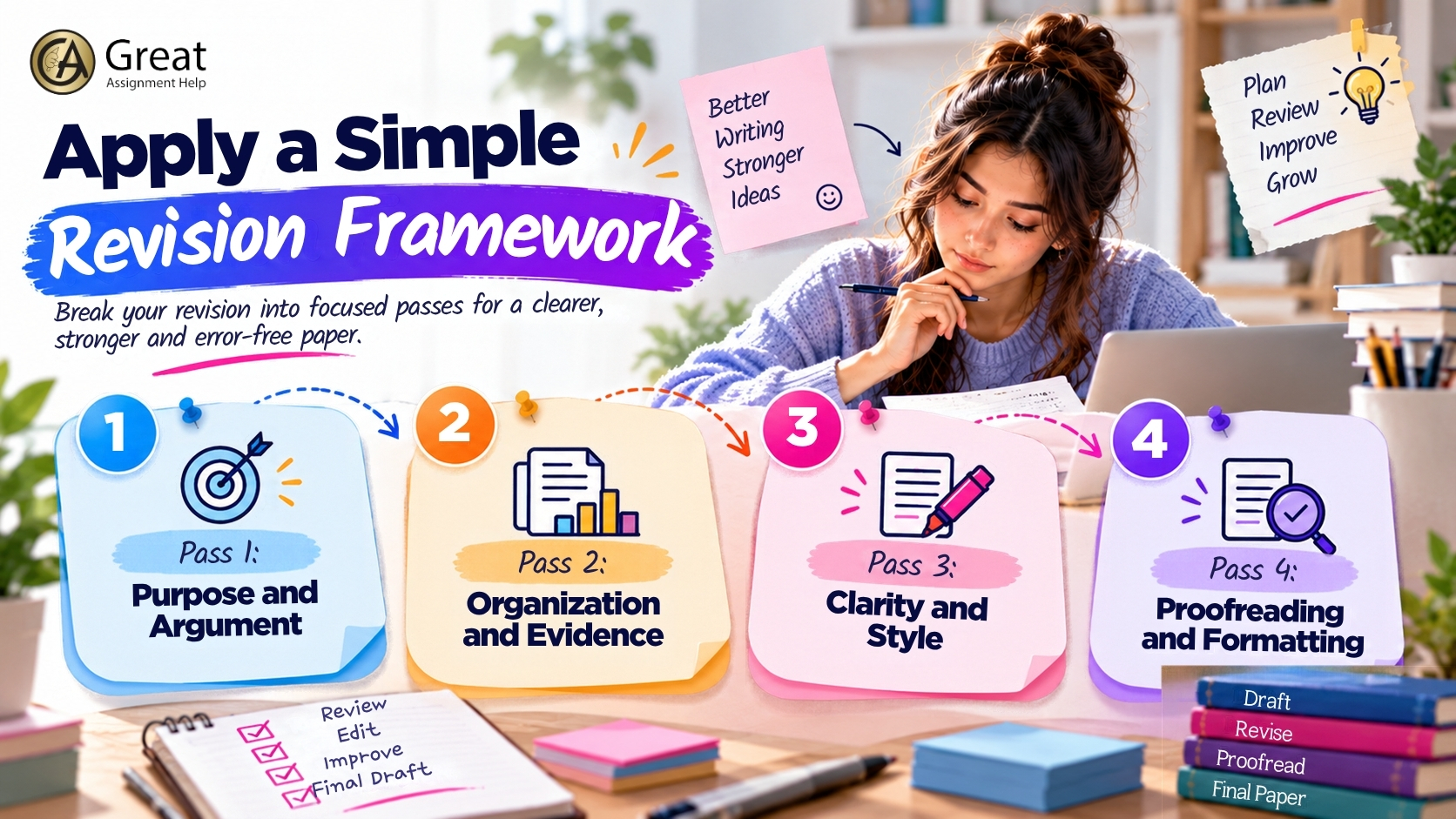
Trying to fix everything at once makes revision difficult and inefficient. Therefore, break the revision process into separate passes.
Pass 1: Purpose and Argument
First, look for assignment requirements, research question, thesis, scope, main arguments, and conclusion.
Ask: What is the purpose of this paper, and does each major section of the paper contribute to this purpose?
Pass 2: Organization and Evidence
After that, check the order of sections, paragraph sequence, topic sentences, supporting evidence, analysis, counterarguments, transitions, and research gaps.
An efficient way would be to make a one-line summary next to each paragraph. In case there are duplicate summaries, merge them. If a paragraph does not have a clear summary, then you might have to rewrite it.
In case of lengthy essays, you need to follow the guidelines for structuring an academic argument. A good academic argument usually links a concise thesis statement with relevant evidence and analysis, and it will be organized logically.
Pass 3: Clarity and Style
Next, proceed with sentences. Make sure to look for ambiguous pronouns, lengthy or complex sentences, duplicated words, weakened verbs, unnecessary jargon, inaccurate references, and inconsistent terminology.
Read hard-to-understand sentences out loud. This process will help you identify awkward sentence constructions you might have missed when reading.
Pass 4: Proofreading and Formatting
Once you finish larger revisions, make sure to look at surface errors that are related to spelling, grammar, punctuation, headings, page numbers, tables and figures, quotation marks, in-text citations, reference list, formatting, word count, and submission criteria.
University of Wisconsin-Madison Writing Center suggests that you look at your draft at the overall, paragraph, sentence, and documentation level. If you have doubts about doing the final check, read our guide on how to proofread an assignment and make it error-free. Always consider proofreading as the last stage of your work, not as the revision process itself.
A Practical Academic Writing Revision Checklist
Use this academic writing revision checklist before you submit an essay, research paper, report, thesis chapter, or dissertation.
Content and Purpose
- Have I answered all aspects of the assignment question?
- Is my research question clearly defined?
- Does my thesis contain the main argument?
- Have I remained within the required scope of the topic?
- Is my conclusion responsive to the assignment question?
Structure and Argument
- Is there a purpose for each section?
- Does each paragraph focus on one key idea?
- Are the ideas arranged logically?
- Is there meaning in the transitions?
- Are counterarguments incorporated when needed?
- Does each key point relate to my thesis?
Evidence and Research
- Is each important claim supported?
- Are my sources reliable and relevant?
- Have I analyzed the evidence instead of just summarizing?
- Have I compared conflicting pieces of evidence when needed?
- Is quotation necessary or can I paraphrase?
- Are all the borrowed ideas cited?
Language
- Is the language clear and precise?
- Have I removed unnecessary repetition?
- Are the sentences concise?
- Is the tone appropriate for my field?
- Do my claims use an appropriate level of certainty?
Final Checks
- Are there any spelling or grammatical errors?
- Are the citations consistent?
- Does each citation in-text have a corresponding entry in the reference list?
- Is the reference list free of irrelevant sources?
- Have I formatted correctly according to the chosen style?
- Have I proofread the paper?
Example of Academic Writing Revision
Suppose that the following sentence is part of your writing:
“Many researchers claim that online learning is advantageous to students as it is flexible and facilitates their learning.”
Your mistake here is not grammatical. The problem is one of precision and evidence.
A revised version could be:
“There are studies indicating that online learning can help achieve educational flexibility, especially for those students who are geographically or temporally constrained. However, the effectiveness of online learning on educational achievement is conditional on course design and student contexts.”
In this case, the revision process narrows down the claim, adds a qualification, and leaves room for further discussion and evidence. Moreover, it shows that revision of academic writing is not about improving sentence structure but about improving the clarity of thought and argument.
Conclusion
When it comes to revising your own academic writing, it is essential to follow a systematic process. First, step away from your draft and check the purpose, thesis, structure, and argumentation. Then, review your evidence, paragraph development, transitions, and clarity. Finally, proofread for grammar, citation style, formatting, and presentation.
Do not hesitate to delete a paragraph, shift sections around, change your thesis statement, or conduct additional research. Most importantly, you should give yourself enough time between drafting and revising to be able to see your paper with a fresh eye. If possible, ask someone trustworthy to indicate where the argument is hard to understand. The results of research on feedback and revision show that thoughtful engagement with the feedback can facilitate independent revision.
Before submission, go over your academic writing revision checklist. Revision may help you transform a collection of good ideas into a well-written and well-argued academic paper. You may utilize the academic editing services of Great Assignment Help if it is challenging for you to proofread or edit your papers.
FAQs
1. What is the difference between revising and proofreading?
Revising focuses on editing the thesis, argument, evidence, structure, and clarity of the content. But proofreading focuses on fixing errors that are related to grammar, spelling, punctuation, and formatting.
2. When should I revise my academic paper?
You should begin revising your academic paper after completing the full draft. But before you start revising, stay away from your paper and return later. Generally, looking at your work after some time will help you spot more errors.
3. What should I check first when revising academic writing?
You should make sure to check the assignment question, thesis, overall structure, and argument first. It would be pointless to make individual sentences perfect if your paper does not answer the question or provide enough evidence for the thesis statement.
4. How can I tell if a paragraph needs revision?
If it is difficult for you to find the key idea or there are multiple ideas mentioned in a single paragraph without any connection, then that paragraph might require revision.
5. Should I use feedback when revising my own academic writing?
Self-revision offers more benefits. But feedback from another person may help you identify gaps or confusing sections that are tough for you to identify and contribute to improving your academic writing. Generally, each person will provide different revision comments, so you should critically evaluate their feedback and select the best advice.