
This article has been reviewed and updated with current information, new examples, and the latest academic requirements for 2026
If you know how to structure an academic argument, then you can effectively present evidence-based arguments, address counterarguments, and persuade your readers. This will enable you to improve your academic writing skills and secure the best grades.
Good academic writing is not only about presenting facts and summarizing scientific studies. It also includes creating a structured and well-reasoned argument that clearly justifies your point of view. No matter whether it is an essay, research paper, dissertation, case study, or other type of assignment, knowing how to structure an academic argument will help you produce quality content, convey your thoughts effectively, and enhance your scholastic performance.
When it comes to structuring academic arguments, many students just provide good information without logically linking ideas and supporting them with credible evidence. This makes their academic papers unclear and unconvincing. However, by regular practice and following the right instructions, you can master the skill of developing well-organized and persuasive academic arguments.
In case you are clueless about how to structure an academic argument according to the requirements of your university, read this guide and follow the proven techniques and academic writing tips suggested by experts. Here you will also learn everything from making a clear thesis statement to structuring your evidence and addressing counterarguments.
Why is Structuring an Academic Argument Important?

A well-structured academic argument forms the basis for successful scholarly communication. It allows you to present your ideas in a coherent, logical, and persuasive manner. Usually, universities expect students to analyze evidence critically and explain ideas with strong reasoning, rather than simply describing information. Generally, through a well-organized argument, you can demonstrate your competence in evaluating evidence, thinking logically, and producing valuable insights into academic discussions.
An academic argument is not the same as a debate. It should not include any personal beliefs or emotions. Rather, it should be developed using thoroughly evaluated evidence, logical reasoning, and credible sources.
Improves Readability
When you present an argument in a structured form, it will become easy for the readers to understand your points from the beginning to the end. Furthermore, it will make it convenient for your instructors to find out how you have connected each idea with your main claim.
If you poorly organize arguments, the readers might experience difficulties in understanding the relation between different ideas, and amongst these, even strong evidence in your assignment might lose its value.
Demonstrates Critical Thinking
Besides evaluating your subject comprehension, universities also check how well you analyze information, compare different viewpoints, and support the main arguments.
Typically, well-structured arguments highlight that you can effectively
- Examine complex issues
- Analyze multiple perspectives
- Spot strengths and weaknesses in evidence
- Derive meaningful conclusions
If you know how to structure an academic argument, then it will be helpful for you in submitting high-quality assignments in different disciplines, such as business, law, nursing, engineering, education, psychology, and the social sciences.
Strengthens Persuasion
Academic writing aims to convince the readers through logical reasoning instead of personal opinions. Therefore, it is essential to support every claim with reliable evidence, such as peer-reviewed research, government publications, university reports, or trusted academic books.
According to Stephen Toulmin, persuasive arguments include claims, supporting evidence, warrants, backing, qualifiers, and rebuttals (Toulmin, 1958). This is one of the most acknowledged approaches for understanding academic arguments.
Meets University Assessment Criteria
Several university marking rubrics grade assignments based on:
- Thesis statement clarity
- Logical structure
- Critical analysis
- Inclusion of evidence
- Coherence
- Academic tone
- Referencing
Hence, improper structuring can lead to poor grades, regardless of high-quality research.
Builds Research Skills
Typically, when it comes to creating strong arguments, you need to check whether sources are reliable rather than simply accepting information without question. This will allow you to engage with academic literature critically.
Simply by taking help from our guide on how to find 20 peer-reviewed sources quickly, you can also improve your research process and discover reliable academic evidence more effectively.
Encourages Independent Thinking
When you use a well-structured argument instead of just repeating existing ideas, it will become easy for you to compare theories, find research gaps, analyze evidence, and develop balanced conclusions.
All these abilities will help you come up with the best assignments and make informed decisions in an academic environment.
“A persuasive academic paper doesn’t simply collect evidence. It explains why that evidence matters and how it supports the writer’s central claim.” Jenfier Richardson, Senior Academic Writing Tutor, Great Assignment Help
Characteristics of an Effective Academic Argument
Generally, you might lose your marks if your assignment ignores opposition viewpoints or contains facts without analysis, evidence irrelevant to the thesis, repeating ideas, baseless claims, or discussion on unrelated topics. But following a clear and structured approach will help you avoid these problems and develop a strong academic argument.
An academic argument is said to be good only if it contains the following features
- A focused thesis
- Logical organization
- Relevant evidence
- Critical evaluation
- Clear transitions
- Balanced discussion
- Accurate referencing
- Objective academic language
All these together will make it easy for your readers to understand your reasoning and evaluate your conclusions effectively.
The Essential Elements of a Strong Academic Argument
You can handle your academic writing process efficiently if you are familiar with the main parts of an argument. Each assignment type follows a unique writing style and format, but the academic argument you create should contain these elements to make it clear, logical, and persuasive
A Clear Research Question
Every good argument begins with a well-defined research question or a problem. Such a question directs your research and ensures that you stay on track while discussing your topic.
For example, a good research question may look like this:
“How effective are carbon taxes in lowering greenhouse gas emissions in developed countries?”
Rather than discussing climate change, this question remains well-focused on a particular issue. Such research questions will help you formulate better arguments since they provide the direction for your study.
A Powerful Thesis Statement
The thesis statement is the central message or argument of your whole essay. Your thesis statement should tell the reader where you stand and what you think about the discussion.
For instance:
“Renewable energy subsidies are a sustainable long-term strategy compared to carbon taxes since they stimulate innovation and lower the cost of energy production.”
This thesis statement takes a position, expresses a claim, and offers explanations for the claim.
Read our guide on how to write a thesis statement if you need more support.
Logical Supporting Claims
After you write your thesis statement, you will need to split it into supporting arguments that further prove its validity.
For example,
“Renewable energy subsidies provide greater long-term environmental benefits than carbon taxes.”
For this thesis statement, you can include increased innovation, economic growth, greater public approval, and sustainability as supporting claims.
Note that you can compose a separate paragraph or section in your assignment for each of these supporting claims. Usually, organizing these points will enable you to maintain a clear flow of ideas.
Credible Evidence
The use of evidence is a significant aspect of every academic argument, as it will support your claims and make your writing more credible.
Some of the sources of credible evidence include peer-reviewed journal articles, reports from the government, university publications, and books from established scholars, statistical data, systematic review studies, and meta-analyses. But you have to stay away from using blogs, opinion pieces, and questionable sources online unless your professor allows them.
The CRAAP Test (Currency, Relevance, Authority, Accuracy, and Purpose), created by the Merriam Library at California State University, Chico, is widely applied to verify the credibility of sources.
Critical Analysis
Critical analysis demonstrates deeper thinking and is an essential part of effective academic writing. So, instead of descriptive writing, choose analytical writing. Descriptive writing aims at presenting facts, whereas analytical writing deeply examines the value of those facts and connects them to the overall argument.
Remember, your analysis should explain why the evidence is important, how it supports your claim, any limitations it has, and how it compares with other research findings.
Counterarguments
Usually, strong arguments highlight different viewpoints. So, add counterarguments. Addressing counterarguments will demonstrate your ability to think critically and evaluate different opinions before concluding. Also, it will make your argument more reliable.
A common approach to writing counterarguments includes presenting the opposing argument, discussing its supporting evidence, evaluating its strengths, and explaining why your position is stronger. If you need additional support, read our guide on how to write a counterargument.
Logical Flow and Cohesion
Each paragraph of your academic work must be connected properly with the next one to ensure a proper flow of ideas. This logical organization will make it easier for your readers to comprehend and follow your arguments without confusion.
For instance, you can use transitional phrases or words like furthermore, however, in contrast, consequently, similarly, therefore, and nevertheless to enhance the linkage between ideas. Overall, this will make your argument more understandable and logical.
A Balanced Conclusion
Although the full conclusion is provided at the end of your paper, each section should continue supporting your thesis throughout the discussion. Moreover, in the conclusion, you should avoid introducing completely new arguments or unrelated information that may distract readers from your main point.
A balanced academic argument helps you present information fairly and avoid exaggerating results. Furthermore, it explains findings accurately while recognizing limitations when necessary.
Common Mistakes to Avoid When You Structure an Academic Argument
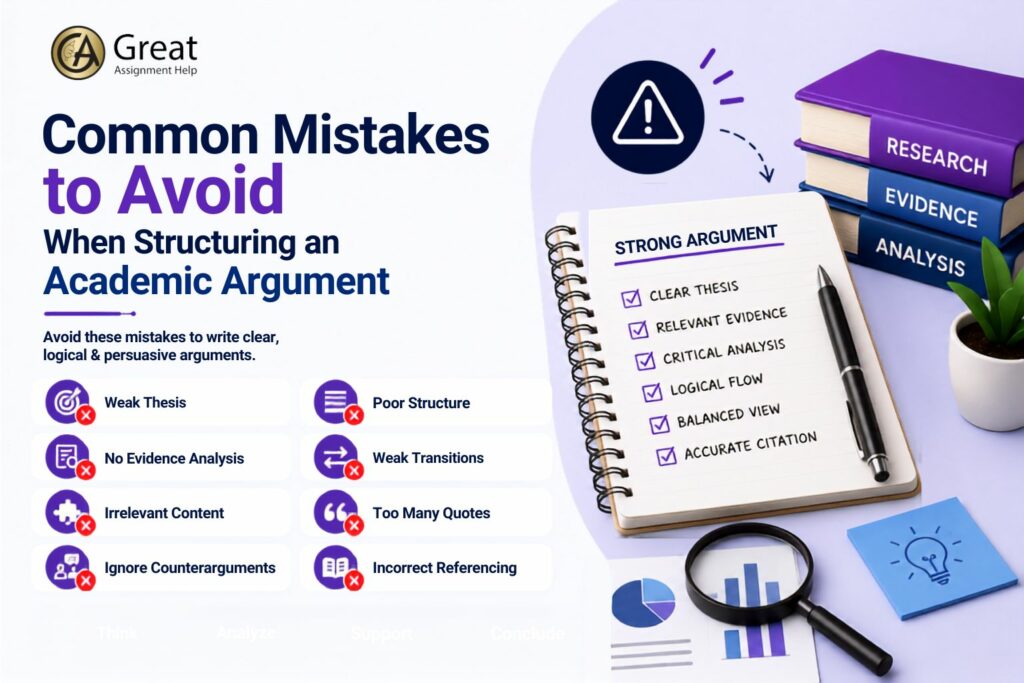
Even competent researchers make mistakes when structuring their assignments. But being aware of these common mistakes will help you avoid them all and write a more coherent and persuasive academic argument.
Not starting with a clear thesis statement
A general thesis statement does not inform your reader about your opinion. Hence, each academic paper must start with one strong claim that will direct the entire discussion.
Using evidence without an explanation
One of the most frequent mistakes while writing academically is the lack of explanation of presented pieces of evidence. You should always tell why and how particular evidence is connected to your thesis. This will make your argument stronger and more convincing.
Adding Irrelevant Information
Each paragraph must be related to your thesis statement. The use of irrelevant information can take your reader’s attention from your main discussion. So, always add only content that directly supports your main argument.
Not Considering Counterarguments
A good academic argument acknowledges other points of view. Taking into account different opinions shows that you have critically analyzed the topic and can justify why your viewpoint is better supported by the evidence.
Poor Paragraph Organization
Each paragraph must have only one key point. So, to keep your writing clear and organized, you need to state your viewpoint, provide supporting evidence, explain its importance, and connect it to your thesis statement.
Lack of Appropriate Transitions
Your ideas must be connected logically throughout the whole essay. The use of correct transition words can help your reader to follow your line of reasoning and enhance the flow of your writing.
Excessive Use of Quotes
Quotations must support your argument instead of replacing your analysis. Therefore, whenever possible, you should paraphrase information and explain how it strengthens your discussion.
Insufficient Referencing
Incorrect referencing can lead to plagiarism and reduce your credibility. So, always follow the required citation style and acknowledge every borrowed idea accurately.
A Simple Framework to Structure an Academic Argument
Usually, a clear framework will help you easily structure an academic argument. If you want to organize your ideas and present a logical argument for essays, research papers, reports, and dissertations, then follow this step-by-step process.
- Formulate your research question: Start your academic work with an effective and clearly formulated research question that will give your study its direction.
- Create a good thesis statement: Make a statement of your position on the topic that presents your argument clearly and briefly introduces the points you will cover further.
- Organize your arguments: Select 3-4 points that support your thesis statement. Arrange them in a way that makes your discussion coherent and structured logically.
- Find high-quality sources: Every claim must be backed up with credible academic evidence, so take help from sources such as journal articles, academic press, books, and government reports.
- Discuss the evidence: Provide an analysis of each piece of evidence by explaining how it supports your thesis statement. Discuss the strengths and/or limitations of the evidence.
- Address counterarguments: Introduce arguments against your views and refute them, proving the superiority of your own argument based on the evidence.
- Conclude your work: Restate your main points and explain their significance without presenting new evidence.
Example of a Well-Structured Academic Argument
This example demonstrates how a clear thesis, logical supporting points, credible evidence, and balanced evaluation combine to create a persuasive academic argument.
Research Question
Should universities integrate hybrid learning into their teaching process?
Thesis Statement
Hybrid learning should be integrated into universities as it ensures increased accessibility, caters to varied learning methods, and provides educational flexibility.
Supporting Arguments
- Hybrid learning provides greater access for students who may have geographical or physical constraints.
- A flexible study environment caters to varied learning methods.
- Digital technologies enhance learning and provide easier access to study materials.
Counterarguments
Some instructors feel that hybrid learning minimizes face-to-face interaction and classroom participation.
Response
While decreased interaction may pose difficulties, research shows that good design of a hybrid course using collaboration exercises allows keeping students engaged while offering more flexibility.
Conclusion
Learning how to structure an academic argument is an important skill for every student. A good argument starts with a well-stated thesis statement and involves logical organization, credible sources of evidence, critical analysis, and consideration of the alternative position. Simply by following a clear framework and avoiding common mistakes, you can create assignments that are well organized, convincing, and meet academic standards.
If you need expert support with essays, research papers, dissertations, or any aspect of academic writing, approach Great Assignment Help. Our competent academic specialists will assist you in developing better arguments and submitting excellent assignments.
FAQs
1. What is an academic argument?
An academic argument is a logical and evidence-based claim that is supported by credible research, critical analysis, and reasoned evaluation instead of personal opinions.
2. How can I improve my academic argument?
You can strengthen your academic argument by creating a strong thesis statement, critically analyzing sources, logically organizing ideas, using reliable evidence, and addressing opposing viewpoints.
3. Can I use personal opinions in my academic argument?
You can use personal opinions objectively within an academic context only when it has supporting scholarly evidence.