
If you want to write references in assignments, first identify the source type. Following that, choose the correct style, add in-text citations when quoting or paraphrasing, and compile a complete reference list or bibliography at the end of your paper.
If you are a college or university student, then you must submit plagiarism-free assignments to achieve top grades. Mainly, to avoid plagiarism, you should cite the sources you have used in your work. Academic referencing will also highlight your research skills, boost the credibility of your assignment, and make your work professional. Initially, it might be challenging for you to write references because of different citation styles, punctuation rules, and formatting. However, learning the basics will help you easily make references. If you are clueless about how to write references in assignments as per USA university guidelines, read this blog. Here, we have explained about writing references in assignments with simple examples from APA, MLA, Harvard, and Chicago styles.
An Overview of Referencing
Referencing is the act of giving credit whenever you use another person’s ideas, words, or research. This may include information obtained from a book, website, video, or a report. Referencing is significant because it indicates that you have reliable work, which is also drawn from genuine sources. Moreover, this is the sort of expectation that lecturers have at top US-based universities such as Harvard or Stanford.
Another significant aspect associated with referencing is that it is helpful when you or a teacher would like to get more information about a particular piece of information. Additionally, referencing demonstrates academic honesty by respecting the work of others while also valuing your own learning. Proper referencing helps you avoid plagiarism, which can happen even by accident if you use someone’s ideas without giving credit.
Understanding Citation, Reference, and Bibliography
Students often confuse the terms citation, references, and bibliography. So, to avoid that confusion, here, we have explained what those terms mean
Citation: This is the general term used to refer to the act of citing sources. It can either take the form of an in-text citation or a reference list entry at the end of the paper.
In-text Citation: It is a brief notice placed within the text of the assignment that illustrates from where the idea or the quote has been taken (for example, (Smith, 2022), or (Smith, page 22).
Reference: It provides all the details about a source at the end of an assignment and is usually listed under “References” in APA or “Works Cited” in MLA.
Bibliography: It is a list of all sources you used in completing your assignment. This may include sources that have been indirectly referenced. Usually, this format ensures consistency with the Harvard and Chicago referencing formats.
Each of these has an important purpose in making your assignment stronger, and you should format them according to the required style guide. Get Online Assignment Help from experts if you have any doubts about academic referencing.
Read More: Learn How to Write a Character Reference Letter with Examples
How to Write In-Text Citations
In-text citations show your reader where your ideas come from by linking them to the real sources in your assignment. You can write an in-text citation in two ways:
Narrative citations: If you follow this citation style, include the author’s name as part of your sentence (for example, According to Johnson (2020)…).
Parenthetical citations: When you follow this format, put the author’s name and the year in parentheses at the end of your sentence (for example, (Johnson, 2020)).
Generally, while you quote directly, paraphrase, or cite a source with no clear author, it changes how you format the brackets. So, you need to make sure they are always correct and consistent.
Common Types of Referencing Followed in the USA
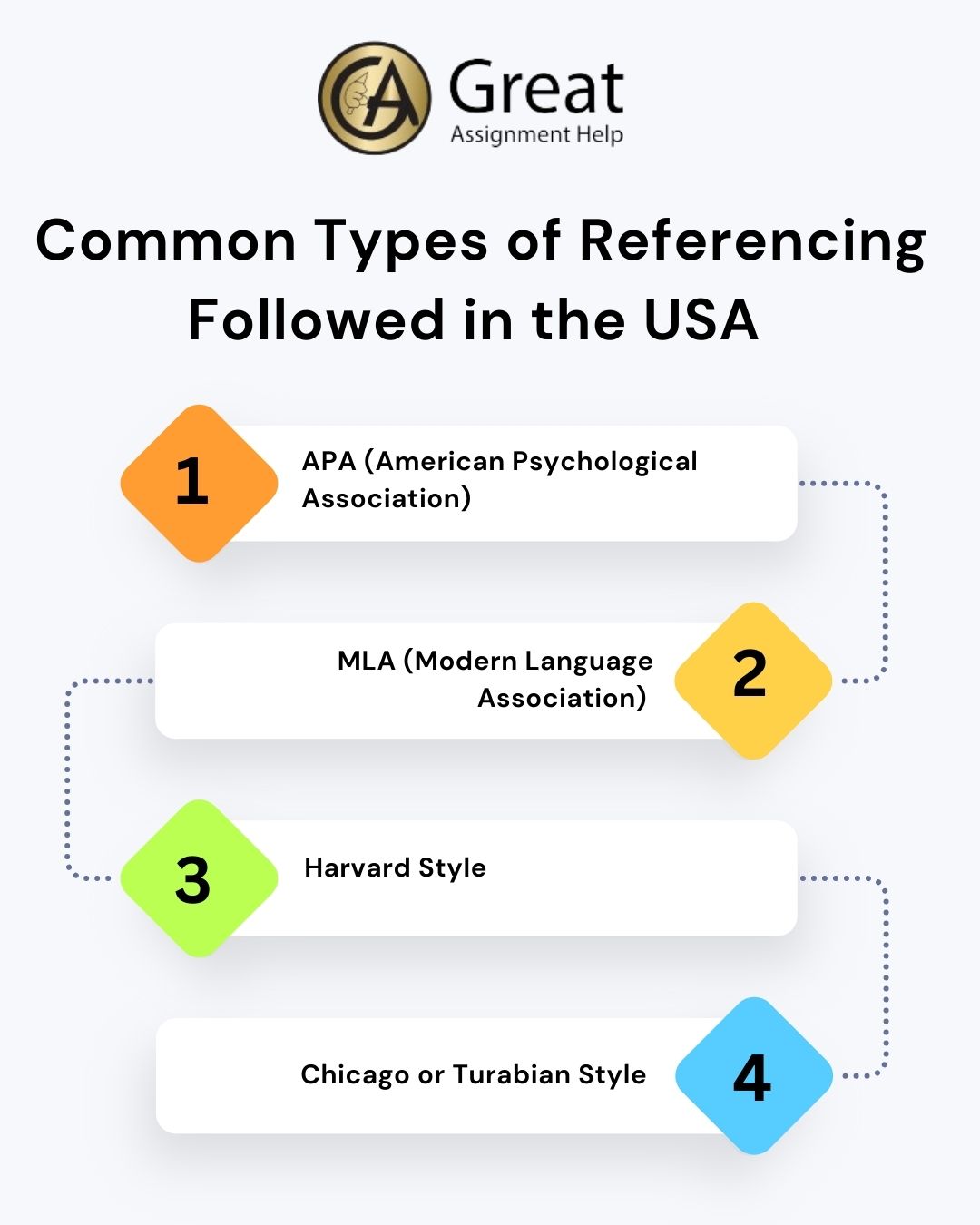
Different subjects use different referencing styles. The following are some major referencing formats that students in the USA commonly use
APA (American Psychological Association)
APA is a style often used in social science subjects. It focuses on including the author’s name and the year of publication. In-text citations usually appear in parentheses, while the reference list at the end gives full details about each source.
Example
- In-text citation (paraphrase):(Smith, 2020)
- In-text citation (direct quote):(Smith, 2020, p. 45)
- Reference list: Smith, J. (2020). Understanding Modern Psychology. Pearson.
MLA (Modern Language Association)
MLA is a style commonly used in literature and other humanities subjects. For in-text citations, it includes the author’s last name and the page number. But the list of sources at the end, called Works Cited, has its own formatting rules that are different from APA.
Example
- In-text citation (paraphrase/quote): (Smith 45)
- Works Cited: Smith, John. Understanding Modern Psychology. Pearson, 2020.
Harvard Style
Harvard style is similar to APA because it also uses the author’s name and the publication year in citations. However, it has its own rules for formatting both in-text citations and the reference list at the end of the assignment.
Example
- In-text citation (paraphrase/quote):(Smith, 2020)
- Reference list: Smith, J., 2020. Understanding Modern Psychology. Pearson.
Chicago or Turabian Style
The Chicago style is often used in history and arts subjects. It has two systems, such as the author-date style and the notes-bibliography style, which uses footnotes or endnotes. Both systems require detailed information about all the sources you use.
Example
- In-text citation (footnote): John Smith, Understanding Modern Psychology(New York: Pearson, 2020), 45.
- Bibliography: Smith, John. Understanding Modern Psychology. New York: Pearson, 2020.
Read More: Tips to Improve Accuracy and Referencing in Medical Research Assignments
How to Create a Reference List
Your reference list should include complete details for every source you cite. Each referencing style has its own rules for how to format different types of entries.
Books
APA Format: Author(s). (Year). Title of the book. Publisher.
MLA Format: Author(s). Title of the Book. Publisher, Year.
Journal articles
APA Format: Author(s). (Year). Title of the article. Title of the Journal, Volume(Issue), Page numbers. DOI (if available)
MLA Format: Author(s). “Title of the Article.” Title of the Journal, vol. Volume, no. Issue, Year, pp. Page numbers.
Websites
APA Format: Author(s). (Year, Month Day). Title of the web page. Website Name. URL
MLA Format: Author(s). “Title of the Web Page.” Website Name, Day Month Year, URL.
Media like videos or podcasts
APA Format (Video): Author(s) or Username. (Year, Month Day). Title of the video [Video]. Platform. URL
MLA Format (Video): Author or Username. “Title of Video.” Platform, uploaded by Username (if different), Day Month Year, URL.
AI-generated content
APA Format: Author or AI tool. (Year). Title or description of content [AI-generated content]. Platform. URL (if applicable)
MLA Format: Author or AI tool. “Title or Description of Content.” Platform, Year. URL (if applicable).
Steps for Writing References in Your Assignment
If you are unsure how to write references in your assignment, then follow these steps
- Identify whether the source is a book, journal, website, video, or AI tool.
- Choose the correct referencing style based on your subject or university guidelines. It can be APA, MLA, Harvard, or Chicago.
- Add in-text citations whenever you quote or put information in your own words.
- Create a reference list at the end of your paper.
- Use citation tools and checkers to find and fix mistakes early.
Practical Tips for Perfect Referencing
If you want to make referencing more efficient and error-free, then follow these best practices or utilize professional Assignment Writing Services offered by academic professionals
- Stick to one style because mixing APA, MLA, or Chicago can confuse your reader and lower your marks.
- Add citations as you write instead of waiting until the end to avoid mistakes.
- Use citation tools and reference managers to save time and stay accurate.
- Make sure every in-text citation appears in your reference list, and every reference is cited in your text.
Read More: What is the Importance of Referencing in Academic Writing?
Wrapping Up
Referencing is more than just something to complete for an assignment; it is an important part of academic honesty and good writing. If you understand its importance and learn the rules of the main referencing styles, then you can protect yourself from plagiarism and make your work more reliable. But only with regular practice, referencing will become a natural and valuable skill in your academic work. If it is challenging for you to write references in your assignments, send us a ‘Do My Assignment’ request. The skilled writers from our team will assist you in preparing well-cited assignment papers as per your university guidelines.
FAQs
1. How can I easily create accurate references?
You can use a citation generator to quickly format references and minimize mistakes.
2. Do I need to cite every time I use a fact or idea from another source?
Yes, you need to include a citation in both your text and reference list for any idea that isn’t your own.
3. Can referencing tools completely replace manual checking?
Tools can help, but you should always review their results to make sure they match your style guide.